
 We reoccupied the farmhouse in October of 2016, after sixteen years of renting the house to two other families. We could not continue to rent the house to others when many major repairs and updates were required. We decided to live at the house a good share of the time while we work on it, enjoy the farm environment, and appreciate the memories made in the only house that my parents ever owned.
The first task was to remove the wall-to-wall carpeting from the main and the second floor. The main floor carpet was approaching thirty years of use; the second floor included carpets that were threadbare after fifty years and more. Nothing was salvageable from these carpets or their pads. Underneath were the original Southern yellow pine floors, hard, durable, and needing refinishing, which would wait until other tasks were completed.
The second task was one that had waited through years of my wondering curiosity—discovering what was hidden in the walls between the three living rooms on the main floor. One room serves as a dining room, one as a living room, and the last as a library, with a small half bath carved out of its corner. The walls between these rooms were thicker than normal in their construction. Vinyl folding doors had separated the rooms, and those doors had been added before we first occupied the house in 1963. They were obviously not original to the 1915 design. The last renters had removed those vinyl doors as they began to fall apart.
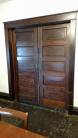
I verified my first suspicion, that the wall between the living room and library contained two heating channels for the second floor, justifying its larger size. I suspected that the other and thicker wall, between the dining and living rooms, had once contained pocket doors that matched the five-section ladder door design throughout the rest of the house. It was not likely that they were still there. Prying the plywood cover off of the door jam revealed the answer. There had been pocket doors there, and they still were there, pushed back into the pocket and covered. One rolled out easily, just as it had originally. The other rolled out a few inches and stopped, resisting to roll farther. They both were covered with dust, after their exile for sixty years or more., but underneath the dust was a beautiful finish, just waiting to be cleaned.
I surmised that the reason someone had hidden the doors was due to the failure of the one door to roll properly. There was no other evident problem with it. My son-in-law Au arrived soon after I had discovered the doors. He grabbed a flashlight, found an easy-to-reach adjustment mechanism, borrowed a screw driver and did a little adjustment, and that door worked perfectly, like the other. No mechanical problems defies Au for long.
How often do we give up on solving a problem before we’ve made a sufficient effort to find an answer? How often do we substitute something that is of poorer quality for something that just needs a little adjustment? How often do we live with something that is unsatisfying before we return to something that is beautiful and durable? How often do we hide doors instead of opening them? Oh, the lessons! The lessons keep rolling out.
Hidden Doors
11 Saturday Nov 2017
Posted in Farm, House, Learning from mistakes, Prayer
 In 1985, while Jan and I were living at Minonk, Illinois, I read an article in the Bloomington Pantagraph about a skilled organist who drove himself in an adapted van back and forth thirty miles to Illinois Wesleyan University. There he played the organ and instructed students, which was remarkable because he was partially paralyzed due to ALS, and he had been dealing with this progressive disease for sixteen years after his diagnosis. To my surprise the subject was my friend Philip, whom I had not seen or talked to since 1968. I had no idea what had happened to him, but I had a clue to why he had seemed to disappear.
  When I was fifteen, my pastor, Glen Sims, introduced me to one of the potentially high and holy moments that ministers get to experience. He took me to visit an elderly woman near death. “If you are thinking about becoming a minister, you must be able to be with people in their most difficult times.” The woman was herself the wife of a minister who had died several years before. She observed my youth, naivete, and shyness with her own years of experience, wisdom, and serenity. “You have a wonderful life ahead of you. I enjoyed almost all of it myself. But I have a wonderful life ahead of me, too.” Such was her faith.
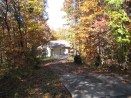 Here in the last days of autumn I look at the variety of leaves remaining on the trees and marvel at the multiple colors. Hidden within the leaves under vibrant greens thoughout the spring and summer were all of these shades of yellow, orange, red, and brown.
 In our first trip through the Black Hills back in 1976, Jan decided to take the wheel, since it was nerve-wracking for her when I tried to drive through the mountains and sightsee at the same time. I took the passenger seat where I could look to my heart’s content and take all the photographs that I wanted. The evidence shows up in our photo album from that year.
 The Middlefork of the Vermilion River bisected the 320 acres that my father farmed during most of my childhood. It was originally a natural river, lined with old growth forest, meandering through highland marshes a few miles downstream from its source, until it was dredged to drain those wetlands and provide rich tillable soil. Many trees were chopped away to clear that land. The outlines of indigenous people’s lodges and hogans still showed near some of the springs that lined the river.
 Midsummer, Jan and I were at the farm with Nathan’s two Golden Retrievers, Sullivan and Tulip, while Nathan was attending a reading conference. This was their first visit to the farm, and the open space and new surroundings obviously stimulated their already super-energized spirits. Sullivan at two and a half years has just begun to settle down into his young adulthood; Tulip at one year is nowhere close to settling down. Jan regards her as a classic case of attention-deficit hyperactivity disorder.
 I was a little boy when I met my Great Aunt Junia from San Antonio at Uncle Lon’s house. She was past ninety. Her angular features and voice of ancient authority made a lasting impression. She spoke to me about her love of creation, especially the beauty and mystery of the heavens, so that, whenever I read Psalm 8, I think of her.
 In early years we sat behind Rev. John Killip, a retired minister who was sometimes called to pray in the service, and who, I was certain, could easily pray aloud for many hours straight. Such a tall, wonderful white-haired gentleman he was, and he taught me to do a proper “Methodist hand-shake.” Later his seat was usually filled by Dr. Wilbur Sauer, an optometrist and minister’s son, who filled those roles and many other serving roles admirably.
 Catnip is one of those weeds that I enjoy having around. I planted some in the herb garden that I established in my yard. When I lived in Minonk and on the farm catnip grew abundantly all over the place. Once before when I lived at Tilton, I started an herb garden and tried to grow catnip. The same thing happened.
 chaplinesblog