• About
  • Celebrating our decades…
  • Welcoming all and inclusiveness

chaplinesblog

~ everyday and commonplace parables

chaplinesblog

Category Archives: Church

“We thought we heard a siren…”

14 Wednesday Oct 2015

Posted by chaplines2014 in Church, Small town life

≈ Leave a comment

Tags

A License to Preach, Memories, Serendipity

Monkeys see, hear, speak no evil, Bangra.com

Making our home in Iroquois, Illinois, during my final year of graduate school provided a challenge to Jan and me and to the people of that rural village. Jan was pregnant with our second child and in charge of three year old Alicia without a support system other than the new friends we were making. I was serving a temporary appointment as a “student pastor” of the only church in town. They had broken away from a yoke arrangement with a church ten miles away. They were getting used to having their own pastor, but one who had no more time to give them than their previous “shared” pastor. In addition I was working on a doctoral project which turned our life together into research on how they responded to historical critical approaches to the scripture and how they were coming to grips with the social and political changes in the world around them. (That was the year that the U. S. involvement in Vietnam came to a formal end with a negotiated settlement. Racial politics and sexual roles were in widespread transition.) I traveled back and forth to Chicago every week to keep up with my doctoral work. We packed a lot into that year. Somehow both they and we survived it.

While we had lived in Chicago, Jan had studied with a fine vocal coach, Elsa Charleston, and regained the wonderful voice she had developed in high school and her first year of college, before she traded her vocal performance major for a Christian education major. In Iroquois she was on her own. Almost every day she crossed the street from the little house they had rented for us to the church, and used the piano to practice. She did the vocal exercises she had learned to do, and she worked on songs that stretched her abilities. The exercises included the “Tarzan yells” that Elsa had incorporated to increase Jan’s volume, support, and range.

One fine fall afternoon, two of the church members were in the yard taking care of the mowing and shrub trimming when they heard a sound that they had never heard before. Henry Easter stopped his lawnmower, and Tom the barber stopped his electric hedge trimmer and listened. It was coming from inside the church! They checked with each other as the sound continued, and they decided that they would have to investigate. They entered the building cautiously and stood in amazement at the back of the meeting room. They were listening to Jan’s practicing. Finally she glimpsed them standing in the back.

“Do you need something?” she asked.

“We thought we were hearing a siren,” Henry answered.

They obviously didn’t know what to think, not only about Jan’s practicing, but about our presence in their community. When the year came to an end, I received my degree, Nathan was born, and our interim appointment to serve that congregation ended also. Many shed tears at our leaving. Were they tears of sadness, or joy, or both? I’m not sure.

I’m Not Done Yet!

07 Wednesday Oct 2015

Posted by chaplines2014 in Caring, Church, Death, Faith, People

≈ 2 Comments

Tags

A License to Preach, Memories, Serendipity

dock at sunset

When I came to Burlington, Ann Parks was a member of the Zion Church Consistory and a member of the Burlington City Council. Ann had built a reputation for community service and interest in progressive causes; chief among them was her campaign to open a refuge for the victims of domestic violence, which came to fruition as the Battered Women’s Shelter. She and a woman of similar energy, Marcia Walker, also on both Consistory and Council, and several other church members active in community life formed a powerful team for public good, the likes of which I had seldom seen.

Within a few months Ann received the troubling news that she had cancer, and she entered into treatment with the same determination that she exercised in other matters. She had a family—a husband, two sons who were nearing adulthood, and a daughter who was nearing adolescence. She had public responsibilities and goals that were notable, and she had a strong desire to overcome the disease that was threatening her life.

Months of treatment passed with signs of hopefulness. Then came the finding that the treatment had ceased to be effective, and something else would be needed. I met Ann in the hospital shortly after that discouraging news. I don’t remember exactly what I said, probably something to the effect that I was sorry to hear that the cancer was spreading again. I do remember her immediate response, “I’m not done yet!”

She definitely put me in my place. She was not ready to accept bad news and yield to it. Plenty of people needed her, and she had plenty of things to motivate her to keep going.

Unfortunately the cancer overcame her within a few weeks in spite of her determination. Her memorial service was held at the large central United Methodist Church, which had more space than Zion for the crowd that would attend, and its pastor was a better-known public figure to host the service. He did invite me to speak a few words as her pastor, and Ann herself had provided the theme.

Ann had been right, after all, to say, “I’m not done yet!” She knew that many things remained to be done in the agendas she had chosen to serve, or that had chosen her. Even though she was no longer there to do the work, anyone who counted themselves among her family, her friends and her associates, knew that they needed to carry on with the same heart and determination that Ann had shown.

If we have a calling at all, it is a calling to do something larger than we are by ourselves, and it is often a calling to be engaged in something that is larger than one lifetime can accomplish. It was Ann’s, and it is ours.

The Family in Worship Together

18 Friday Sep 2015

Posted by chaplines2014 in Church, Faith, Growing up, Prayer

≈ Leave a comment

Tags

A License to Preach, Memories

Pentecostal banner

I usually sat next to my father in worship. After my early years my mother worked two out of three Sundays as the head cook at the Ford County Nursing Home. “Families that pray together stay together” was too simple a slogan but it applied to us. There were drawbacks to sitting next to my father. He was tone deaf when he sang the hymns, or at least I thought he was. It seemed like we sang “Holy, Holy, Holy,” page 1 of the Methodist Hymnal, almost every Sunday, and it did not sound good in a drone. In front of us sat Rev. John Killip, a retired minister, who was sometimes called upon to pray in the service, and who, I was certain, could easily pray aloud for many hours straight. (But such a tall, affable, white-haired gentleman he was, teaching me to do a proper ‘Methodist handshake.) My father, who worked regularly sixteen hour days on the farm, would often succumb to the warm, quiet, restful atmosphere, and I would have to be alert to nudge him before “The Snore” began. We always stayed until the last people left the building as we talked with friends. I do not recall ever wanting to be anywhere else on Sunday mornings.

I was amazed in my father’s last years, when I again had the occasional privilege of sitting next to him in worship, how much his singing had improved, how beautifully tonal it was, and how alert he had become. He was always an intelligent man, so I wasn’t surprised by how intelligent he became after I left home, but I was moved by how his potential for embarrassing conduct had diminished.

God blessed me with children who were not only independent thinkers, who often resented the constant pressures of churchery , but who also respected my wishes that they take part in worship, even though they often had to sit by themselves. Alicia gave me fair warning when, as an infant, she burped some milk down the back of my suit coat just before I walked down the aisle, though I didn’t know it at the time. Nathan found that the pulpit made a good hiding place and pews provided a good racetrack for imaginary race cars, complete with quiet sound effects. As they grew they showed me that the presence of the Ineffable had taken root in their lives, the same One who was present for the dunkards, quakers, methodists, various anabaptists and separatists, Lutherans, Catholics, and Jews who were our family ancestors.

Parents learn most of their parenting skills from their parents, for better or worse. Teachers learn most of their teaching skills from their teachers. Where do preachers learn? I learned in an environment that seems much different from the prevailing values today that I began to wonder how many opportunities I lost along the way to nurture that mutually accepting family environment. Why did I not contribute more to an enriching spiritual life for other families? Some parents and young people accept the challenge of worshipping together, but they are a minority. They will find a center for their lives that will hold them steadily and graciously.

As I listen to other ministers, active or retired as I am, I realize that I am not alone in this sense of missing many chances to nurture varied families and their young people in the worship of God. There is no comfort in this commiseration. There is only comfort in the prospect of communities of faith doing better, and the awareness that some are.

The Different Dogs of Chicago Politics

22 Saturday Aug 2015

Posted by chaplines2014 in Caring, Church, Faith, People

≈ Leave a comment

Tags

A License to Preach, Community Development, Life in the City, Urban Renewal

Chicago skyline 1970Dick Simpson, a political science professor at University of Illinois Circle Campus in Chicago, called Chicago “the most corrupt city in the country, and Illinois the third most corrupt state” in a February 2012 report for the Chicago Journal. “The truth is that the governor’s mansion and the city council chambers have a far worse crime rate than the worst ghetto in Chicago.” http://chicagoist.com/2012/02/17/dick_simpson_study_says_chicago_is.php

I met Professor Simpson in January of 1969, when he was instrumental in organizing the Independent Precinct Organization, and I was a student at Chicago Theological Seminary. The seminary encouraged students to get involved in churches , community and political organizations, and to engage in cycles of action and reflection (theological and ethical) with other students. I had worked, successively but not successfully, with the Eugene McCarthy and the Hubert Humphrey campaigns in 1968. The Chicago democratic machine held no attraction for me, but independent community-based politics was a different matter. Many local churches were involved in our own 5th Ward and in the 43rd Ward on Chicago’s North side, and it was easy to volunteer.

The first campaign for the IPO backed Bill Singer for Chicago Alderman for the 43rd Ward against the democratic machine. Singer had been a protege of Senator Paul Douglas and a friend of 5th Ward Alderman Leon Despres. I admired both of them, so I signed up to help with the Singer campaign, door to door canvassing and poll watching. Against odds, Singer was successful. The most inspiration, however, came from Dick Simpson, and his encouragement of young people and community residents to take part in the political process, in spite of the cynicism and despair that had gripped most reform efforts during those years. When other organizations gave up (the University Christian Movement among them), and others went underground (Students for a Democratic Society), the IPO offered hope to those of us who were inclined to believe that change would eventually come if we just kept working, even if it was only on a small local scale. Where else would it begin?

Change came, and it didn’t. Dick Simpson ran for alderman and joined the City Council for several years. Other independent candidates for mayor succeeded after Mayor Richard J. Daley’s death, and positive results followed, but corruption has continued to dog Chicago and Illinois politics. I and many others can take inspiration from the dogged determination of people like Dick Simpson, who are still involved and working.

Growing Catnip

22 Saturday Aug 2015

Posted by chaplines2014 in Church, Faith, Garden, Yard

≈ 1 Comment

Tags

A License to Preach, Serendipity

park bench in spring

Catnip is one of those weeds that I enjoy having around. I planted some in my herb harden. At former homes in Paxton and Minonk, catnip grew all over the place, and I pulled it out except where I wanted it to grow. Once before, when I lived at Tilton, and tried to grow catnip, the same thing happened. It got a good start and was growing beautifully. One morning I looked out and it had disappeared. In its place was a well-satisfied tabby, new to the neighborhood. She had eaten every particle of the catnip.

Some things are just too good to pass up. Some things attract would-be connoisseurs from a distance. I have dreamt about being that kind of preacher and leading the kind of congregation that would be one of those attractive entities. Some characteristics of ours would simply attract without our having to do the work of listening, relating, interpreting, and living out the faith. Like catnip.

In the real world we must sow seeds with such abandon and in such abundance that there will be plenty to take hold, survive, and grow regardless of who shows up to take voracious advantage of the crop. We cannot hope to grow it in one small space and have it flourish.

I know I could have catnip if I fenced it in, protected it, and really tried to preserve it from contact with the cats who really seemed to need it. Instead I have decided that catnip does better as a weed growing all over the place than as a protected herb, confined to one small garden spot. Even so, most things faithful.

You have to be “on the inside”

18 Tuesday Aug 2015

Posted by chaplines2014 in Caring, Church, House, Learning from mistakes

≈ Leave a comment

Tags

A License to Preach, Serendipity

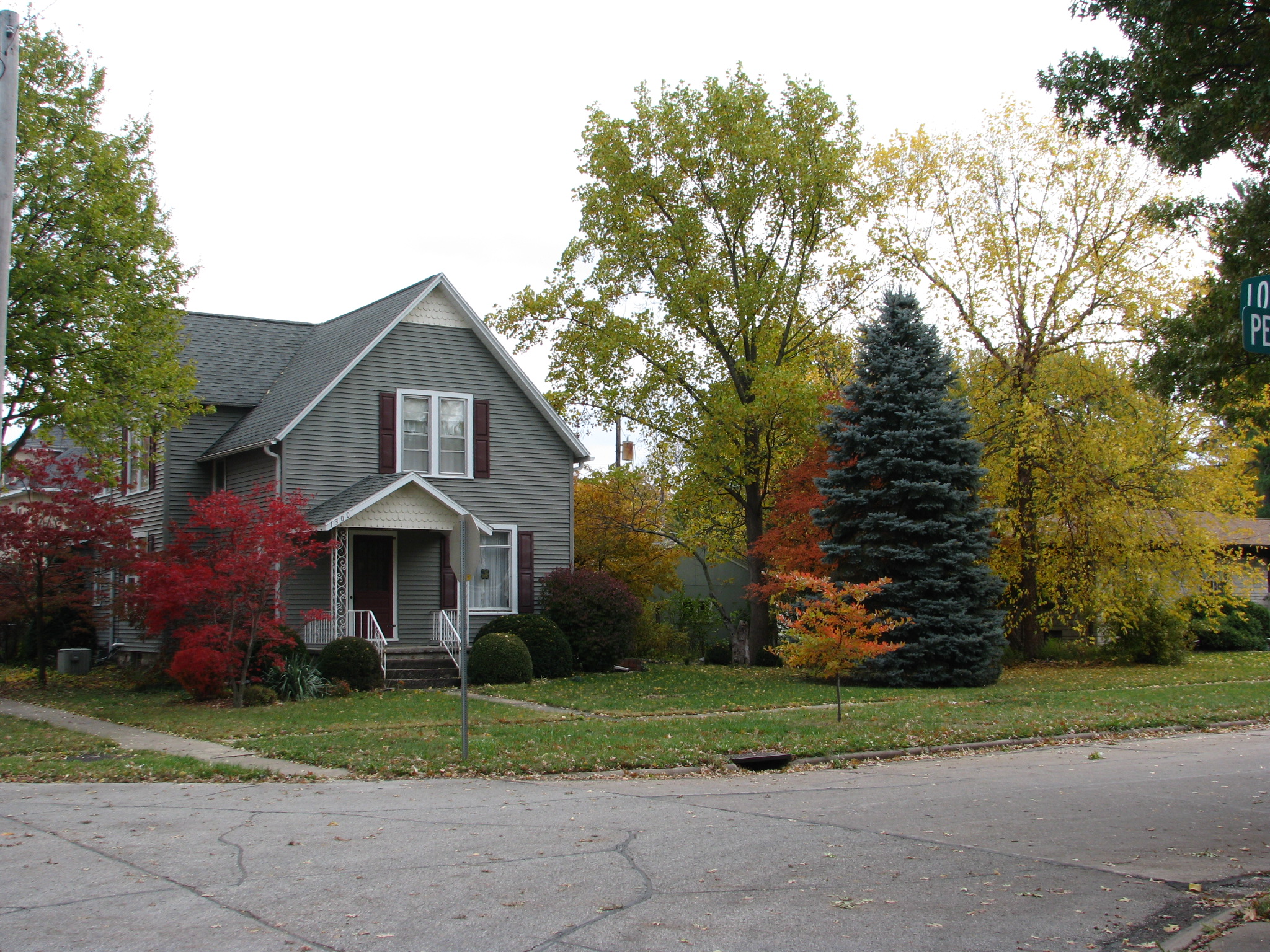
Burlington house in fall

We moved into our old house in Burlington in August of 1988, twenty-seven years ago. Friends helped us to move from Minonk, Illinois, and we sat together on folding picnic chairs on the back porch and had lunch. They noticed that there was a doorbell on the back porch, just outside the kitchen. It worked well, making a “dong” sound, and when the front doorbell sounded it made a “ding-dong” sound.

The doorbell location presented a problem. You had to go through the rear door of the house to get to the doorbell. By the time you made it to the kitchen door, you were already inside the house, and since the kitchen was usually the center of activity in the house, most of the time you could just say hello to anyone who was working or sitting around the kitchen table. You wouldn’t need to use the doorbell.

Like many old farmhouses, most people who know us come to the back door anyway, but the fact is that, unlike when we lived in the country, we usually lock the back door, so getting to the doorbell presented a challenge. You would have to knock on the door in order to get us to let you in so that you could press the doorbell.

Many years ago the back porch was really an open porch. There was no door because there were no walls. The kitchen door was the back door. Sometime in the 1960’s, the Nelsons hired a young Jim Wilson to enclose the back porch, build walls, and put in a row of casement windows to make a three season unheated room. (We liked it so much that we added insulation and a heating vent and made it into an all-season room.) But no one bothered to move the doorbell.

Maybe the previous residents were so friendly that people could just open the door and walk in. Ideally we would like to live that way, but we tend to live a bit more privately, even though the large windows on all sides of the house make it a see-through first floor when the curtains are pulled to the side.

We don’t always make it easy for people to get inside. With the door locked, you had to raise a ruckus to get our attention. It would be a lot more welcoming to place a doorbell in a convenient location, so that is what I did, among one of the top items on my “to do” list.

We don’t always make it easy for people to get inside other things either, but hospitality means making the changes that make it easier to get in.

Best Laid Plans

19 Sunday Jul 2015

Posted by chaplines2014 in Church, Learning from mistakes, People

≈ Leave a comment

Tags

A License to Preach, Serendipity

Monkeys see, hear, speak no evil, Bangra.com

Few things end as we expect. This is the lesson of the huge cost overruns that have become a way of life in our Department of Defense. Sophisticated and ambitious plans are drafted, limited numbers of production experts make bids on the plans, bids are awarded to one of the few competitors, greater than expected difficulties in production are encountered, additional intricate specifications are added to the original design, and cost overruns escalate. No end is in sight for such costly miscalculations, and the tendencies remain in human character as well.

Too many factors must be considered in most of our decision-making. We want to stop thinking about it and just make a decision. Consider the choice of a mate. A million qualifications could be appropriate. The chances for error are large. Success in marriage becomes a daunting prospect, and people are generally waiting longer to decide.

I worked for a church that spent sixty years trying to eliminate pigeons from nesting on top of the belfry. The flat belfry roof provided an excellent roosting place. Pigeon guano piled up and had to be removed every six months. Church attenders had to duck the droppings of pigeons as they flew in for a landing. Rainwater leaching through the manure digested the roof shingles and corroded the drain pipes. They tried many solutions. Many solutions! Finally they built a steeply sloped pyramid roof on top of the belfry. Pyramid power. No more pigeons.

The same church had an embossed metal ceiling in its sanctuary which had been painted a dozen times in eighty years, until paint would no longer adhere to the metal, but kept peeling off and falling on the congregation in large patches. Talk about the roof falling in when someone comes to church! Ideas were abundant. Cover it with acoustical tile? That would ruin the acoustics of the room and look drab in due time. Sandblast the paint off the metal? That would condemn the building to sandy surfaces and paint fragments for generations. Finally they checked to see what was underneath the metal. A beautiful carved wooden ceiling, dirty but paintable,  hid under the metal. Removing the metal left a result that was both cheaper and more attractive than any of the alternatives considered. We cannot always be so fortunate.

When making plans or watching other people’s plans unfold, what do we need to do? Take as many facts into consideration as we can.  Test as many assumptions as we can. Be prepared to change course when either facts or assumptions prove inadequate. One way or another they will be.

Time Stands Still

15 Wednesday Jul 2015

Posted by chaplines2014 in Church, People, Small town life, Words

≈ Leave a comment

Tags

A License to Preach

Self-potrait 1988

But not in very many places. The longest pastorate in one of the congregations that I served was thirty-seven years. In the succession of those who came after him, I was third and each of us served eight years. Someone had placed a sundial in a small circular patio on the church front lawn as a memorial to their long term pastor. The sundial sat in the shade and the gnomon was missing. The “gnomon” for those who do not know is “one who knows,” and that is the name of the device that casts a shadow across the sundial to indicate the hour. In the shade the dial is perpetually in shadows anyway.

One member claimed to have the gnomon in his garage, and he intended to put it back in place some day. He was the same person who told me that there was only one pastor that he ever liked (guess who?), and he did not intend to like me. He died a couple of years later, and I got to officiate at his funeral, whether he liked me or not. I must admit to feeling some affection for the codger.

The gnomon never turned up. It was not found in his garage, which would have required an EPA Superfund cleanup to do it justice. For some people time had stopped in that parish. They were geographically and emotionally isolated from the rest of the world, and they held on to things of significance from the past. Other folks were just as quick to let go as the first group was firm in hanging on, so there was no end to possibilities for controversy. I tried to serve as a gnomon for my term in office, and I cast a few shadows that still remain. Now there are probably a few people hanging on stubbornly because of my efforts as well as my predecessors.’

Of course time does not stand still even if we remove the gnomon or dwell in the shadows. We must make some kind of peace with the movement of time even when we refuse to be clock-watchers. It is going somewhere with or without us. Even without a gnomon, without knowing where time is going, we still hope to cast some kind of shadow across the places in which we will stand.

I will not hold on too tightly to the past, and I will appreciate the present, and the future? I will let it be exciting. I will yield to it. It will belong to Another, as all time truly does. Therefore it will be better that I imagine it can be.

Steering from the Front of a Canoe

11 Saturday Jul 2015

Posted by chaplines2014 in Church, Gullibility, Learning from mistakes, Life along the River, People, Vehicles

≈ 2 Comments

Tags

A License to Preach

Monkeys see, hear, speak no evil, Bangra.com

David was a cheerful, gregarious, easy-going young man who came to the congregation as a pastoral intern one summer after his four years of undergraduate work and one year of seminary. Three other ministerial students had interned in the congregations I served, and because of his temperament David was the easiest to tease.

Showing a willingness to tackle any task, it was no surprise that he wanted to go with the youth group on a camping and canoeing adventure, even though he did not have canoeing experience. He was a swimmer, his family had a cabin on a lake some distance away, and he was familiar with rowboats and motorboats.

Everyone partnered with someone who had experience, and most of the young people on that trip had been canoeing on a river before, so little training was necessary for that trip. I chose David as my partner. I had no intention of losing him, but had every expectation of getting him wet on a sultry summer day. Since he was young and strong, and I was old and tried, I explained to him, I would put him in the bow of the canoe to provide both forward motion and guidance. You guide a canoe from the front, I said, testing to see if he caught my misdirection, but catching no indication of it. We must, of course, keep up with the rest of the group to make sure that everyone was proceeding safely down the river, through its rapids and many boulders. Meanwhile I rested in the stern, barely putting my paddle in the water. Soon we were zigzagging our way from one bank to the other, and we were lagging behind. David was beginning to show his frustration and asked what he was doing wrong.

“Not a thing,” I said. “You just need help.” I admitted that I had given him the wrong instruction. You can indeed propel a canoe forward from the bow, but it is difficult to guide from there. The stern provides the guidance. This is one example where leadership comes, not from the one in front, but from the one in back. When I did my part, we soon caught up with the rest, and managed to get as wet as we wanted to be.

That was a theme we pondered on other occasions during that summer, as we worked with would-be and effective leaders, and tried to practice leadership ourselves, not always from in front of other people. David just celebrated thirty years of effective leadership in several congregations. He has somehow maintained his sense of humor and eagerness for his work, which is still exercised from the front sometimes, and sometimes from the rear.

Firehouse Camaraderie

10 Friday Jul 2015

Posted by chaplines2014 in Church, fighting fires, Learning from mistakes, Small town life

≈ Leave a comment

Tags

A License to Preach, The Volunteer Fire and Rescue Squad

Yellowstone PoolEvery week, Wednesday evening was devoted to training and work at the firehouse. As a minister, I found it difficult to give up Wednesday nights, which I had reserved for many years as “church night,” but my congregation no longer had any regular events planned for Wednesday nights, and several members of my congregation were involved in the volunteer fire and rescue services, so it made sense for me to join in their Wednesday evening activities. Besides, I desperately needed training, and I needed to do my share of the work.

As far as any definition of fellowship, mutual support, and service to others could be concerned, the crew at the firehouse measured up. They regularly responded to calls for aid, protected each other in threatening circumstances, and, for the most part, enjoyed their work and each other while doing it. Many times we could sense the exhaustion of one or more of the crew, and the difficulty of continuing to work into the evening after a full day’s work elsewhere, or an already hectic week of emergency calls. Still, our situation called for as much training as we could fit in, whether it was actual practice with our equipment, videos and accounts of events elsewhere, review of successes and failures in recent calls, or formal hours for certification.

Every fire engine and emergency vehicle had its idiosyncrasies, every new piece of equipment had its peculiar instructions for use and maintenance, and every individual had strengths and weaknesses that needed to be learned. Sometimes maintenance tasks consumed so much time that we had little time for instruction. We always had “on the job training,” but the citizens of our community took little comfort from earning that some of us were unprepared for the unique tasks we were facing in any particular call. Who had not used the “jaws of life?” Who had not performed CPR? Who had not operated the new engine #4? Who had not fought a chemical fire? Who could not drive the old manual transmission water tanker that required double shifting? That person would probably be called upon to do that very thing sometime during the next few weeks. We regularly received lessons in humility provided by difficult circumstances.

The few officers of that volunteer team proved their rank by the experience and leadership they provided. The rest of us knew each other by the work that we did and our performances under pressure. Our vocabularies, educational attainments, bank accounts, wardrobes, and possessions did not matter at all when the time for duty arrived. Only the capacity to respond counted for value.

Once in a while someone planned an event that was supposed to be a party or a recognition of our service. No one could imagine a more awkward or useless event. We partied when we gathered to work.

In some ways the volunteer fire and rescue service provided a model of what a church could be.

← Older posts
Newer posts →

Subscribe

  • Entries (RSS)
  • Comments (RSS)

Archives

  • February 2022
  • May 2020
  • October 2018
  • December 2017
  • November 2017
  • October 2017
  • June 2017
  • April 2017
  • March 2017
  • February 2017
  • January 2017
  • November 2016
  • October 2016
  • September 2016
  • August 2016
  • July 2016
  • June 2016
  • May 2016
  • April 2016
  • March 2016
  • February 2016
  • January 2016
  • December 2015
  • November 2015
  • October 2015
  • September 2015
  • August 2015
  • July 2015
  • June 2015
  • May 2015
  • April 2015
  • March 2015
  • February 2015
  • January 2015
  • December 2014
  • November 2014
  • October 2014

Categories

  • beach
  • Books by Gary Chapman
  • canoeing
  • Caring
  • Cherokee history
  • Church
  • Citizenship
  • Death
  • Disabilities
  • Events
  • Faith
  • Farm
  • fighting fires
  • Forest
  • Garden
  • Growing up
  • Gullibility
  • guns
  • Health
  • Hiking
  • House
  • Innocence
  • Learning from mistakes
  • Life along the River
  • Miracles
  • Nature
  • Patience
  • People
  • Prayer
  • Racial Prejudice
  • rafting
  • Running
  • Seasons
  • Small town life
  • Suffering
  • Travel
  • Uncategorized
  • Vehicles
  • Volunteering
  • Words
  • Yard

Meta

  • Create account
  • Log in

Blog at WordPress.com.

Privacy & Cookies: This site uses cookies. By continuing to use this website, you agree to their use.
To find out more, including how to control cookies, see here: Cookie Policy
  • Subscribe Subscribed
    • chaplinesblog
    • Join 71 other subscribers
    • Already have a WordPress.com account? Log in now.
    • chaplinesblog
    • Subscribe Subscribed
    • Sign up
    • Log in
    • Report this content
    • View site in Reader
    • Manage subscriptions
    • Collapse this bar
 

Loading Comments...