• About
  • Celebrating our decades…
  • Welcoming all and inclusiveness

chaplinesblog

~ everyday and commonplace parables

chaplinesblog

Category Archives: Death

The Dove that Would Not Fly Away

03 Sunday Dec 2017

Posted by chaplines2014 in Caring, Church, Death, Faith, People, Prayer

≈ Leave a comment

Tags

Memories, Serendipity, Synchronicity

dove   As a participant in church youth activities and outings, he was one of those young men who was always athletic, good-natured, cooperative, and congenial. When he graduated from high school and enlisted in the Army, following in the military footsteps of his relatives, we sent him off with every expectation that he would succeed and serve admirably. Toward the end of his basic training we received the terrible news that he had killed himself, alone in his barracks, when everyone else was away on leave. Family and friends were devastated. As his pastor officiating at his funeral I also was at a loss to speak much more than our affection and appreciation for the young man we knew and to pray that God heal his and our broken hearts.
People took part in the funeral with the open emotions and incredulity that come with a largely young adult crowd. Even those of us who were much older could only register our questions and grief. Tears and comforting hugs passed abundantly. The crowd moved to the cemetery in old Aspen Grove, where the trees provided graveside shade on a sunny afternoon, on the edge of a slope into a sheltered valley.
The family had chosen a symbol that seemed fitting of the idea of the spirit’s release into the heavens—a white dove, actually a homing pigeon, freed at the end of the graveside committal service to fly away. Only the bird, once freed, made a circle and came right back to the casket to perch. A little polite waving had no effect on the bird. We proceeded, of course, to complete the actions at the cemetery, accommodating the presence of the white dove.
Family and friends returned to the grave in the following days, only to find the dove nearby or at the marker. “What does this mean?” they asked each other, until presumably the owner of the pigeon came to claim his bird and take him home. Not believing that everything necessarily has a meaning, I deferred to others’ answers. Still, I heard people say often enough that he did not really want to leave us and needed to find a way to let us know.

Points of Pastoral Privilege

09 Thursday Nov 2017

Posted by chaplines2014 in Caring, Church, Death, Faith, Growing up, People, Prayer

≈ Leave a comment

Tags

A License to Preach, life experiences, Memories, Serendipity

Pentecostal banner   When I was fifteen, my pastor, Glen Sims, introduced me to one of the potentially high and holy moments that ministers get to experience. He took me to visit an elderly woman near death. “If you are thinking about becoming a minister, you must be able to be with people in their most difficult times.” The woman was herself the wife of a minister who had died several years before. She observed my youth, naivete, and shyness with her own years of experience, wisdom, and serenity. “You have a wonderful life ahead of you. I enjoyed almost all of it myself. But I have a wonderful life ahead of me, too.” Such was her faith.
Up to that point, the privilege of being with people at very special and terrifying times was an aspect of ministry that was hidden to me. I had observed the work of worship, even helping to serve communion at the kneeling rail around the altar, as was the Methodist custom of those days. Pastor Sims had invited me on a few occasions to lead a pastoral prayer in front of the congregation, and he loaned me Harry Emerson Fosdick’s Prayers, so I had a model to use. I knew about the activities of meetings and Church School classes, and youth events. I had no idea about being with people who were sick, or dying, or in crisis, or grieving. I could not imagine trying to moderate disputes between angry spouses or alienated family members, or aggrieved church members, or offended community people. The thought of being an advocate for people who were poor or needy or in trouble had not crossed my mind. Eventually he and other mentors introduced me to these challenges of ministry.
These are privileges that the people of the church make possible for their ministers and to some extent for each other. The door opens to the hardest challenges that people face. The embrace is extended. The chair is offered. The mutual tears are shed. The horrible fears are faced together and with the halting words of fervent prayer.
I told my pastor that I didn’t think I had the strength for this. I asked him how he was able to do it. I can still hear him admit that he wasn’t able, not on his own. He talked about a power greater than he was, greater than anyone on their own, that lets people come together in such times and struggle together. God’s Spirit comes and helps people face the hardest trials and get through them.
In thousands of episodes that followed—hospital visits, counseling sessions, emergency calls, and everything else—some moments remained terrifying enough to send me back to some quiet corner where I might enjoy being a gardener, a scholar, a writer, or anything other than a pastor. My own pastor’s words became flesh many times over. There are holy moments when our God of compassion and wisdom comes near enough to be tangible in the air we breathe and the light we see. Blood, sweat, and tears all yield their power and make room for the mysterious presence of the Living God.

Seeing Jesus

11 Tuesday Apr 2017

Posted by chaplines2014 in Church, Death, Faith, People, Prayer, Suffering

≈ Leave a comment

Tags

A License to Preach, events, life experiences, Memories, Serendipity

Pentecostal banner

Lillian lived a rough life. She had been married a short time, but she got out of it because she saw quickly that it had been a mistake. She made a living as a secretary, in an assembly line, and finally as a clerk in a package liquor store. She was a chain smoker for many years, so it was not a surprise when Chronic Pulmonary Disease took over her final years.

Her older sister, Margaret, on the other hand, lived a comfortable life, married to Bob for over fifty years, mother of two daughters, who were also married and raising families. With her husband, Margaret was active in her church and as a volunteer in the community, but she never had to earn a living outside of the home. Margaret always worried about her little sister, and when Lillian became sick and lived by herself, she made sure that her sister had a comfortable home near her own, had help when she needed it, and that her pastor would visit Lillian and, with the Elders, offer her communion as they did for other shut-ins in the community.

That is how I met Lillian. She didn’t resemble her sister, until she shared a picture of them together as young women. When I met her, Lillian was extremely thin, wrinkled, and leathery, while Margaret was plump, relatively youthful-looking, and often smiling. They were a study in contrasts in appearance, temperament, and life histories.

Underneath the obvious differences, they did share not only their childhood history, but other characteristics as well. They both had worked hard in their own ways and neither took an easy route when the harder route appeared better. Both were questioners and somewhat skeptical, not accepting a superficial answer, but digging deeper. In spite of the different paths their lives had taken, they shared many values underneath the surface.

Lillian did not respond immediately when I first visited her. She seemed a little irked that her sister had asked me to come. She was distant and unresponsive, but I persisted, saying that I liked to keep in touch with the people of our village, whether they were church members or not, just to see if there were needs that we could fill, which was part of our purpose as a church, and Margaret was one of those who made sure that we served that purpose. It was my usual spiel when talking to our non-member and indifferent neighbors. She allowed me to come and eventually to bring the communion elements that she had not received since she was a young woman.

Eventually her health deteriorated to the point that she no longer could stay at home and use oxygen there. She made several trips back and forth to the hospital and spent her final year in a nursing home, where I continued to see her about once a month. It was likely in her last trip to the hospital that she would not be discharged back to the nursing home. She seemed to be slipping deeper into unresponsiveness every day.

Then one day it was different, and she seemed to be unusually bright and alert. After a few light comments, she announced that she had a wonderful experience the night before. Jesus had come to visit her. She saw that I was taken aback, for she continued, “No, really. I know that you were here earlier, even though I didn’t feel like talking. And I know what you’re thinking—that I mistook you with your beard for him, but it really was him. I know the difference between you and Jesus! Don’t think I don’t!”

By this time we both were smiling, for this was the old plain-spoken Lillian that I hadn’t seen for a while. “Well, then, what did Jesus say to you, that made such a difference in you?”

 “He said, not to worry, that I would be coming home with him tomorrow night, and I would be able to breathe again. We had a wonderful talk, and then I relaxed and fell asleep. When I awoke he was gone.”

I don’t know what else we said about that visit with Jesus, but soon I was praying a thank you prayer with Lillian, and telling her that, one way or another, I expected to see her again. That night she fell asleep for the last time.

Where Was Chicken Trotter and When?

24 Friday Feb 2017

Posted by chaplines2014 in Books by Gary Chapman, Cherokee history, Citizenship, Death, Events, Learning from mistakes, People, Racial Prejudice, Small town life, Suffering, Travel

≈ 2 Comments

Tags

Books by Gary Chapman, events, life experiences, Our Land! Our People!, Serendipity, The Trail of Tears

OLOP Cover Photo 3

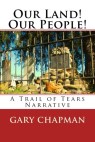
Recently I was presenting Our Land! Our People! at the Talbot Library and Museum in Colcord, Oklahoma. I did not expect to find much in the little town of Colcord, Oklahoma, but I was wrong. Talbot publishes some significant works on Cherokee history, and their facsimile editions of the 1843 Claims were illuminating on the John Bell family in several respects. For the first time I could actually see the English and Cherokee handwriting of four key family members—John Bell, the father, and three of his Bell sons—John Adair, David Henry, and Devereaux Jarrett (better known as Chicken Trotter).

The 1843 Claims record unreimbursed losses prior to the Cherokee Removal in 1838-39, usually due to thefts or confiscations of property by non-Cherokee white men. They were submitted to recover those losses, and they had to be witnessed by at least two other reputable citizens. The Bells served as reporters of their own claims, witnesses to others, and, in the case of Chicken Trotter, an official recorder of several dozen claims by others.

Chicken Trotter’s reports are some of the clearest and most beautifully written in all of the volumes. Deciphering other writing was sometimes impossible, but “D. J. Bell” provided some of the best. That surprised me, because in other places he is recorded by the simple notation “his mark,” and I never found evidence that he had attended any of the Cherokee schools. It is no wonder that he didn’t sign his work “Devereaux Jarrett” but “D. J. Bell” works well, and there is no competitor for the use of those initials among the Bell family. David Henry Bell would be “D. H.” and he just signed as “David Bell.” As these claims were recorded in the first few months of the year, there was enough time for Chicken Trotter to get back to Texas in order to work with Governor Sam Houston to conclude the Treaty of Bird’s Fort on September 29, 1843, which ended the four years of conflict between the Texas government and several tribes. Conflict followed the second Texas governor, Mirabeau Lamar’s attempt to eradicate the native population. Sam Houston, the first governor, an official Cherokee himself,  had tried to grant reservation status to the Cherokees among others. From one administration to the next, the policies reversed from welcoming people of different cultures to trying to destroy them, and back again.

Chicken Trotter, according to the records of the Texas Cherokee population, had come to Texas during the mid-1830’s, when Chief Duwali (or Bowle, as he was also known), led the tribe. They were and continue to be located in Rusk, Cherokee and Smith Counties, as the areas are known today. When in 1839 Governor Lamar and the Texas militia killed Duwali and at least half of the tribe in a genocidal attack, Chicken Trotter soon became one of the remaining leaders.

Because of the Texas Cherokee account I rewrote Our Land! Our People! removing Chicken Trotter from Alabama, where his father lived, and from the Bell Detachment on the Trail of Tears, and putting him in Texas through the late 1830’s. After publishing, I found evidence that Chicken Trotter served his brothers in the Bell Detachment as a treasurer paying bills along the route. If he accompanied the group the whole way, he was travelling to Indian Territory from September 1838 through early January 1839, before returning to Texas in time to be in danger during the massacre of Duwali and the Cherokees in July.

When a group of Cherokees, including John Adair Bell and David Bell travelled to Texas in September and October of 1845, accompanied by the diarist and newspaper reporter William Quesenbury, they visited the northeast Texas Cherokee settlement, and Chicken Trotter was there leading the group, having established a community farm, including watermelons and pumpkins as Quesenbury notes, because some of their horses got loose and tore up the patch.

In 1848, Chicken Trotter was again in Indian Territory, joining his brother Sam and other Cherokees planning a journey to California to prospect for gold. Sam died on the way but Chicken Trotter and his wife Juliette got there before returning to their people in Texas a year or so later. There is no record about his success or failure in finding gold.

Chicken Trotter was a busy man, travelling back and forth quickly in days when travel was difficult. Maybe that is how he acquired his name.

A Church Embraces People with AIDS

23 Thursday Feb 2017

Posted by chaplines2014 in Caring, Church, Citizenship, Death, Faith, Health, People, Suffering

≈ Leave a comment

Tags

life experiences, Memories, Serendipity


spiral aurura

In the 1980’s and early 90’s, when AIDS was still a scandal to many people, a modern leprosy, popularly associated with promiscuous homosexual activity, although we knew it was acquired by other means as well, a church invited AIDS Burlington to use their facilities without charge for their regular and special meetings. AIDS Burlington consisted of people with AIDS, their friends, partners, and families, public health workers, and other interested and compassionate people who wanted to work together to learn how to respond personally, medically, educationally, and politically. They needed to meet regularly and have safe space to talk confidentially as well as space to present information to the public as it became available. They had no funds for these purposes, especially when medical bills were already overwhelming.


The church consistory discussed the possibilities. Outsiders might consider this church a sponsor of the activities associated with AIDS, instead of a giver of hospitality to people in need. We might receive threats from extremists. People might avoid our building, thinking it was contaminated. AIDS sufferers and their families might want to come to worship or take part in other activities, which could be a benefit to them, or it could drive other people away, who were afraid of contact with them. Not much helpful information was available for the first few years and misinformation was rampant. It was such a small thing to give space and to be present with the people who were trying to confront the medical and social problems that came with AIDS. Should we hide from those who needed our help?


The church offered space and the offer was accepted. For a few years, when several members of the community and their families were dealing with the AIDS crisis, before there was any systematic treatment or undisputed public information, AIDS Burlington were our guests, and they were both appreciative and respectful guests, who, as usual, gave at least as much to us as we gave to them. Some of those who able to survive and those who had to say farewell to their loved ones became a part of ‘us.’

We faced some of the unwelcome responses we feared, but never enough to make us regret the decision that we had made.


The Surprising Loss of My Virginity

30 Monday Jan 2017

Posted by chaplines2014 in Death, Events, Faith, Growing up, Gullibility, Health, Innocence, Learning from mistakes, Suffering

≈ Leave a comment

Tags

events, life experiences, Memories, Serendipity

3 Owls

The fall of my sophomore year at Illinois Wesleyan began with high expectations. I had finished my freshman year with straight A’s. I had a steady girlfriend.  I was newly elected president of the Methodist Student Movement. I was enjoying my classes including “Greek II,” “Creative Writing,” and “Biology,” which I hadn’t gotten to take in high school. And I was preparing for the next summer to be spent in Mexico with a Catholic student work project. But after the first few weeks I began to suffer sharp pains in my back, which only grew worse as I grew weaker every day. Finally, early on one weekday morning in October, I made it into the dormitory bathroom with severe pain in my bladder and penis, pouring bloody urine into the toilet until I passed out. When I awoke and the blood was just oozing, I dressed and headed for the campus health service. I thought I was dying.

Nurse Velma Arnold looked at me knowingly as I explained what had happened. “You have VD,” she said. It took a minute for that to soak in, before I said, “But that is impossible.” And she said, “That’s what they all say. Obviously I can’t help you. You will have to see Dr. Cunningham. I will need to know who your sexual partners have been.” It was hard to make her believe that I couldn’t answer the last question, since I hadn’t had any. She finally let me go anyway.

Later that day, still in misery, I saw Dr. Cunningham, who seemed to take a broader view of the matter. He recommended that I drink as much beer as I could while I was waiting to see Dr. Killough, the urologist. He suspected that I was experiencing kidney stones or a urinary tract infection or both, which is what it turned out to be. Having never drunk an alcoholic beverage, and being 19, under the legal drinking age, on a campus where possession of alcohol was considered cause for expulsion, I was not inclined to take his advice about the beer. He didn’t give me a prescription for beer, but he did give me an antibiotic sulfa drug. By the time I saw Dr. Killough, a day or two later, and he confirmed the double diagnosis with a cystoscope, I was also beginning to show the hives of an allergic reaction to the sulfa drug. The cystoscope, experienced regularly during the next several months, along with a few days in the hospital over Christmas break, removed every ounce of false modesty that I had developed in my 19 years. I had discovered more about my own genitalia than I ever wanted to know.


I was not completely clear of infection or signs of kidney stones until the next summer. The plans for a Mexican work trip cancelled, I wished my Catholic friends and girlfriend farewell, took a summer course in the history of Christianity, and looked for something else to do.

Playing with Dynamite

13 Wednesday Apr 2016

Posted by chaplines2014 in Caring, Church, Death, Disabilities, Events, Growing up, Learning from mistakes, People, Small town life

≈ Leave a comment

Tags

A License to Preach, events, Memories

Monkeys see, hear, speak no evil, Bangra.com

Marty (not-his-real name) was one of my parishioners many years ago—memorable nonetheless. His life would have been a case study in oppositional defiance if anyone had chosen to examine it. His parents and siblings were “good church members”—steady, reliable, active in volunteering and supporting as well as anyone else, but Marty was a no-show in the church and in the community as long as I was acquainted with him.

His father was a World War II veteran and his brother had served in the army, but Marty first showed up looking for me when he learned that I had been a draft counselor, and Marty wanted to avoid the draft at all costs, not on any principled grounds, as this was during the Vietnam war, but just because he didn’t want to serve his country under any circumstances. His timing was right and he managed to slip between the cracks when the draft lottery was instituted.

Next came his girlfriend, seeking help in dealing with his bad moods and abuse, which, predictably when co-dependence is strong, escalated steadily. He lived with his under-age girlfriend in her mother’s home, which I naively assumed should make it easy for her and her mother to kick him out. No child was involved. Neither she nor her mother could carry out a resolution to make Marty behave or leave. It appeared that her mother was as emotionally tied to Marty as his girlfriend was. We talked about all of their options, legally and behaviorally and in seeking help, but they did not change anything. Marty continued to abuse them within their own house.

Marty had trouble keeping a job, mostly because he could not take orders or follow directions. He always knew better than anyone else how any job should be done, or he simply did not want to do the job in anyone’s time other than his own. In his favor, Marty was intelligent and curious enough to figure out many things, and well-meaning employers saw his potential, especially when they knew the rest of his family and attempted with their enabling persuasion to give Marty another chance. Marty went from job to job at a time when many young adults were having trouble finding a first job.

Marty’s record included any misdemeanor you can name—tickets for speeding, parking, noise, shoplifting, drunkenness, disorderly conduct. Someone was always bailing him out in one way or another, although I could not persuade people that this was not helping Marty accept responsibility. I tried to find him, to talk with him about the direction of his life, but he was more adept at avoiding me than I was in catching him. For a while I lost track of him and the newspaper carried no more news of his infractions. I had hope that he might be growing up. He and his girlfriend had a son. She had stopped calling me to ask for advice. Things might be working out, I thought. Certainly I knew that there were many people praying that they would.

The end came in an unusual way. Marty had worked for a man who cleared trees and prepared land for development, and he knew where the dynamite was stored. Marty broke into the building and stole some dynamite and decided to have some fun with it, blowing things up. He was successful. One of the first things he blew up was himself.

I officiated at Marty’s funeral. I said in passing that there were many ways that Marty played with dynamite. My words were not appreciated.

Courage Comes in Varied Guise

22 Tuesday Mar 2016

Posted by chaplines2014 in canoeing, Caring, Death, Learning from mistakes, Life along the River, Suffering

≈ Leave a comment

Tags

Memories, Serendipity, Shannondale

Shannondale Community Center

After Rod became a participant in Zion Church, he also showed strong support for Zion’s youth fellowship and frequently lended his adult help to the youth causes and events. This included sharing his vacation time in the renewed service and recreation trips to Shannondale. Knowing that Rod was new to canoeing and not comfortable in water, we tried to persuade him of the safety and enjoyment potential of the activity, assuming his careful attention to a few basic canoeing instructions. These included wearing his flotation device, learning how to read the waterway in front of the canoe, practicing some basic paddle strokes, and, of course, leaning toward an obstacle downstream when the paddlers inevitably lose control of the canoe and the current pushes them against it. His nervousness was obvious as the time approached for canoeing. Others novices were likely just as nervous, but unwilling to show it. We paired new canoeists with more experienced ones, and hoped that they would have time to learn “the ropes” before they ran into any challenge that the Current River might offer.

I chose Cedar Grove as the place to put into the river. From Cedar Grove the flow was moderate and there would be few places where portaging would be necessary due to shallow water. The river was relatively narrow there. My impression was that snags, rootwads, boulders, and other obstacles were rare in that part of the river, so Rod and other nervous beginners should have time to gain some skills before they faced more challenges downstream. We did everything but promise that they would have no problems. Even if they overturned their canoes, the river would be shallow enough in most places for them to stand up in the river and set the canoe right again, and we would be there to help. Rod accepted our encouragement and suppressed his fears.

The day for canoeing came, and the morning was cool and a little foggy, but the sun promised to burn the fog away quickly and open us to a clearer late morning and afternoon. We got an early start, and the Shannondale bus left us on the Cedar Grove beach. There was no turning back. We distributed the gear, lined up on the shore in the order that we would depart, reviewed a few basics, praised God for the beauty surrounding us and the opportunities ahead of us, and sent off one canoe at a time. Rod’s canoe was not first but among the early ones. I was probably in the last canoe, to be in a position to help the stragglers and less successful ones. The river turned to the right immediately after the put-in, so no one left on the shore could see what the canoes ahead of us were facing after the turn. Trees and brush obscured the way forward.

Right after the turn there was a snag difficult to avoid, even by an experienced canoeist, and, as it happened, the snag collected debris over a hole that was deeper than any of us was tall. Rod’s initiation into canoeing came during the first hundred yards as his canoe overturned into a pile of debris. Most of the canoes managed to avoid the obstacle, but Rod’s and another canoe overturned and they needed our help to collect themselves and their gear and get started again. Rod did not accuse us of malicious intent, but he well could have. It was evidence of his good nature that he did not complain (at least aloud), he did not give up (with nowhere to go but downstream), and he did keep going (although I could sense his relief with every break we took).

Rod continued to accompany us on trips, and he even succeeded in canoeing the next year and the year after that. Along the way in years to come, he decided to devote himself to other useful business while the rest of us canoed. He had taken his life in his hands enough times without finding a way to “enjoy” it.

He Said ‘Yes’

27 Saturday Feb 2016

Posted by chaplines2014 in Caring, Church, Death, People

≈ Leave a comment

Tags

A License to Preach, Memories, Serendipity

When I asked him to continue working with the children in a puppet theater project, he said yes.

When I asked him to use some of his precious vacation time to accompany the youth on a canoeing and service week to Shannondale Community Center, he said yes, and I said, of course, his wife Jeri could accompany us. This happened several years in a row.

When I asked him to help raise funds for the youth trips with carwashes, suppers, and garage sales, he said yes.

When I asked him to help clean up, paint, and refurbish the old stage at Zion (that hadn’t been used for many years), and help direct stage plays for dinner theaters, with the youth as actors and servers, to again raise funds for youth activities, he said yes.

When I asked him to work on preparations for peace-themed worship services at Zion he said yes.

When I asked him to dress in a Roman toga and serve as the master of ceremonies at a “Latin Banquet” addressing the theme of Zion’s participation in programs and projects of civic responsibility in the community, he said yes.

When I asked him to serve as the chair of audio-visual service at Zion, working with and replacing our equipment, videotaping services and weddings, and training others to serve in that way also, he said yes.

When I asked him to serve as chair of the social action committee for Southeastern Association of the United Church of Christ, he said yes, and he continued thereafter to say yes, serving in many other leadership roles in the association.

When I asked him to substitute for me in preaching and leading worship at Zion, he said yes.

When I asked him to engage in dialogue sermons, interrupting my sermon-in-progress with key questions and observations, or in other ways providing an unexpected and interesting sermon event, he said yes.

When I asked him to help teach a nine month confirmation class he said yes.

When St John UCC north of Burlington had a pastoral vacancy and asked him to serve them he said yes.

When a new program for training lay ministers, CENTER/LEARN, became available, and he had a chance to deepen his understanding of ministry, even though he was working full time for the railroad and serving a church “on the side,” and hundreds more hours would be required over a three year period, he said yes.

When his ministry at St John came to an end and he was seeking another way to serve the church and use his talents, I asked him to lead a third worship service at Zion aimed primarily at young couples with children attending concurrent church school classes, with a minimal honorarium for his services, and he said yes.

When I asked him to renew his license to minister, signing a contract with the association, even though he no longer had a call to one church but was willing to serve any church in pulpit supply or other needs, and even though he faced opposition from some of the ministers who did not think that request was appropriate, he said yes.

When there was a pastoral vacancy at St Paul Church, West Burlington, and I proposed that he, Jim Ritters, and I form a team to serve as their interim ministry for a year, he said yes.

When West Burlington St Paul invited him to return to their ministry part-time when their pulpit was again vacant he said yes, and when St Paul UCC in Donnellson invited him to serve there he said yes.

And when Dean Moberg said yes, he followed through and did what he said he would do, and did not only what was expected, but much more and as well if not better than just about anyone could do it.

So, when asked a few days ago if he would continue to serve as a messenger, and whisper in people’s ears that need encouragement that every day is a gift from God, and every person you meet is a potential friend, and patience is indeed a virtue, and a sense of humor is a requirement not an option, and other essential truths, he said yes, and when asked to appear in people’s dreams and talk about nearly everything up to and including the steadfast loving-kindness of our God, he said yes, of course. He would and he did, and he will keep doing it.

The Excitement and Fascination of Large Population Die-offs

12 Monday Oct 2015

Posted by chaplines2014 in Death, Events, Learning from mistakes, Nature

≈ Leave a comment

Tags

A License to Preach, Serendipity, Synchronicity

Monkeys see, hear, speak no evil, Bangra.com

As Granddaughter Willow has spent several summers in recent years working at The Mammoth Site in Hot Springs, South Dakota, we have joined for many weeks in exploring the fascinating deposit of bones left by scores of mammoths and hundreds of other animals of many species about twenty-six thousand years ago in a warm water sinkhole. Few other specimens of the giant short-face bear have been discovered, and the skeleton found here is impressive. New finds occur regularly, and the excitement that accompanies the discoveries grows with the potential new information about life in another era. The mammoths are almost entirely young adult males who have wandered away from the herd and sought the late winter, early spring abundance of plant food at the edge of the sinkhole, only to slide in the mud into the water and be unable to get a footing to climb out.

Another fascinating location, directed by a former member of The Mammoth Site staff and friend of Willow, is near Waco, Texas, which the President recently designated as Waco Mammoth National Monument. There a natural disaster, presumably a flash flood, destroyed a large herd of mammoths and several other animals, including a camel and a saber-tooth cat, all at one time, 65,000 years ago. As excavators remove tons of earth from that site, even more information comes to light about animals, plants, and climate during that era.

The Gray Fossil Site in East Tennessee, whose vertebrate curator also serves as the new director of The Mammoth Site, provides a deposit of animal and plant fossils in a marshy area, as-yet-undated millions of years ago. So much information lies buried there, along with unusual species, like an extinct red panda, giant tortoise, tapir, peccary, alligator, and rhinoceros, that excavation is expected to continue for over a hundred years.

As a graduate student Willow now works in the collections of the University of Nebraska, including thousands of specimens from the Ashfall Site in northeastern Nebraska, where a plume of volcanic ash from a mega-volcano in Idaho killed animals, birds, and plants at a watering hole twelve million years ago, and left populations of rhinoceros, horses, camels, and many other species in the region extinct, and the land became barren for hundreds of years. Other discoveries in Nebraska and Wyoming continue to add specimens to a collection that will help to identify a long pre-history of information on interactions of climate and conditions with plant and animal life.

These locations join with others popularly known, like the La Brea Tar Pits in Los Angeles or Dinosaur National Monument in Utah, in providing extraordinary locations for exciting discoveries that can change our perceptions of the world and its development through aeons.

The dark side of all of this excitement is the fact that each site is the remnant of the suffering and death of thousands of creatures. Without such tragic events we would know much less about the world around us. In the future, perhaps, we will care enough for our own human species to study and discover why tens of thousands of human beings kill each other with guns every year, with no personal or social benefits as a result. That should be of interest and fascinating, too, though it appears to be harder for us to get excited about understanding that tragic and unending story in our own era.

← Older posts

Subscribe

  • Entries (RSS)
  • Comments (RSS)

Archives

  • February 2022
  • May 2020
  • October 2018
  • December 2017
  • November 2017
  • October 2017
  • June 2017
  • April 2017
  • March 2017
  • February 2017
  • January 2017
  • November 2016
  • October 2016
  • September 2016
  • August 2016
  • July 2016
  • June 2016
  • May 2016
  • April 2016
  • March 2016
  • February 2016
  • January 2016
  • December 2015
  • November 2015
  • October 2015
  • September 2015
  • August 2015
  • July 2015
  • June 2015
  • May 2015
  • April 2015
  • March 2015
  • February 2015
  • January 2015
  • December 2014
  • November 2014
  • October 2014

Categories

  • beach
  • Books by Gary Chapman
  • canoeing
  • Caring
  • Cherokee history
  • Church
  • Citizenship
  • Death
  • Disabilities
  • Events
  • Faith
  • Farm
  • fighting fires
  • Forest
  • Garden
  • Growing up
  • Gullibility
  • guns
  • Health
  • Hiking
  • House
  • Innocence
  • Learning from mistakes
  • Life along the River
  • Miracles
  • Nature
  • Patience
  • People
  • Prayer
  • Racial Prejudice
  • rafting
  • Running
  • Seasons
  • Small town life
  • Suffering
  • Travel
  • Uncategorized
  • Vehicles
  • Volunteering
  • Words
  • Yard

Meta

  • Create account
  • Log in

Blog at WordPress.com.

Privacy & Cookies: This site uses cookies. By continuing to use this website, you agree to their use.
To find out more, including how to control cookies, see here: Cookie Policy
  • Subscribe Subscribed
    • chaplinesblog
    • Join 71 other subscribers
    • Already have a WordPress.com account? Log in now.
    • chaplinesblog
    • Subscribe Subscribed
    • Sign up
    • Log in
    • Report this content
    • View site in Reader
    • Manage subscriptions
    • Collapse this bar
 

Loading Comments...