• About
  • Celebrating our decades…
  • Welcoming all and inclusiveness

chaplinesblog

~ everyday and commonplace parables

chaplinesblog

Category Archives: Growing up

‘Give Us This Day Our Daily Bread’

02 Friday Sep 2016

Posted by chaplines2014 in Faith, Growing up, Learning from mistakes, Prayer

≈ Leave a comment

Tags

A License to Preach, life experiences, Serendipity, Synchronicity

Chicago Old Town

I spent much of that May evening in 1971 walking in a park and praying about my wife and baby daughter and my future. My year as an intern pastor was coming to a close, and finding a job to support us and a place to live and enough money to return to seminary in Chicago were on my mind. So far I had no idea how these issues could be resolved. We had spent all of our savings, meager as they were, during the intern year, replacing a failing vehicle, and paying daily expenses. There was nothing left, even to pay for a small U-Haul truck to move our stuff. Every option I had investigated during the previous three months had gone nowhere. We would soon be out of time as well as money, as the internship ended in two weeks. My mood was bleak.

In the next afternoon, a knock on the door opened to a man who was active in one of the churches I had served. He said his wife and he had been praying together the evening before, and they thought of us, and they wanted to help. He handed me a check for $100. On the evening of the next day I met with a study group I had organized during the year. They wanted to thank me for the many evenings we had spent together; they had collected $150. The next day I finally got word that a small apartment would be available to us, and I had been awarded a fellowship that would pay for our housing, tuition, and living expenses at seminary; the seminary had received an unexpected donation to organize its archives, and the fellowship supported me to do that, with my experience working in the seminary library and prior graduate history studies. In the next few days more gifts came from several co-workers in the churches.

We had enough, just enough, within a week of my night of despair. It was a lesson that would be repeated in many circumstances in the following years, but none more dramatically for us.

Gender and Job-Seeking

23 Thursday Jun 2016

Posted by chaplines2014 in Caring, Church, Growing up

≈ Leave a comment

Tags

A License to Preach, Life in the City

Chicago skyline 1970

In 1970, while Jan, my wife, was serving as an interviewer for the Illinois State Employment Service in Woodlawn on Chicago’s south side, a couple of transvestite job-seekers came into her office. They were obviously enjoying the day, with make-up applied and dressed more extravagantly than anyone in the office. Jan prepared their forms, leaving the male or female box for the next referral counselor to fill in. She regretted that the next available counselor was Mr. Z, who tended to be abrupt and careless, instead of Mr. P, who saw the best in everyone. It wasn’t long before the two clients emerged from Mr. Z’s office, acting as though they had never been so insulted in their whole lives. Jan and I again had something new to think about at supper that evening.

When did we cease to play the game of dress-up, playing with the discarded dresses, purses, and high heels that my grandmother provided to her 30 plus grandchildren? Probably around the age of five or six; after that it became either a cause of ridicule or a rare source of fun, although one of my cousins made a career out of it, serving in the costuming and entertainment industry. Why did people make such an issue of the clothes that people wore or the gender roles that they identified with?

Some of our high school, college, and seminary friends had wrestled with sexual identity issues personally, finding little acceptance when they “came out” to others, but they remained our friends, and we found them just as faithful, and socially and morally appropriate as we were.

We studied sexual identity issues in bible classes in seminary, finding that a close reading of scripture gave no support for the kinds of discrimination and cultural exclusion that had dominated our society. The very words that were sometimes translated “homosexual” did not refer to the same behaviors that they did in our contemporary society, and the censure of transgender behaviors was, at best, part of a rigid culture long gone.

In 1982 we happened upon the movie Victor, Victoria, while we were taking a rare three-day trip without the children. A charming commentary upon gender identity, sexual orientation, culture, and poverty, the movie represented issues that were always present but often suppressed. Birdcage came in 1996, and Connie and Carla in 2004; otherwise our transvestite cultural contacts have tended to be rare. Along with other media, these movies made their points effectively with good humor.

In 1983 I was a delegate at the United Church of Christ 14th General Synod, meeting at Ames, Iowa. I gladly voted in favor of the “’Resolution Calling on United Church of Christ Congregations to Declare Themselves Open and Affirming.’ This resolution encouraged a policy on nondiscrimination in employment, volunteer service and membership policies with regard to sexual orientation; encouraged the congregations of the United Church of Christ to adopt a nondiscrimination policy and a Covenant of Openness and Affirmation of persons of lesbian, gay and bisexual orientation within the community of faith.” It felt like a small step in the right direction.

In 2003, I was a synod delegate assigned to the study committee on transgender issues at the Minneapolis Synod. Along with a group of dozens of UCC members who represented different forms of transgender identity, we elected belatedly to add “transgender” to the list of people for whom “open and affirming” should apply. The joy expressed in that room when the vote was almost unanimous contrasted with the stories of risk and rejection that many had shared.

Again in 2005, I was a delegate voting in favor when the “Equal Marriage Rights for All” resolution passed the 25th General Synod of the UCC in Atlanta, Georgia. We knew that a statement by seven hundred was just a little step, when so many people in our country had expressed outrage against it.

In my life these have been small and relatively easy matters, but they are still a part of some substantial and significant changes for people’s acceptance of themselves and others.

Voting for a Compromise Nominee

07 Saturday May 2016

Posted by chaplines2014 in Citizenship, Events, Growing up, People

≈ Leave a comment

Tags

events, Life in the City, Memories

Chicago skyline 1970

For the first election in which I was eligible to vote, 1968, I began the year as a supporter of Democratic Senator Eugene McCarthy, the anti-Vietnam War candidate for President. Only a handful of political leaders took on the challenge to oppose the war. The opinion polls indicated that a majority of U.S. citizens still supported the war even though the reasons for it changed with the calendar. Some military analysts stated that the U.S. would have to prosecute the war for another thirty years before any resolution could be expected. Already we had used more armaments than we had during the entire Second World War, and the prospects of suffering in Southeast Asia and loss of life for everyone involved would surpass that war if the analysts were correct.

When Bobby Kennedy joined the campaign, I did not immediately move to support him, even though I knew that he had a better chance of mounting a successful campaign than McCarthy. His willingness to join the war opposition seemed late and calculated, depending on the courage of McCarthy and others to clear the way. Nonetheless I knew that I would vote for Kennedy when the time came. Sirhan Sirhan removed that possibility in the wake of the successful Kennedy campaign in California.

Next came the Chicago convention and the disastrous clashes between demonstrators and police that alienated people on all sides. The convention nominated a stalwart and hard-working liberal, Hubert Humphrey, who in ordinary times would have seemed an outstanding selection to win the office. Humphrey had been supportive in his role as President Lyndon Johnson’s Vice President, but as a candidate he tried to conciliate between those who supported and those who opposed the war, without specifying changes in the conduct of it. Republican candidate Richard Nixon promised that he had a plan for ending the war, but he was no more specific in describing his plan than Humphrey. Perhaps, given Nixon’s history, people could have foreseen that his plan for ending the war involved a major escalation in waging it, doubling the deaths and destruction, but a majority of voters chose Nixon and his secret plan.

Having my own views of the histories of Nixon and Humphrey, I opted reluctantly to support Humphrey. In this first election I also decided to work for him, canvassing the precinct including our apartment in Hyde Park on Chicago’s south side. I volunteered at precinct headquarters and was assigned to a Mr. White, a distinguished Jewish gentleman. While we worked together in his precinct, he invited me into his home, my wife and me to join him and his wife for a meal, and to worship with them at their Reform synagogue.

Mr. White had endured through many decades of Chicago politics and somehow remained idealistic. His work for Senator Paul Douglas and Alderman Leon Despres had given him sufficient hope to keep at it. Somehow he had managed to negotiate the tortuous route between the Chicago Democratic “machine,” the needs of people in his precinct, and his sense of the larger world beyond the city. He and his wife were the only bright spots in what proved to be a disappointing election.

Playing with Dynamite

13 Wednesday Apr 2016

Posted by chaplines2014 in Caring, Church, Death, Disabilities, Events, Growing up, Learning from mistakes, People, Small town life

≈ Leave a comment

Tags

A License to Preach, events, Memories

Monkeys see, hear, speak no evil, Bangra.com

Marty (not-his-real name) was one of my parishioners many years ago—memorable nonetheless. His life would have been a case study in oppositional defiance if anyone had chosen to examine it. His parents and siblings were “good church members”—steady, reliable, active in volunteering and supporting as well as anyone else, but Marty was a no-show in the church and in the community as long as I was acquainted with him.

His father was a World War II veteran and his brother had served in the army, but Marty first showed up looking for me when he learned that I had been a draft counselor, and Marty wanted to avoid the draft at all costs, not on any principled grounds, as this was during the Vietnam war, but just because he didn’t want to serve his country under any circumstances. His timing was right and he managed to slip between the cracks when the draft lottery was instituted.

Next came his girlfriend, seeking help in dealing with his bad moods and abuse, which, predictably when co-dependence is strong, escalated steadily. He lived with his under-age girlfriend in her mother’s home, which I naively assumed should make it easy for her and her mother to kick him out. No child was involved. Neither she nor her mother could carry out a resolution to make Marty behave or leave. It appeared that her mother was as emotionally tied to Marty as his girlfriend was. We talked about all of their options, legally and behaviorally and in seeking help, but they did not change anything. Marty continued to abuse them within their own house.

Marty had trouble keeping a job, mostly because he could not take orders or follow directions. He always knew better than anyone else how any job should be done, or he simply did not want to do the job in anyone’s time other than his own. In his favor, Marty was intelligent and curious enough to figure out many things, and well-meaning employers saw his potential, especially when they knew the rest of his family and attempted with their enabling persuasion to give Marty another chance. Marty went from job to job at a time when many young adults were having trouble finding a first job.

Marty’s record included any misdemeanor you can name—tickets for speeding, parking, noise, shoplifting, drunkenness, disorderly conduct. Someone was always bailing him out in one way or another, although I could not persuade people that this was not helping Marty accept responsibility. I tried to find him, to talk with him about the direction of his life, but he was more adept at avoiding me than I was in catching him. For a while I lost track of him and the newspaper carried no more news of his infractions. I had hope that he might be growing up. He and his girlfriend had a son. She had stopped calling me to ask for advice. Things might be working out, I thought. Certainly I knew that there were many people praying that they would.

The end came in an unusual way. Marty had worked for a man who cleared trees and prepared land for development, and he knew where the dynamite was stored. Marty broke into the building and stole some dynamite and decided to have some fun with it, blowing things up. He was successful. One of the first things he blew up was himself.

I officiated at Marty’s funeral. I said in passing that there were many ways that Marty played with dynamite. My words were not appreciated.

Our Land! Our People! A Trail of Tears Narrative

01 Friday Apr 2016

Posted by chaplines2014 in Books by Gary Chapman, Cherokee history, Faith, Growing up, Racial Prejudice

≈ Leave a comment

Tags

Our Land! Our People!, The Trail of Tears

OLOP Cover Photo 3

Our Land! Our People! A Trail of Tears Narrative
is now  available from:
https://www.createspace.com/6014646
Amazon.com by title
and…
Burlington By the Book

Becoming a Draft Counselor

18 Monday Jan 2016

Posted by chaplines2014 in Citizenship, Events, Faith, Growing up, Learning from mistakes

≈ Leave a comment

Tags

Books by Gary Chapman, Memories, Out of My Hands, The River Flows Both Ways, Vietnam and Cambodia

Chicago skyline 1970

I was almost finished with applications for conscientious objector status when a physician informed me that the question had no personal significance since I would not pass the physical examination anyway, even if I wanted to serve in a non-combatant role. Since I was opposed to the U.S. involvement in the war in Vietnam, I looked for other constructive ways to be involved. In the fall of 1968, as we took up residence in Chicago and I continued graduate studies for ministry, I entered the American Friends Service Committee training for draft counselors.

Having training in law would have been an advantage in dealing with the selective service system and legal precedents in the cases that we studied, in order to give helpful information to people who came with concerns, both draft-eligible men and their families. Having more experience in counseling also would have been useful, but some of that came with the counselees as they presented their questions. Motivations and concerns varied greatly, and responding equitably and sympathetically to people who held different beliefs and values was challenging. Enough trained people participated as counselors that it was not overly demanding for each of us who entered the volunteer AFSC network, and that was important as I tried to balance all of the requirements of study, work, service to others, and being a new husband. It could have been much harder, and I still would not have faced a fraction of the hardships that several of my friends and family, and especially my family-members-to-be, were facing in Vietnam.

Those who came with questions included people who were conscientious objectors, people who were simply draft avoiders, people who wanted to help others in their family or friendship circles who were having trouble dealing with the variety in draft boards and their practices, people who were in the military service but unwilling to fight in Indochina, people who were already in trouble one way or another, and those who were interested in all the options that were available before they committed themselves. We all had a lot at stake, and, although I was glad that an all-volunteer force replaced the selective service system, finding ways to serve our country as good citizens was in front of all of us in ways that have not been matched afterward.

Serving our country as citizens remains a universal duty, but being willing to kill people who differ with us in perspective, who are not threatening us, as persons or as a nation, in any direct or meaningful way, is not justifiable. Often personal judgment must be set aside, but too often conscience has been set aside as well, in responding to the orders that come from a chain of command.

We are now in the gap between the Vietnam War’s foggy beginnings and ignominious ending fifty years ago. I still puzzle about how to honor those who served their country as soldiers and those who served their country as resistors, then and now. The phrases “serving our country” and “defending our freedoms” pass easily off the lips of many people. The reality is much more complicated and difficult.

The Youth Trip of a Lifetime

14 Thursday Jan 2016

Posted by chaplines2014 in Church, Citizenship, Events, Faith, Growing up, People, Travel

≈ Leave a comment

Tags

Memories, Serendipity

cropped-great-river-bridge-sunrise-january-2015.jpg

Last night I dreamed about a youth trip that didn’t turn out so well, but often I think about the scores of trips that I led (with the assistance of many helpers!!) that went better than I had any right to expect, and the first trip (led by others when I was seventeen) that set the stage for all of the rest. It was 1963, and a couple of Methodist minsters had a brainstorm that the Central Illinois Conference would send a bus-full of high school juniors and seniors to New York City and Washington, D.C., in January of 1964, to experience a seminar on religion and current events.  With their plan, they were braver than I ever became, but I was privileged to be on the bus. This was entirely due to the benevolence of my pastor at the time, Rev. Glen Sims, and a generous older member of my congregation at Paxton Methodist Church, Gladys White.  All of my expenses were paid.

Many of the teenagers on board that week knew each other from camps and youth fellowships, but we all got to know each other, and at least one became a friend for life. The bus travelled all day and night, and those couples who knew each other found not-so-quiet corners of the bus to expose their raging hormones during the long dark hours, but that was not me (or the aforementioned friend). I just noted the consternation of some of the adults who didn’t foresee this aspect of packing so many teens so closely together for so many hours.

We arrived in New York in time to attend worship and the site chosen was Marble Collegiate Church where Norman Vincent Peale was continuing to share his “power of positive thinking.” Peale’s center-stage style and the white-gloved, tuxedoed ushers made an impression.  There, too, some of the adults had preferences in other directions that were fulfilled when we visited Riverside Church and the Interchurch Center, headquarters at the time of the National Council of Churches and several denominational offices, and a Methodist Church in Manhattan that sponsored many outreach services to needy people.

The next two days saw us spending time at the United Nations and the Church Center for the United Nations, where we heard presentations and engaged in discussions about current affairs involving church interests, especially the Conventions on Human Rights that were in the process of development. We stayed in small crowded rooms in a hotel just off Broadway, and we must have eaten somewhere, but, surprisingly for me and my appetite, I do not remember any food. I do remember our exposure to Charles Wells, a Pennsylvania Quaker who posted a newsletter to which I promptly subscribed until he retired years later and my subscription transferred to his compatriot , I. F. Stone.

We again boarded the bus for the shorter trip to Washington, D.C., where our itinerary took us on a tour of the White House and several sights—the Lincoln Memorial, of course—and we listened to church lobbyists at the Methodist center across the street from both Capitol and the Supreme Court. Desegregation, plans for the war on poverty under the new president, Lyndon Johnson, and international affairs in the Cold War were high on the agenda. We went across the street for a meaningful discussion with Illinois Senator Paul Douglass, who supported the U.N. Conventions, but did not see a path for their early approval, and another but less meaningful meeting with Senator Everett Dirksen, whose memorable words focused on his sympathy for us being there in winter and missing the cherry blossoms in bloom. The Soviet Embassy provided an interesting stop, and I was impressed with the many publications in English and the ambassador’s efforts to impress us with how friendly and progressive Russians could be. In the light snow of a gray afternoon, we visited Arlington Cemetery, the Tomb of the Unknown Soldiers, and freshly turned earth and eternal flame of President John F. Kennedy, whose efforts I had just begun to appreciate when he was assassinated.

I did not realize at the time how much of my world shifted during that week, how much larger it became, how many of my thoughts about church, state, national and international concerns began. We talked for a while as the bus turned toward Illinois, but mostly we slept. We were very tired.

[C1]

Mumps the Second Time Around

09 Saturday Jan 2016

Posted by chaplines2014 in Growing up, Learning from mistakes

≈ Leave a comment

Tags

Memories

Bridge in Autumn

We had lived in the Paxton area for several months but had not yet established a family doctor. Doctor Hilgenberg at Tolono, Illinois, had served our growing family for twelve years before we moved to Paxton. He had delivered two babies, David and me, and seen my family through a multitude of young adult and childhood illnesses, but we needed a doctor close to our new home. Our neighbors recommended Dr. Peterson, who had earned their loyalty through many years of sacrificial service.

I had been ill for a several days with an increasingly severe sore throat. Dad and I climbed the long dark stairway to Dr. Peterson’s office on the second floor of a downtown business—he carried me the last half of the stairs. We entered a crowded waiting room and sat for what seemed like an eternity to my seven year old internal clock. Finally the nurse called us into the doctor’s examining room, and Dr. Peterson gave his diagnosis. It was a simple case of the mumps.

“He’s already had the mumps,” my father answered. He had them a year ago when his brother did.”

Dr. Peterson was not perturbed. “He has them again. It happens sometimes.”

We went home and resumed the waiting for the mumps to take their course. As the days wore on, the fever increased, as did the swelling and pain, not only of my throat, but in my chest and in the joints in arms and legs. Mom and Dad became more anxious as I became sicker, and they decided to try the new clinic that had just opened with some physicians new to the community.

Dr. Noble was not well-known, as Dr. Peterson had been, and he was exceptionally sober and reserved. “Not mumps.”  I recall that he mentioned two more words—penicillin and hospital, which led to a conversation about how to care for me at home and come in for a shot and exam every day for the next as yet undetermined number of days.

That is how I began second grade, at home, making regular trips to the clinic for shots in my sore butt, and doing homework assignments while lying on the couch, with occasional drawings and letters from my classmates that my teacher, Mrs. White, included with the assignments  sent home with Mom. As I gradually began to feel better, it was a treat to receive the attention of classmates from a distance. I was ready some weeks later to go back to school, but I soon learned that I was behind everyone else in my class and had some catching up to do. When reading aloud I was the slowest and far from the smoothest.

Dr. Noble listened to my heart everyday and told me that I had developed  a murmur, but it wasn’t too bad. From that point on I could always feel my own heartbeat and assumed that everyone else could, too.  

Sneaking into the Christmas Gifts

16 Wednesday Dec 2015

Posted by chaplines2014 in Events, Growing up, Learning from mistakes, Seasons

≈ Leave a comment

Tags

Memories

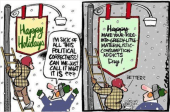
Happy Holidays.

My brother and I never had a reason to be in my parents’ bedroom when they were not there. The room was upstairs in a ‘newer’ wing of the hundred-some year-old farmhouse where we grew up. We gained access to the bedroom by going through the bathroom that replaced one of the three tiny bedrooms of the original story-and-a-half cabin. (You might say that it became the ‘Master Suite’ except that there was only one ‘inside’ bathroom in that house, and everyone used it when it worked, which was only part of the time.) Obviously my parents were not at home when we went into their bedroom. My older brother, David, must have been about thirteen, and me, eight, when this event occurred. We felt safe in sneaking in.

David thought he knew where the Christmas gifts must be kept—in the little closet at the far end of the bedroom. He opened the door and rummaged through the clothing and shoes to get to the hidden part of the closet, and he said that—sure enough—there were packages back there. Did I want to see what I was getting?

Of course, I wanted to see. What was I doing in that room with him if I didn’t want to see what I was getting for Christmas? What eight year old boy wouldn’t want to know ahead of time? At that moment something told me not to look and not to ask and not to let him tell me. I shrank from knowing ahead of the time how my parents wanted to surprise me.

My brother became a generous man. Perhaps it was an early manifestation of his generosity that he was sharing with me this escapade into sneakerdom. He certainly didn’t have to include his bothersome little brother in this opportunity. He didn’t need me as an accomplice either. It is not clear in my memory that my mother discovered this intrusion into the back corners of her closet, but she was observant and she probably did, and my brother probably paid for the infraction of unwritten Christmas rules with the humiliating insight that he could not be trusted in that day’s responsibility.

Among the many gifts coming from my parents that I do remember from those childhood years, I do not remember what I received on that particular Christmas, except the knowledge that I could be tempted, and that finally I could resist the temptation of knowing what I wasn’t supposed to know ahead of time. I could wait and be patient and learn in due time. That, and what my brother learned, were the most important and memorable gifts from that Christmas.

Too Eager to Get to Christmas

13 Sunday Dec 2015

Posted by chaplines2014 in Events, Growing up, Learning from mistakes

≈ Leave a comment

Tags

Memories

3 trees lighted in different colors

Like most families we had some Christmas morning rituals when I was a child. We arose early, full of excitement, but several steps preceded the first glimpse of the Christmas stockings and the gifts under the tree. We had to put on our clothes for the day, check to see if Santa had found the cookies and milk left on the kitchen table, and, of course, he had. Then we had to finish a full breakfast, which, for me, was probably my favorite—orange juice, and toast with mayonnaise—I wasn’t much of a breakfast eater in those days. If there were any chores that needed to be done before we gathered around the tree, they were done, like milking the cows or checking on the waterers, to make sure that they were open and not frozen. Finally, all together, my two brothers, Mom and Dad, and I got to go into the living room, and open the stockings first, the oldest going first, and then the wrapped presents under the tree, again starting with the oldest among us. We were naturally eager to get everything out of the way, and on with the business of opening the presents.

On one Christmas morning, when I was probably six or so, when my brothers and I were rushing down the narrow stairway that ran from the second floor bedrooms down to the kitchen, I tripped near the bottom step, fell, and ran my knee right into the metal grate at the base of the stairs. It was a nasty little gash that bled enough to need cleaning and bandaging, further delaying the goal of our hurried descent. I don’t know which hurt more, my knee or the delay.

I should have learned then not to hurry through the steps that approach the gifts of Christmas. I should have learned.

← Older posts
Newer posts →

Subscribe

  • Entries (RSS)
  • Comments (RSS)

Archives

  • February 2022
  • May 2020
  • October 2018
  • December 2017
  • November 2017
  • October 2017
  • June 2017
  • April 2017
  • March 2017
  • February 2017
  • January 2017
  • November 2016
  • October 2016
  • September 2016
  • August 2016
  • July 2016
  • June 2016
  • May 2016
  • April 2016
  • March 2016
  • February 2016
  • January 2016
  • December 2015
  • November 2015
  • October 2015
  • September 2015
  • August 2015
  • July 2015
  • June 2015
  • May 2015
  • April 2015
  • March 2015
  • February 2015
  • January 2015
  • December 2014
  • November 2014
  • October 2014

Categories

  • beach
  • Books by Gary Chapman
  • canoeing
  • Caring
  • Cherokee history
  • Church
  • Citizenship
  • Death
  • Disabilities
  • Events
  • Faith
  • Farm
  • fighting fires
  • Forest
  • Garden
  • Growing up
  • Gullibility
  • guns
  • Health
  • Hiking
  • House
  • Innocence
  • Learning from mistakes
  • Life along the River
  • Miracles
  • Nature
  • Patience
  • People
  • Prayer
  • Racial Prejudice
  • rafting
  • Running
  • Seasons
  • Small town life
  • Suffering
  • Travel
  • Uncategorized
  • Vehicles
  • Volunteering
  • Words
  • Yard

Meta

  • Create account
  • Log in

Create a free website or blog at WordPress.com.

Privacy & Cookies: This site uses cookies. By continuing to use this website, you agree to their use.
To find out more, including how to control cookies, see here: Cookie Policy
  • Subscribe Subscribed
    • chaplinesblog
    • Join 71 other subscribers
    • Already have a WordPress.com account? Log in now.
    • chaplinesblog
    • Subscribe Subscribed
    • Sign up
    • Log in
    • Report this content
    • View site in Reader
    • Manage subscriptions
    • Collapse this bar
 

Loading Comments...