• About
  • Celebrating our decades…
  • Welcoming all and inclusiveness

chaplinesblog

~ everyday and commonplace parables

chaplinesblog

Category Archives: Hiking

An Answer to Prayer

15 Wednesday Nov 2017

Posted by chaplines2014 in Forest, Growing up, Hiking, Nature, Prayer

≈ Leave a comment

Tags

life experiences, Memories, Serendipity

deer & fawn
I rolled out my sleeping bag on the wooden planks of the log cabin porch at Morgan-Monroe State Forest in Indiana. Nestled in a wooded valley next to a loudly gurgling brook, the cabin was a century old, but I was barely thirteen. I felt much older because the other Boy Scouts and I had hiked twenty-five miles that day. The back-country sheds and shacks we had passed, with roaming cows, pigs, chickens, and assorted other creatures, must have been like the little farmsteads my people had come from many decades before in Ohio and Pennsylvania and Virginia, unlike the treeless prairie in central Illinois where I was born. The autumn splendor of the trees and hills surpassed anything I had yet seen.
The night was cool and star-studded, and the porch was more inviting to me than the dark interior of the cabin. Wherever we chose, we lay down to sleep. The attempts to whisper inside the cabin were just audible. They thought I couldn’t hear, and they were talking about me. They were telling a lie about something I had done, poking fun at it. It was something important to me, one of the first things in my life that I was really proud of doing. I was angry and ready to go in and set them straight. But the plank floor was too comfortable, and the stars were shining brightly, and I asked God how I should defend myself, and all I heard was the music of the stars and the distant whippoorwill.
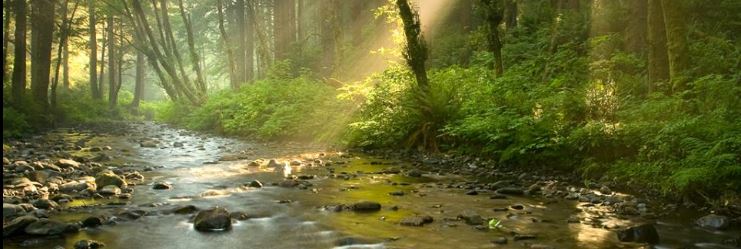
The next morning I awoke before anyone else to a misty sunrise filtering through the trees. To my surprise there was a doe and fawn drinking from the brook barely twenty feet from the porch where I was lying. I had never before seen deer in the wild. They finished drinking and the doe wandered toward me and stopped at the railing and looked at me, our eyes meeting. Then she slowly turned and nudged the fawn and bounded away.
Life was good, and life has remained so. Some things are so beautiful that they erase all thoughts of the ugly. I no longer felt the need to correct the misinformation that the boys had spoken about me. Nor did I tell them about the deer. I just proceeded to fix the best breakfast outdoors that those fellows had ever eaten, and I said the blessing.

The Hidden Springs of Hidden Springs Trail

23 Thursday Feb 2017

Posted by chaplines2014 in Forest, Gullibility, Health, Hiking, Nature, Running, Seasons

≈ Leave a comment

Tags

life experiences, Names and Titles, Serendipity

cropped-rock-creek-wilderness-oregon.jpg

With many record-setting warm days in a row, I’ve had an opportunity to try some of the many new trails in Northwest Arkansas. On cold days I hesitate to go where I might get lost or take a long time to return to where I can rejoin Jan. On warm days I can wander. There are more than forty miles of trails and 700 miles of roads in Bella Vista, not counting the golf course paths, and there are even more miles of trails in the contiguous cities to the south, so there are plenty of places to explore.

A new favorite is the Hidden Springs Trail that navigates a narrow steep-sided valley known as the Slaughter Pen, presumably because it was easy to drive herds of cattle from the broad plain at the top of the valley into an ever-narrowing channel until a herd would be compressed into a fenced neck before the valley broadened again. A fast, full current of water pours down the creek in the center of the valley, and the developed concrete and asphalt trail runs beside the stream for more than two miles. The stream looks and acts like one of the cold cave spring-fed streams along the Current River three hours east of here, where millions of gallons pour out of the ground every day, so it is an invitation to follow the stream until one comes to the “hidden springs” that give the trail its name.

The stream joins a couple of others below this valley where I have run for years, around Bella Vista Lake and along Little Sugar Creek. Amazingly in a couple of spots all of that water disappears below shelves of limestone, and then reappears a few hundred yards farther. Along the Hidden Springs Trail the water flows on the surface all the way and pours down some three and four feet tall falls in a few places, made even more lovely by the woods and shrubbery around them. Along the base of the rocky outcrops that line both sides of the valley, bare dirt bicycle paths run, and in several places the bicycle paths run half-way up the fifty to hundred foot cliffs or even along their top edges, providing a challenge to the experienced rider. It would be challenging enough for me to walk them, when I knew no bicycles were coming down those narrow paths, but I am content to keep walking the center until I find the source of all that water.

As I explored every day I ran a little farther up the developed trail, reaching the point where the busy stream was joined to a lazy, slower stream, and following the active one in my search for the hidden springs. Since the entry to the trail lies a half-mile beyond the parking lot, and the point where the streams converge is already a mile and a half upstream from that trail entrance, my three mile daily goal was easily surpassed in the quest. The early spring flowers, birds, and critters made it interesting, so I kept going. After two more days I could see that I was finally nearing the goal, three miles from where I started, where water poured into the creek bed.

A great blue heron stalked the small turbulent pool that fed the stream, and there was little bubbling or frothing of the water, so it must have been clear of most of the chemicals that saturate the groundwater these days, which was surprising. The source of the stream, instead of being the hidden springs I sought, was a series of large concrete vessels that served the Bentonville Sewage Treatment Plant.

The Appalachian Trail–Seeing the small things

27 Wednesday May 2015

Posted by chaplines2014 in Forest, Hiking, Nature

≈ Leave a comment

Tags

Appalachian Trail, Serendipity

Rock Creek Wilderness, Oregon

Hiking a mountain trail brings to mind distant stunning and beautiful vistas, but smaller sights near at hand can also impress. A tree-shaded slope covered with ferns as far as the eye could see was my first unforgettable vista. On another slope bright red strawberries were growing everywhere; being wild they didn’t have much flavor, and the fact that they were overgrown by a beautiful three-leafed, red-stemmed vine also made me wary to enter the patch.

Look closer and you see the varieties of color in wildflowers, each adjusted to different altitudes in the landscape, and in a seasonal succession. Trillium in red, purple, pink, yellow, and white, in various sizes, some as large as a foot and a half across, are always easily identifiable. The daisy family is well-represented almost everywhere. Others need that reference book that is too heavy to carry on a long-distance hike. What was that 1 ½ inch, four-petaled, red blossom with a yellow center, that stood on a four feet tall stalk, with leaflet whorls every eight inches? I don’t know, but there were a lot of them half-way up Burnett’s Mountain.

The lichens that make their homes on boulders are as impressive on a miniature scale as any multi-acre landscaped garden. Every color is represented in the microcosm, and the boulders appear to be covered with these multi-colorful furs, velvet black underneath where something has peeled a section loose.

From a distance we saw what looked like a kindergarten of plastic children’s toys. The objects were perfect primary colors of red, orange, yellow, green, blue, and purple, in rounded and flattened shapes. As we came closer we saw that they were varieties of mushrooms clustered in this one damp, warm area. We just stood and looked at them in amazement.

The birds deserve attention in the arena of smallness, though the vultures, hawks, owls, and falcons are often sizable. The birdcalls of early morning resonate throughout the woods like an orchestra. Most of the sounds then and throughout the day remain nameless to my untutored ears. Bluebirds, tanagers, pileated and downy woodpeckers, grosbeaks, and warblers were easy enough to recognize, when we took the time to look at them.

A copperhead was the only snake we saw on several trips, though he had been sunning himself on a forest service lane, run over by a truck, and appeared to be dead. We didn’t check too closely. My notes make mention of only one insect—a two inch long, one inch wide, black beetle, that rooted and dug into the ground at every foot of its course, as if surveying the ground; it was headed away from our tent, and I was grateful.

On top of Blood Mountain, seeing forever

08 Wednesday Apr 2015

Posted by chaplines2014 in Forest, Hiking

≈ Leave a comment

Tags

Appalachian Trail

redwood trees

May 17, 2008, on the Appalachian Trail

Bob and Shelly joined us last night at the Woods Hole Shelter, and spoke about their experiences hiking the Pacific Rim Trail and the Rocky Mountain Trail. They labelled the Appalachian Trail the hardest of all, and Bob’s working on his third completion of it. We took him at his word. Fifteen to twenty years younger than Dave and me, Bob is a musician and a teacher by trade. He published a book of camp songs titled Hiking a Round. The problem with the AT, he said, was the impossibility, most of the time, of seeing the vistas and the horizon, due to the large amount of forest cover, and the moisture in clouds and fogs, unlike the drier and sparsely forested West.

Dave and I hiked from there to the top of Blood Mountain, one of the places and one of the clear days that contradicted Bob’s claims. Blood Mountain has the reputation of being the busiest section of the Georgia AT, and this weekend lived up to that. All the way up and down, we met assorted hikers and groups of all kinds. If there was anything between us and the gorgeous views of the distant landscape, it was more likely to be people than trees or clouds.

We ate our lunch on the mountaintop, broad enough for hundreds of hikers to find secluded spots and limitless views, enjoying the sunshine, lying on the rock shelves, and listening to the music of birds and breezes, punctuated by people sounds, of course.

On the way down the north slope, we met one extended family group of about twenty, with their grandpa bringing up the rear. As we passed, he said to us, “We ought to be old enough to know better, but I love doing this.” Huffing and puffing his way up, he and everyone else in his group appeared to be carrying heavy loads of picnic gear. I asked how heavy, and he said about seventy pounds. That made our thirty-five pound backpacks seem a lot lighter.

On the whole I was glad we had taken the opposite route to theirs, as well as carried half the weight. The ascent of the south slope was gradual, green and flower-covered, and much easier. The descent on the north face was steeper and rockier. After the spectacular scenery of the first several hundred yards, the rest of the descent was tricky, with improvised steps and steep sections, so we were both glad to be going down, not up, with just ourselves, not a group of kids to supervise, with light packs, not heavy ones. Their descent would be back the same way they came, and a lot of what they carried would be inside them, not in their packs. More power to them! We all would have a fine and full day.

Two AT Hikers Lost in a Stampede of Wild Whats?

17 Tuesday Mar 2015

Posted by chaplines2014 in Forest, Hiking

≈ Leave a comment

Tags

Appalachian Trail

IMG_0002

After an unseasonably cold night for mid-May, the day broke blue and clear, and the sun soon thawed us out from our night’s discomfort.  We left  Wood’s Hole Shelter at 7:30 heading south. We appreciated the endless stretches of trillium that lined the trail with deep purple flower buds still tight, and full blossoms in lavender, pink, white,  and yellow, and large expanses of ferns, turtle-head lilies, and multi-colored lichens spread upon the worn igneous boulders.

Over the years we had almost become indifferent to the possible dangers of the hike, though the trail log book back at the shelter had provided some engrossing narratives of previous hikers’ encounters with bears and snakes. Perhaps they were fictions invented for the impressionable. The worst that we had encountered were some very noisy and drunk motorcyclists tearing up a forest service road a year before, persuading brother David and me to stay hidden on the trail nearby.

We were close to Jarred’s Gap on the trail map, and whether it was that gap or not, it was a low, flat area, filled with head-high tall plants growing thickly in damp soil that we had come to expect when we reached the base of the mountain trail.  We had seen large scat on the trail that made us wonder who or what had been there ahead of us. We were not prepared for the noise we heard that made us turn around and stare in the direction we had come. Such a ruckus of crashing brush, squeals, and fast rampage through the woods, coming toward us, crossing the trail about fifty feet from us, and just as quickly moving away. We counted at least a dozen wild razorbacks running full out in the craziest “follow the leader” race we had ever seen.

Had we stopped in the spot they chose to cross, we might as well have been  standing in front of a semitrailer truck on an interstate highway. Splat! There was a danger no one had warned us about. We walked on in silence for a while, pondering how embarrassing it would be to leave a legacy for our family of being the only hikers on the AT to lose our lives in a stampede of wild hogs. On such a beautiful day, too.

Laurel Hell on the Appalachian Trail

16 Monday Mar 2015

Posted by chaplines2014 in Forest, Hiking

≈ Leave a comment

Tags

Appalachian Trail

IMG_0002

We had climbed strenuously to the 2500 foot level and the trail had turned into a gentle incline. We were entering a thicket of laurel “trees” which my brother Dave identified for me. Too bad we had missed them in bloom, he said. They were gorgeous in bloom. I usually think of laurel as a shrub, but these were 15 to 20 feet high. The branches were thickly intertwined, forming a wall closing in on either side of the trail, which zigzagged through the laurel, so that one could not tell what might be ahead more than twenty feet or so. Then I remembered what I had read in the notebook in the shelter the night before. Some hiker had written about his experiences the day before, seeing a bear in the laurel hell.

A bear could be just a few feet away, and we would not know it was there unless we stumbled upon it. Among the worries we shared when we started, of course, were bears, poisonous snakes, swiftly flowing rivers crossed only by logs for us to balance on, and trails that were nearly washed away on steep slopes. So far we hadn’t found anything that matched our fears, but this laurel thicket made us wonder.

But why did they call it a “laurel hell?” Then we realized that if there were no marked trail through this area, which reached perhaps a half mile in each direction, we could wander around for a long, long time before ever escaping. At any point we could run into one of those fears we had imagined. At any point we could run into un unclimbable rock face or cliff or river bed, and we would have to turn around and head another direction until we would be completely turned around, which means, we could be lost forever, if there wasn’t a trail. But there was a trail, which someone had conveniently cut through this maze ahead of us.

We didn’t come upon a bear, but later that day we were walking through a “rodie hell.” There the rhododendron formed the same kind of maze that the laurel had formed alongside the trail we had walked through earlier. But the rhododendron were in full bloom, masses of white flowers and lightly sweet fragrance filled the air. We didn’t expect to see these in full bloom in mid-July, but the altitude had delayed their blossom season. It was a marvelous sight and the blossoms just kept on going for hundreds of footsteps, and yet, without the trail, we would have been just as hopelessly lost.

Someone had been there ahead of us, maybe only a few years, maybe generations back, lost in time, finding a way through this beautiful maze. They had blazed the trail. Now we just followed it and enjoyed it … mostly enjoyed it, as long as we didn’t find the bear.

What is that smell… on the Appalachian Trail?

12 Thursday Mar 2015

Posted by chaplines2014 in Forest, Hiking, Seasons

≈ 1 Comment

Tags

Appalachian Trail

IMG_0002

What is that smell? My brother and I found ourselves asking that question as we hiked along the trail. The odor resembled garlic or onions, strong and persistent in a local area, then as we walked on, it vanished. Sometime later the odor came strongly again. We looked around to see if there were some kind of onion in the vicinity, but all we could find was wild ginger, trillium and mayapples. The area was wooded and shady, of course; virtually everywhere along the trail was wooded; oak and maple predominant in this particular area, about 2500 feet in altitude. The soil was noticeably loose and rich, full of humus, with the mountain slope providing plenty of drainage.

I thought it was the wild ginger. I have a small patch of wild ginger in my garden, but I’ve never noticed a distinctive odor coming from it. The roots are supposed to be usable as an herb, similar to the ginger found in grocery stores, but not botanically related. Still I surmised that the odor of such large amounts of ginger might be strong, as the flavor usually is. I have little experience of wild ginger, certainly none of patches that are as large as tennis courts. I took a leaf and a stem and crushed them in my hands, and all that came out was a fresh grass-like scent. I smelled the soil around the ginger, and although the ambient area was filled with the distinct aroma, the soil smelled like, well, soil.

Dave thought it smelled like ramps. What are ramps? He had attended a ramp festival somewhere in North Carolina. They cooked with ramps, and told stories about ramps, which are popular in the Appalachian region. He didn’t particularly like what he had tasted, which is unusual for my brother, but he knew that people collected ramps in the mountains.

Still there was no sign of an unusual plant. We walked on until we came to another patch of wild ginger, where the aroma was again strong. Every time we entered a large patch of ginger, which was regularly at the same altitude and type of environment, the aroma came. I guessed that the aroma percolated up through the soil from the roots.

Maybe ramps and wild ginger are the same plant? We wondered about it, but walked on without knowing. Recently I took the time to investigate further. Wild ginger, which I had correctly identified, is Asarum canadense. Ramps are an entirely different plant, scientifically identified as Allium tricoccum and Allium burdickii. Both wild ginger and ramps show up in the same kind of mountain environment. Ramps look something like lily of the valley, but the leaves die back after their spring appearance, leaving the onion-like bulb in the soil.

My favorite story about ramps, also called “wild leeks,” comes from their seasonal character. Mountain families would find and use them alongside morels and other mushrooms in their spring cooking. Children often enjoyed ramps’ sweet taste, and ate them like candy, with the problem being that a vile smell oozes from people’s pores for days after eating them. Children were often excused from school for those days.

So we have to go back. We have to dig up the roots and see whether there are some onion-like bulbs among all those wild ginger roots. We will put our trowels to use in this scientific quest, which is different from their typical use along the trail.

May you find yourselves on fruitful quests throughout the coming spring. May your curiosity be piqued and your senses be stirred with aromas, flavors, sights, sounds, and textures in limitless variety. Taste and see that God is good.

At the foot of Blood Mountain

12 Thursday Mar 2015

Posted by chaplines2014 in Hiking, Seasons

≈ Leave a comment

Tags

Appalachian Trail

IMG_0002

We left the Appalachian Trail at the foot of Blood Mountain in Georgia. The next fifteen miles climbed the mountain and descended the other side. Near the highest point in Georgia this section of the trail is the most popular and scenic stretch in that state. At mountaintop sits an eighty year old rock cabin that serves hikers as a shelter from the storms that sometimes rake the barren summit. Prominent signs warn hikers to carry water from the spring a mile below the summit if they plan to stay at the cabin overnight. It is not supposed to be an easy climb, but the rewards on the other side include a fully stocked store and showers at the foot of the mountain’s other side. As near to heaven as the AT gets. 

The name of Blood Mountain intrigues us. Known by that name before the Europeans came people assume it came from a prehistoric battle between native peoples. Over the thousands of years of human habitation every space on earth has seen its share of blood, but occasionally the toll is heavy enough to mark the sites with lasting titles that warn us– Starved Rock, Devil’s Den at Gettysburg, the Crater at Petersburg, Wounded Knee, Little Bighorn. Those places all have tragic stories to tell, and so, I suppose, does Blood Mountain, but the details of the story were lost and so the name became generic and universal. 

So we planned to return to the trail  to pick up where we left off, knowing that this mountain is a symbol of a universal and hopeful quest that we will someday climb beyond the stories of slaughter to a place of refuge and serene circumspection. From that vantage point we will see in perspective all the paths traveled by people with plans that intersect and plans that merge, where either cross-purposes or reconciliation could emerge from the deep woods and thickets with just a slight turn of the compass.  

Already some people have climbed that mountain and achieved such perspective, following the leader up to the top. How heavy that burden must have been, weighed down as it was with so many rivers of blood, before he arrived there, and foretelling so many more needless sacrifices to follow. Yet he carried it, with a little help from yet another hapless victim chosen at random to add to the burden of insult. He carried it up to the top and then still higher as he ascended to the place of thrones and final judgments. 

Again we mark Jesus’ ascent of a cross and of a path to heaven. Again he tells us to put away our swords and suffer the temporary humiliations of defeat while at the same time we accept the stronger force of stubborn love to insist on healing instead of harm. From the perspective of a bloody mount we look all around at the world God has made, and see how beautiful it can be.

An abandoned village on the Appalachian Trail

11 Wednesday Mar 2015

Posted by chaplines2014 in Hiking

≈ Leave a comment

Tags

Appalachian Trail

IMG_0002

The gap between the mountains was broader than many, about a half mile of relatively easy slope or level ground. My brother and I had read that there was a mountain village here between 1750 and 1900, and the last building, a church, had burned down in the 1930’s. All that remained would be a gravel road, a cemetery that had once surrounded the church, and a 12 acre clearing that still produced some hay.

As we walked down the Appalachian Trail toward the abandoned village we began to see some signs of stone foundations, overgrown pathways, and finally the road and the clearing. We wondered where the churchyard was. The guidebook was deep in the pack, so we didn’t dig for it, not remembering whether it told us more details or not. We explored the edges of the clearing for a while, but there were no signs of gravestones or anything other than timothy grass and weeds. Under the trees, deep ruts marked where streets had been. Since it was noon, we sat on some rocks that others before us had obviously used, and enjoyed our jerky, granola and water. Afterward we spent a little more time looking for that churchyard, wondering whether names and epitaphs would tell us more, but we didn’t find it. There were no wooden structures visible above the brush, no rock chimneys, no markers, just the depressions in the ground where once people lived and worked– who and how many, anyone’s guess. Whether they were some of our mountain ancestors or not, we had no clues. We met no one else in that place. We decided to walk on.

Across the earth the story repeats. Where once communities thrived for a time, sometimes for hundreds and thousands of years, there is little left to tell us. The accomplishments and monuments of the past disappear to all but the diggers and the story-tellers.  We walked on in silence for awhile, imagining what life was like and what major events in people’s lives went unrecorded in that place. The hundred years that had passed might as well have been ten thousand years before, when the first people had come to those mountains.

If people had lived there for a hundred fifty years, or thousands, was it a failure of community that emptied that high pass, or simply time to move on, as for my brother and me in our much shorter stay? Even if we didn’t find it, was it a sign of the people’s endurance and faith that the churchyard had been among the last signs of occupation? Or was it the clearing that remained a hayfield that became the last will and testament to future passersby?

If we had dug in our pack and found the book, we would have known that the gravel road that intersected our trail would have led us down a gradual slope, around a bend, and ended at that churchyard a half mile northwest of our explorations.   We were just not industrious enough to dig the book out and walk that far off our trail. It would have rewarded us. The book says that families gather there for reunions every summer. They must know the stories of the earlier days, and tell them to each other then, and continue the caring that began in that place. The road itself is their monument.

Dog Boy on the Appalachian Trail

10 Tuesday Mar 2015

Posted by chaplines2014 in Hiking, Seasons

≈ Leave a comment

Tags

Appalachian Trail

IMG_0002

Dreaming about summer, I dug up this Chaplines from 2005:

Dog Boy* came trotting down the trail alongside his Irish Setter late afternoon on July 11. Brother Dave and I were staying our first night on the Appalachian Trail at Gooch Mountain Shelter. We shortened that day’s hike to five crow-fly miles due to the soaking rain, from tropical storm remnants of the two early season hurricanes. We had had an alarming experience at Gooch Gap, where lightning had us hunkered down for thirty minutes, after we had searched in vain for the shelter that used to be there.

We decided to stay at the Gooch Shelter a mile and a half farther after we finally found it. It was eight intensely hard miles to the next shelter, and tenting in a soggy campsite was no match for the dry shelter, even with its one side open to the air. Dog Boy explained that he was a trail runner, and his banter raced even faster than his scrawny legs.

“You got a cell phone? (Yes). Can you get a signal? (No.) If I could get a signal I’d just stay here all summer and work from my camp. I might just do that anyway. I live in Atlanta, but here is where my real home is. I’m camped up at . . . [Five minutes later.] Did you know you’ve got a Scout Troop coming, about an hour behind me? Three adults. Six tired and sore boys. They’ll probably sleep tonight . . . [Another five] You’ve got synthetics to wear? [Our wet synthetic clothes were stretched out on lines under the shelter roof to “dry.”] You can’t survive out here without synthetics. If I were teaching a course on hiking the AT I would just toss all the hikers, shoes and clothes and all, into a swimming pool, and then make ‘em hike for a week. That would get ‘em used to what it’s like. You never can dry out. Socks and shoes just stay wet all the time. . . [At one point I did manage to squeeze in a question about the river crossings that lay ahead of us; Dave and I both had imagined trying to cross swollen streams walking on a narrow slippery log.] They’re OK. Got a little foot bridge on one and some slippery rocks to walk across on the other. Just get your feet wetter, that’s all. I’ve got . . . .” [The Irish Setter listened more patiently than I.]

Forty minutes later, after his discourse on wilderness survival and environmental protection, the first instalment of Scouts arrived, and we moved our things aside. There would be plenty of room in the double decker shelter for all of us. Dog Boy stayed a few more minutes, then took off, saying he hoped to be back at his own tent camp, next to a Forest Service road, shortly after dark.

The next day we did indeed see Dog Boy in his camp, explaining the facts of AT life to two other hikers. We waved and slipped past. It was reassuring to know that he was not an apparition, since the mists and sounds of the wilderness made everything take on an other-worldly mantle. We met no one else until we came into the next shelter at Hawk Mountain.

Trail runners scout the trails regularly to make sure they are passable, to make notes of where fallen trees must be removed and paths restored, to find the lost and discouraged stragglers, and, obviously, they have other social or anti-social agendas as well. We didn’t meet another, but there were plenty of signs of regular volunteer maintenance on the trail. With the wash-outs and recent windstorms there was a lot to be done soon. We appreciated the warning about the fallen tree that was covered by a huge lush poison ivy vine. Climbing over it or through it was inadvisable. Climbing around it took us through more poison ivy, but we at least had a chance soon to wash the ivy oils off our legs.

With small captive audiences who really do need a lot more advice, and plenty of trails to maintain, and a wonderful, extraordinary environment in which to work, trail runners are an unexpected and unremarked feature of the trail experience. Not a bad job to have. Come to think of it, I think I had that job for a lot of years.

* An old Appalachian Trail custom is for hikers to adopt a “trail name” while hiking the AT. Nobody needs to know the name you use in the rest of the world. Dog Boy introduced himself with this trail name.

Subscribe

  • Entries (RSS)
  • Comments (RSS)

Archives

  • February 2022
  • May 2020
  • October 2018
  • December 2017
  • November 2017
  • October 2017
  • June 2017
  • April 2017
  • March 2017
  • February 2017
  • January 2017
  • November 2016
  • October 2016
  • September 2016
  • August 2016
  • July 2016
  • June 2016
  • May 2016
  • April 2016
  • March 2016
  • February 2016
  • January 2016
  • December 2015
  • November 2015
  • October 2015
  • September 2015
  • August 2015
  • July 2015
  • June 2015
  • May 2015
  • April 2015
  • March 2015
  • February 2015
  • January 2015
  • December 2014
  • November 2014
  • October 2014

Categories

  • beach
  • Books by Gary Chapman
  • canoeing
  • Caring
  • Cherokee history
  • Church
  • Citizenship
  • Death
  • Disabilities
  • Events
  • Faith
  • Farm
  • fighting fires
  • Forest
  • Garden
  • Growing up
  • Gullibility
  • guns
  • Health
  • Hiking
  • House
  • Innocence
  • Learning from mistakes
  • Life along the River
  • Miracles
  • Nature
  • Patience
  • People
  • Prayer
  • Racial Prejudice
  • rafting
  • Running
  • Seasons
  • Small town life
  • Suffering
  • Travel
  • Uncategorized
  • Vehicles
  • Volunteering
  • Words
  • Yard

Meta

  • Create account
  • Log in

Blog at WordPress.com.

Privacy & Cookies: This site uses cookies. By continuing to use this website, you agree to their use.
To find out more, including how to control cookies, see here: Cookie Policy
  • Subscribe Subscribed
    • chaplinesblog
    • Join 71 other subscribers
    • Already have a WordPress.com account? Log in now.
    • chaplinesblog
    • Subscribe Subscribed
    • Sign up
    • Log in
    • Report this content
    • View site in Reader
    • Manage subscriptions
    • Collapse this bar
 

Loading Comments...