• About
  • Celebrating our decades…
  • Welcoming all and inclusiveness

chaplinesblog

~ everyday and commonplace parables

chaplinesblog

Category Archives: Nature

The Forest Continually Changes

21 Thursday May 2015

Posted by chaplines2014 in Forest, Nature

≈ Leave a comment

Tags

Serendipity

redwood trees

Our Arkansas Ozark house stands on a promontory in the midst of several wooded acres and tree-lined ravines. The area was mostly clear-cut over a hundred years ago, and the old fence-lines and ruts from the lane of a farm still stretch through the land less than fifty steps from the house. The land was mostly abandoned for natural seeding and return of the oaks, maples, cedars, southern pines, sassafras, wild cherries, redbuds, and dogwoods that now dominate the area. Ferns and mayapples cover the forest floor. Where there are small sunlit clearings, black raspberries, tickseed, red poker, and dozens of other wildflowers bloom their hearts out.

The raspberries filled with white blossoms this May, more abundant than ever, although I never saw a pollinator buzzing through all the days that I stayed there. I wonder what kind of harvest we will see from all of those blossoms?

Rains finally came in substantial amounts in May, filling the old valley lake eight miles upstream, when it had previously shrunk to the level of a few small ponds joined by the old course of Little Sugar Creek. The herons seemed to enjoy the return of abundant water, along with a variety of geese and ducks. As I ran around the lake path, all varieties of birds seemed to be singing their gratitude for the water.

The last six years have seen perennial droughts in the area, and the most obvious casualties are the oldest and largest of the oaks. Six red, black, and burr oaks within sight of the house must have sprouted soon after the deforestation years, and stood for the hundred years since. Their progeny surround us with their smaller, younger trunks, six to ten inches in diameter. That the roots of any tree can grab into the cherty clay and grow large seems a wonder.  The drought has left the smaller trees, but each of the older ones have died, leaving their huge trunks as hulking memorials.

Meanwhile, more pines have sprouted, seemingly hardy in spite of the drought. They appear to be saying to us, “We were here first, and we shall return.” The old photos of the valley show the dominance of Southern Yellow Pine, and here and there one stands that must have escaped the ax, but who knows what the next forest will look like, as hotter, drier temperatures intervene?

I would like to have kept the woods just as it was when I first entered it sixteen years ago. Now it is markedly different, and I recognize that nothing that I could have done would have halted the inevitable change that each year brings.
The Impressive Nighthawk

08 Friday May 2015

Posted by chaplines2014 in Nature

≈ Leave a comment

Tags

Serendipity

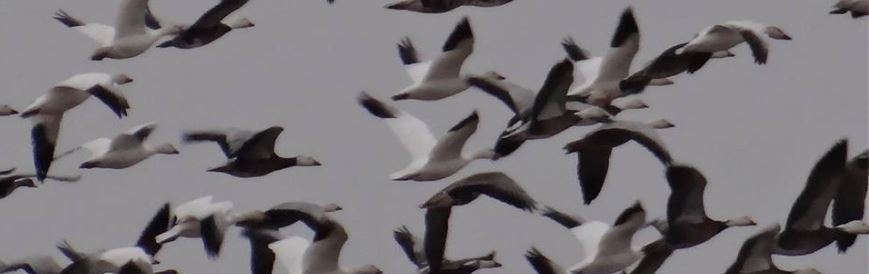
snow geese migration near St Elmo IL, Dave Moody 2What bird is more impressive than the nighthawk as it dive bombs to catch an insect and makes that victorious booming buzz with its feathers when it reverses direction upward again? All you see of it is a dark flash of long, pointed wings or a silhouette high in the sky.

Other realities about the bird are less impressive. It is neither a hawk nor nocturnal, so its common name is inappropriate. Nor does it nest as other birds do but the female lays her eggs on the ground, logs, or rooftop gravel. Here is another case of a bird that does not live up to its billing.

The name may be wrong but the power dive is still impressive. Sometimes the bird is called the “nightjar” and this name captures the fact that a single bird can capture and contain up to 500 mosquitoes in an evening’s work. That makes it my friend, regardless of its mistaken etymology and lack of a decent place to lay its head. After all other people have accomplished much without a place to lay their heads.

We continue our journeys, laying our heads in various odd places. Some places live up to expectations and some do not. Visiting old friends and celebrating their accomplishments does. We visit other churches and often find people who believe in essentials unity, in nonessentials diversity and in all things diversity, or better yet, love. We investigate places where some of our ancestors sojourned in their quest for religious freedom, economic prosperity, or peace at last. Often they had to move on, and we do too.

When we travel there are always lots of incongruities, plenty of disillusionments, and many expectations met and exceeded in any life fully lived. But even if we do not fully live up to our names, if we can catch 500 mosquitoes in one evening and do impressive power dives we must be considered successful.

Gardening as a political act

03 Sunday May 2015

Posted by chaplines2014 in Nature, Yard

≈ Leave a comment

purple butterfly

I’ve spent a lot of time in the garden lately—removing a tree, pruning, cleaning up, hoeing, and weeding. I must admit I feel much better about the world. When chain-sawing a tree into little pieces, it is easy to think about those people who continually call for preparations for war instead of negotiations for peace. When pruning, my thoughts focus on those who constantly reduce funds for human needs, foodstamps, Medicaid, and education, while eliminating taxes for people who already have more than enough wealth for themselves. While cleaning up, I visualize those who cater to the preferences of their multi-million dollar campaign contributors, while the ideals of public service and the general welfare decline. As I hoe and chop and hack, I release my pent-up frustrations with the proliferation of weapons and the innocent or near innocent victims of their abuse. When weeding, the confusion of immediate and temporary profit at the expense of long term environmental degradation and the increasing probability of global climate catastrophe transforms into clarity as I pull up each unwanted and undesirable weed. In the garden, the plants yield to my care and my power, and I can gradually resolve all the problems of the world.

If only.

The garden offers respite from a jungle of unresolvable tangles in the rest of the world. The work releases stress.  Mounting anger and helplessness find their targets in real-world associations, but the result can be constructive. We can exercise a degree of control over the design and cultivation of the garden, as long as we take our steps in small increments that match our limited energy and resources. Keep it small, and we can manage. The larger it gets, and the more subject to weather, pests, intruders, and other unforeseen influences, the more the garden resembles the tangled jungle beyond it. We have to learn to cooperate with the changes that come and exercise our influence with humility.

We learn that politics can shape our garden in small but meaningful ways for the future we want to enter. The garden can become a haven for birds, beneficial insects, butterflies, and the animals that need a home. The garden can match the environment, its water resources and climate-suited plants, and become a testing ground for reducing chemicals, poisons, and additives that reduce the health of the whole. The garden can preserve plants and seeds that provide genetic variety and diversity. The garden can recycle mulches, pavers and walkways, and reduce the waste that we send to the landfill. Food for the picking and beauty for the senses are at hand in the garden.

So many benefits, but none of them offer an escape from politics. Instead they offer a healthy way to reenter them. Just leave the dirt in the garden.

Another Uninvited Intruder

01 Friday May 2015

Posted by chaplines2014 in Forest, Learning from mistakes, Nature

≈ Leave a comment

Tags

A License to Preach, events

Monkeys see, hear, speak no evil, Bangra.comAt Camp Quest in 1963, I was a church camp counselor in charge of an open-sided “hogan” full of junior-age boys. I was 16. Recruiting older folks to serve as primitive camping counselors was difficult; I was recruited in the last days before the camp began. I had a lot of camping experience for a 16 year old, but I was still a green recruit. Getting ready for the night’s sleep, I had not reminded the boys to put their candy or foodstuffs into a suspended container in a tree, away from the hogan.

Campfire over and extinguished, last group walk through the dark woods to the latrine accomplished,  boys and girls separated to their own hogans, boys bedded down, lights out, quiet hour imposed first, second, and third times, we entered into what may have been my favorite part of the day—sleep time. Not to say that spending sixteen active hours with 9, 10, and 11 year-olds wasn’t fun, after a fashion. One of the older counselors, a minister in his fifties with a dozen children at home, said that the slow pace of this camp in its rustic natural setting made this week one of his favorite in the year. He had volunteered for it several years in a row. I wouldn’t have described the camp quite that way, but it was O.K.

That night I woke sometime after midnight, as I often did, and lay on my cot quietly, enjoying the soft snores of my nestlings along with the crickets, tree frogs, cicadas, and a distant whippoorwill, when I also heard some rustling under one of the boy’s cots. The moonlight shone into a corner of the hogan, so it was not difficult to see when I peeked out of my sleeping bag over the edge of my bed. The black fur was nearly invisible, of course, but the white stripe was quite obvious. The skunk evidently enjoyed the treat as it rustled its wrapper, and then moved on to another knapsack to find something equally enticing.

If my prayers with the children up to that moment had been rote, forced, uninvolved, and lame, they gained a new fervency. May none of these boys wake up. May the skunk eat its fill and leave as uneventfully as it came. May the children’s dreams all remain blissful and undisturbed. I don’t know how long I remained in that state of sanctified solicitation, but it seemed like hours. Finally, the skunk moseyed away. I added my thanks and relaxed. When the boys woke up the next morning and discovered that an invader had devoured their candy stashes, I had to tell them what had happened.

I didn’t have any trouble persuading the boys or the girls to put their secreted snacks into the tree storage container the next night. Of course that also meant they had to share what they had hidden away.

When there were No Deer Left in Central Illinois

28 Tuesday Apr 2015

Posted by chaplines2014 in Farm, Nature

≈ Leave a comment

Tags

events, Serendipity

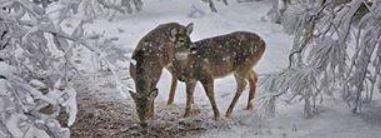
pair of deer in snow

Twenty-one years old and the only deer I had seen were in a zoo and one early morning when I was sleeping with some other guys on the cabin porch at Morgan-Monroe State Forest in Indiana, and a doe came out of the mist to investigate the snores, or something.

Then, according to my father, deer began to show up at dusk at the edge of the woods on the Buck farm, which he leased from the Buck family (hence the name we used). Therefore, every time we visited, we took an evening break to drive the five miles to the Buck farm to see the deer. Although we must have made that trip two dozen times, and my father assured us that he often saw deer emerge from the woods while he was working there in the evening, we never saw the deer.

Then one night, after dark, when I was driving home alone from my summer job, at the speed limit, just a few miles from the farm, a buck deer appeared at the edge of the road in front of me. I didn’t count points on the antlers. A vision of collision appeared before me, and the deer moved into the road in front of me and leaped over the hood of my car, clearing the car completely, leaving me breathless and amazed.

It was worth the wait.

Summer teenager tanager

17 Friday Apr 2015

Posted by chaplines2014 in Forest, Nature, Seasons

≈ Leave a comment

park bench in springA colorful bird, a little smaller than a cardinal, landed in the oak tree near the bee’s nest. Bright red and round-headed, shading to orange then to yellow on its back and underside, its wings were definitely green mixed with gray. His bill was light colored, almost white, concave underneath, and he used it effectively to snag bees. If not for the standard bird shape, I would have thought he was a parrot escaped from the tropics.

He ate his fill before he left, and I proceeded to consult the books. A juvenile summer tanager, they said. When he will reach his full growth, his coat will be bright red with black wings. That I would have recognized, though I would have had to look carefully to distinguish him from his scarlet tanager cousin.

I thought I had seen the last of him, but he made several more visits. Later that day, when I had backed the car from the garage, he flew down in all of his glory and sat on the ground next to the car. I rolled my window down and heard him say, Pik-i-tuk, very quietly, so I tried to say the same thing back to him. Pik-i-tuk-i-tuk, he said, and so did I. Then, quite a bit louder, as if freed by having an audience, he said, Pik-i-tuk-i-tuk-i-tuk-i-tuk-i-tuk-i-tuk-i-tuk-i-tuk. He didn’t seem to mind that I lost track of how many i-tuks he spoke, so we continued talking for a while. He and I had reached an understanding. Day by day he continued to visit, though our conversations dwindled; they never had quite the spark of the first one. Still he seemed to be glad for the contact and the meal.

Perching on a branch near the hive, he practiced his craft, measuring the flight of bees, their speeds and trajectories. First he would dive and miss, or sit with his beak bobbing back and forth in time with the passing bees. Soon his fluttering wings would create “Z” and “W” patterns in the air as he managed to outfly the bees and catch up with them. You could see him learning to strategize his approaches.

I appreciate any friendly contact with an adolescent, and it seemed that having a readiness to listen and try to stay abreast–  so to speak–  with his willingness to talk, or not, was something he appreciated too.

Day by day his color seemed to change, more red, less orange and yellow and green, and darker wings. We watch respectfully the maturation and experience and, we hope, the gaining of appropriate confidence to match the needs of the day. At points we can remember when we’ve been in the same place; at others we understand that they have been where we never have been, and we learn as children from them.

This was more than a bright spot in these days, when other moments were not soright or encouraging. Thank you, God, that you find ways to refresh the spirit! Such grace that a visit from a young summer tanager can fill a person up.

The spirits of the trees

18 Wednesday Mar 2015

Posted by chaplines2014 in Forest, Nature

≈ Leave a comment

Tags

A License to Preach, Serendipity

IMG_1206

Standing in the forest, in winter, the bare branches of the oaks and maples, and the undergrowth dogwood, redbud and sassafras, intertwine in contortions and still barely touch each other. The breeze moves the branches in a thousand directions at once, and still the trees do not scrape or bother each other. They dance and swing, bow and bend.

These are living beings, not inanimate things. Aristotle believed all living things had souls, along with the animists of primitive faiths. So our ancestors worshipped the spirits of the trees. They had a glimpse of something true. The life in such wonderful plants outnumbers us by far, and our health and well-being depends on them.

The trunks stretch and crack. With an ear to the wood I hear the sound of stress and relief throughout the organic system. Doing this, Martin Buber claimed that we can have an “I-Thou” experience with a tree, that opens us to the possibility of Thou within and beyond the self and the universe, divine and exquisite. All I know is that the tree is part of me, and I am in the tree.

The power and weakness of the trees become obvious as they move, from top to bottom. I had thought that the trunk stood still, but look at it stretch and bend! The oldest tree stands most rigid, and that becomes its problem, as its core decays and allows water and air, squirrels and birds to take up residence. Yet even it spreads out tender, youthful extremities, to reach the light and make the air that we breathe, to claim its unique place among the living.

Should it be “I cannot see the forest for the trees,” or “I cannot see the trees for the forest?”

Silent unseen companion

28 Saturday Feb 2015

Posted by chaplines2014 in Forest, Nature, Seasons

≈ Leave a comment

Tags

Serendipity

IMG_0002

My desk sits next to and facing a window, and the only problem with that comes from my tendency to gaze into the woods instead of attending to the project that sits on my desk. On this day I’m glad I looked up when I did. About fifty feet directly in front of me, still in my yard, though my “yard” is all undeveloped forest, I catch a slight movement. It appears to be the twitch of an ear, a rabbit, I think. Then I look closer and see the body lying in the fallen leaves, blending perfectly into the snow covered forest floor in a depression next to an old stump. That is the biggest rabbit I have ever seen! Instead, as I take some minutes to observe, it proves to be a deer. 

She sits silently, motionlessly, except for an occasional reaction to a gust of wind or a wary reflex to a sound nearby. Likewise I am absorbed in meditating on her, as she has chosen to rest mid-morning in such close proximity to my home. She is well-concealed, nearly invisible, camouflaged in color and stillness, and secure in her choice of resting place. 

Not thirty minutes before this I walked around the house, passing just a few feet from her. She must have been there then, but still she stayed. She lies there, and even when I stand to get a better look, she makes no move. Now I know where deer go during the daytime. In the evening we often see them along the road. They leave their tracks all around the house. On a wintry night I have walked outside and interrupted a herd of ten or more nearby, but during this particular day, she is by herself and secure in her secret. If she had not moved so slightly when I happened to look up in her direction, I never would have noticed.  

I have moved enough, and made enough noise, that I know she is aware of me. Once she even stands and looks in my direction, then turns around and moves a few feet, still in view, and lies down again. For three hours, as I work at the desk, she is my silent partner. 

How many times have I missed such a visitor? What am I not seeing now, even as surprised as I am by this one, and as intent on seeing someone or something else? Does the barred owl still rest on this day in the stump nearby? Does the armadillo dig in the loose leaves and make a nest for sleep during this day?  

How hard it is to learn to be observant and sensitive to the world around us! Only by accident do most of us note what is there for us to understand all along. Accelerate the hustle-bustle of our pace, and we miss even more. Slow it to a steady, thoughtful pace, and we at least have a chance to notice. Now I too must move along and do some other work, but her soft, gracious presence has beautified my day. When I return she too has moved on to something else. But, I think, she is still nearby, observing me.

The question of burrowing muskrats

25 Sunday Jan 2015

Posted by chaplines2014 in Farm, Growing up, Nature

≈ Leave a comment

What makes muskrats build domed lodges in the middle of ponds instead of burrowing in the banks at the edge? A friend told me of the problems they were having with muskrats that erode the banks of their pond with their constant burrowing. “Just train them to build lodges instead of burrows,” I answered. The solution is simple enough.

I think about the muskrats of my childhood. We trapped the gentle rodents and sold their pelts for fur. Unlike raccoons, opossums and badgers, no one suggested eating muskrats, and their pelts were a poor value compared to mink and fox. Eventually we just left them alone. One year they decided to reward us by building the most amazing group of townhouses in the middle of our farm pond. Before that they, like my friend’s muskrats, had lived in burrows along the river.

Maybe someone knows how to train muskrats. I don’t. They gave their lodges to us freely, not knowing the gift they were giving. If we had tried to make them build lodges they would undoubtedly have returned to burrows. If we had made an issue out of it, they would have done whatever they wanted to do anyway. Muskrats are like that.

The issue is not what is easiest. Lodges appear to be harder to build than burrows. At least muskrats have a choice. Badgers burrow, and beavers build lodges, but muskrats can do either, depending on the circumstances. A naturalist might explain why they decide to do one or the other. When “our” muskrats chose to build lodges, the riverbanks were still there, still accessible, and the circumstances did not appear any different from usual, yet they worked twice as hard gathering the materials for lodges and constructing them. Was it the “Spirit” that moved them?

If you are having trouble with burrowing muskrats, you must get some of that Spirit. Shooting them is not the solution. Some of that Great Muskrat Spirit is.

The Joy of the arrival of seed catalogues

25 Sunday Jan 2015

Posted by chaplines2014 in Nature, Seasons, Yard

≈ Leave a comment

Tags

Serendipity

It’s January, and the plant and seed catalogues have begun to arrive. Their pages are filled with spectacular specimens that provide a winter diversion until signs of spring actually arrive. I am tempted to order everything so that my yard will be as full of color as the pages of the catalogues. I imagine a large windbreak of Messer Forest spruce and pine on the north side of the house alongside the shade garden, an orchard of Stark Brothers dwarf apple, pear and peach trees on the east side, every kind of Wayside Gardens viburnum, agapanthus, aconitum, heuchera, aquilegia, campanula, coreopsis, echinacea… in the south and east yards, except for the space reserved for the Gurney’s vegetable garden and the strawberry patch and the Perkins rose garden. Our yard isn’t big enough, of course, for any of that. But this late winter break is for dreaming, not working.

Not that there isn’t work to do. The dried stalks of last year’s garden have served their purpose and need to be cut before the first buds of the new season poke their heads through the soil. The stalks have allowed the roots to breathe through the winter’s frozen crust, and they have formed the “architecture” of the winter garden, according to the sages of Victory Garden and HGTV. In reality I just never get around to cutting them until late winter, so I use any excuse for delay.

All it takes is a few warm days in February to encourage the tulips, daffodils and lilies to show up. Their first appearances always get frost bite, but they spur our hopes for an early spring. The winter accumulation of leaves from the oak trees across the street and any other vagabond neighborhood trees must be cleared, along with the candy wrappers and overflow waste from the neighboring yards that get caught in the existing landscape plants. There is plenty to do before the first crocus blooms, but it will surprise us before it all gets done.

Then we will begin again with the trips to the greenhouses and the selection of a few annuals to fill the empty spaces and provide the splashes of color that the perennials don’t provide in the season’s gaps.  We will take a census of the survivors of the wintry tests, and discover what new arrivals the birds have brought and deposited in the soft earth and mulch. Sometimes they have brought visitors that we have not imagined would take up residence here. Then we will resume the weekly hour of prayer and meditation in the yard following the lawn mower in its noisy labyrinth.

I rarely order anything from the catalogues, but that does not make me appreciate them any less. They provide a welcome tour of anticipation through the seasons ahead and relief from the heaviness of winter’s last effects. In similar ways the combination of secular and religious events on the calendar provide a way of marking time until better days arrive. Between Valentines and St. Patrick’s Day, M L King’s and President’s Day, Lent and Easter and Pentecost, there is a mixture of nature and history to keep us moving along in our hopes and imaginations. We count the days with an expectation that something new will break through the old patterns and refresh our spirits and make it possible for us to see with new eyes and hear with new ears and feel with new hearts that God is indeed good…all the time.

← Older posts
Newer posts →

Subscribe

  • Entries (RSS)
  • Comments (RSS)

Archives

  • February 2022
  • May 2020
  • October 2018
  • December 2017
  • November 2017
  • October 2017
  • June 2017
  • April 2017
  • March 2017
  • February 2017
  • January 2017
  • November 2016
  • October 2016
  • September 2016
  • August 2016
  • July 2016
  • June 2016
  • May 2016
  • April 2016
  • March 2016
  • February 2016
  • January 2016
  • December 2015
  • November 2015
  • October 2015
  • September 2015
  • August 2015
  • July 2015
  • June 2015
  • May 2015
  • April 2015
  • March 2015
  • February 2015
  • January 2015
  • December 2014
  • November 2014
  • October 2014

Categories

  • beach
  • Books by Gary Chapman
  • canoeing
  • Caring
  • Cherokee history
  • Church
  • Citizenship
  • Death
  • Disabilities
  • Events
  • Faith
  • Farm
  • fighting fires
  • Forest
  • Garden
  • Growing up
  • Gullibility
  • guns
  • Health
  • Hiking
  • House
  • Innocence
  • Learning from mistakes
  • Life along the River
  • Miracles
  • Nature
  • Patience
  • People
  • Prayer
  • Racial Prejudice
  • rafting
  • Running
  • Seasons
  • Small town life
  • Suffering
  • Travel
  • Uncategorized
  • Vehicles
  • Volunteering
  • Words
  • Yard

Meta

  • Create account
  • Log in

Create a free website or blog at WordPress.com.

Privacy & Cookies: This site uses cookies. By continuing to use this website, you agree to their use.
To find out more, including how to control cookies, see here: Cookie Policy
  • Subscribe Subscribed
    • chaplinesblog
    • Join 71 other subscribers
    • Already have a WordPress.com account? Log in now.
    • chaplinesblog
    • Subscribe Subscribed
    • Sign up
    • Log in
    • Report this content
    • View site in Reader
    • Manage subscriptions
    • Collapse this bar
 

Loading Comments...