• About
  • Celebrating our decades…
  • Welcoming all and inclusiveness

chaplinesblog

~ everyday and commonplace parables

chaplinesblog

Category Archives: Racial Prejudice

Which John Bell?

09 Thursday Mar 2017

Posted by chaplines2014 in Books by Gary Chapman, Citizenship, Events, Learning from mistakes, People, Racial Prejudice

≈ 3 Comments

Tags

Books by Gary Chapman, events, life experiences, Memories, Our Land! Our People!, The Trail of Tears

OLOP Cover Photo 3

John Bell was such a popular name in the 1800’s that hundreds of references to that name show up in southern and Midwestern records. Many can be eliminated as related to one another because of birthdates, locations of death, and other indicators that they are not related to the John Bells that are part of our own family, but many remain single references that are unconnected to any other data.


We began with confidence in our own closest ancestors with that name, the great-uncles and great-great-father who are buried in the family cemetery near New Salem, Illinois. From where did that Great-great grandfather come? There were other Bells and even John Bells in the immediate vicinity and surrounding counties who could be easily disregarded because there were no plausible family connections.


You can imagine my excitement when I found a ‘John Francis Bell’ born in the Cherokee Nation with the same birthdate as the Grandfather John F. Bell, reported by his grandson (our Grandpa Hillmann) to be raised among the Cherokees with twenty-one siblings. Then I found a maternal uncle, James Starr, traditionally responsible for his nephews’ upbringing, with twenty-one children of his own. The name ‘John Bell’ also appeared as one of the youthful protectors (or was it a gang?) of the Cherokee Nation’s eastern border, along with Starr’s own sons and several other relatives and neighbors. These instances provided a connection to a full line of John Bells well-documented in Cherokee records. John Francis Bell also disappeared from Cherokee Nation records in 1848 just after the murder of his father, and just before our John Francis Bell appeared in the New Philadelphia-New Salem area.


It was not the case that the records were entirely in agreement with each other. Sometimes two John Bells in the same Bell family appeared in each generation. John Francis Bell had a younger brother named John Martin Bell. They had an uncle named John Adair Bell who had first cousins named John Bell. Often the middle names were not used in separate records.


John Adair Bell was the most famous among them since he and his brother Samuel Bell signed the New Echota Treaty with the Federal Government in 1835. John Adair Bell led one of the large detachments of Cherokee people in the 1837-38 Removal, usually called the Trail of Tears. Members of the Bell detachment were mostly residents of the ancient city of Coosawattee in Georgia, and John Adair’s father, and his brothers, including David Henry Bell, and David’s son, John Francis Bell, were probably among its numbers. I must add ‘probably’ because no full listing of the detachment members has been recovered, and other circumstantial information has been assembled that points to their presence.


The John Bell who was the grandfather of the grandfather of our grandfather, in other words the father of John Adair Bell, has often been mistakenly identified as the signer of the New Echota Treaty and the leader of the detachment, instead of his son. To add to the confusion, his middle name may or may not be the John ‘Christopher’ Bell, born in Greenville, South Carolina, in May 1, 1782, although that date seems to be firm as the grandfather’s birthdate, so I will use that name for the sake of identification. John C. Bell married Charlotte Adair, the mixed Scot and Cherokee daughter of John Adair (the founder of Adairsville, Georgia), and their children included John Adair, David, Samuel, and Devereaux Jarrett, as well as several other well-documented men and women.


John C. Bell’s 1842 Registered Claim clears some additional confusion about his life. He gives reasons for his 1833 move from Coosawattee to Alabama, where his brother Francis Bell was residing in that part of the Cherokee Nation, and the claim clearly indicates that John C.  Bell was ‘white,’ although his family is Indian. John C. Bell is a member of the Cherokee Nation because of his marriage to Charlotte, not because he was born into it. The Georgia legislature’s claim on John C. Bell, later declared unconstitutional by the Federal Court, was a claim on him as a white man and citizen of Georgia. This is interesting because many Cherokee records, dating from around 1900, claim that John C. Bell was half-Scot and half-Cherokee, like his wife. They often say that John C. was the half-blood son of John Bell, the Scotsman, who married a Cherokee woman of the Deer Clan.  This would make John C. commit incest, according to Cherokee tradition, when he married Charlotte Adair, who was also a member of the Deer Clan. I account for this lapse in Our Land! Our People! with the documented incidents later when families in the next generation disregarded clan membership when marrying, as the clan system was breaking down, and people were adopting the English familial system and different definitions of incest, but there was no corroboration of this with regard to John C. Bell and Charlotte Adair, and it is more likely that people later just got confused about which John Bell was which. John C. Bell, a Scot, married a woman of the Deer Clan, Charlotte Adair, and their children, observed the clan traditions and married spouses of the Wolf Clan, or other clans that were not Deer. John C. Bell’s father may have been named John Bell, or he may have been another David Bell; this is where the lines become unclear again, but neither married a Cherokee woman.


If I were to rewrite Our Land! Our People! I would consider John C. Bell as a full-blooded Scotsman, still with his Scot accent, who was one among several men who married Cherokee women and were adopted into the Nation. He was a well-known traveler, trader, farmer, and blacksmith who fell in love with a Cherokee woman, who was the daughter of another well-known Scot trader and traveler, John  Adair. That was enough of a challenge for their lives at the time without the additional burden of an accusation of incest.


It would have been a lot easier if there were not so many ‘Johns Bells’ in and out of the family.


Where Was Chicken Trotter and When?

24 Friday Feb 2017

Posted by chaplines2014 in Books by Gary Chapman, Cherokee history, Citizenship, Death, Events, Learning from mistakes, People, Racial Prejudice, Small town life, Suffering, Travel

≈ 2 Comments

Tags

Books by Gary Chapman, events, life experiences, Our Land! Our People!, Serendipity, The Trail of Tears

OLOP Cover Photo 3

Recently I was presenting Our Land! Our People! at the Talbot Library and Museum in Colcord, Oklahoma. I did not expect to find much in the little town of Colcord, Oklahoma, but I was wrong. Talbot publishes some significant works on Cherokee history, and their facsimile editions of the 1843 Claims were illuminating on the John Bell family in several respects. For the first time I could actually see the English and Cherokee handwriting of four key family members—John Bell, the father, and three of his Bell sons—John Adair, David Henry, and Devereaux Jarrett (better known as Chicken Trotter).

The 1843 Claims record unreimbursed losses prior to the Cherokee Removal in 1838-39, usually due to thefts or confiscations of property by non-Cherokee white men. They were submitted to recover those losses, and they had to be witnessed by at least two other reputable citizens. The Bells served as reporters of their own claims, witnesses to others, and, in the case of Chicken Trotter, an official recorder of several dozen claims by others.

Chicken Trotter’s reports are some of the clearest and most beautifully written in all of the volumes. Deciphering other writing was sometimes impossible, but “D. J. Bell” provided some of the best. That surprised me, because in other places he is recorded by the simple notation “his mark,” and I never found evidence that he had attended any of the Cherokee schools. It is no wonder that he didn’t sign his work “Devereaux Jarrett” but “D. J. Bell” works well, and there is no competitor for the use of those initials among the Bell family. David Henry Bell would be “D. H.” and he just signed as “David Bell.” As these claims were recorded in the first few months of the year, there was enough time for Chicken Trotter to get back to Texas in order to work with Governor Sam Houston to conclude the Treaty of Bird’s Fort on September 29, 1843, which ended the four years of conflict between the Texas government and several tribes. Conflict followed the second Texas governor, Mirabeau Lamar’s attempt to eradicate the native population. Sam Houston, the first governor, an official Cherokee himself,  had tried to grant reservation status to the Cherokees among others. From one administration to the next, the policies reversed from welcoming people of different cultures to trying to destroy them, and back again.

Chicken Trotter, according to the records of the Texas Cherokee population, had come to Texas during the mid-1830’s, when Chief Duwali (or Bowle, as he was also known), led the tribe. They were and continue to be located in Rusk, Cherokee and Smith Counties, as the areas are known today. When in 1839 Governor Lamar and the Texas militia killed Duwali and at least half of the tribe in a genocidal attack, Chicken Trotter soon became one of the remaining leaders.

Because of the Texas Cherokee account I rewrote Our Land! Our People! removing Chicken Trotter from Alabama, where his father lived, and from the Bell Detachment on the Trail of Tears, and putting him in Texas through the late 1830’s. After publishing, I found evidence that Chicken Trotter served his brothers in the Bell Detachment as a treasurer paying bills along the route. If he accompanied the group the whole way, he was travelling to Indian Territory from September 1838 through early January 1839, before returning to Texas in time to be in danger during the massacre of Duwali and the Cherokees in July.

When a group of Cherokees, including John Adair Bell and David Bell travelled to Texas in September and October of 1845, accompanied by the diarist and newspaper reporter William Quesenbury, they visited the northeast Texas Cherokee settlement, and Chicken Trotter was there leading the group, having established a community farm, including watermelons and pumpkins as Quesenbury notes, because some of their horses got loose and tore up the patch.

In 1848, Chicken Trotter was again in Indian Territory, joining his brother Sam and other Cherokees planning a journey to California to prospect for gold. Sam died on the way but Chicken Trotter and his wife Juliette got there before returning to their people in Texas a year or so later. There is no record about his success or failure in finding gold.

Chicken Trotter was a busy man, travelling back and forth quickly in days when travel was difficult. Maybe that is how he acquired his name.

Considering Social Security

06 Monday Feb 2017

Posted by chaplines2014 in Citizenship, Growing up, Innocence, Racial Prejudice

≈ Leave a comment

Tags

Carl and Bessie- True Friends, life experiences, Memories


farm windmill

In the 1960’s our visits with our large extended family became rare. We lived at least fifty miles away from most of them, my parents were both working full-time, my brothers were away starting their careers, and I was busy with my school and extra-curricular activities. The three of us, my parents and I, did regularly go to see Grandma and Grandpa Warfel. That is when I learned how politically interested my grandparents were, Grandpa vocally, Grandma less so. I listened. They talked. Prohibition was Grandma’s prime concern in several conversations; Social Security was Grandpa’s. They teased about cancelling each other’s votes when they went to the polls. It was a common tease; they usually agreed about their votes.


Grandma had been a long-time member of the Women’s Christian Temperance Union. She began to become senile in those years, before she was 70, much to everyone’s surprise, because she was a loving, intelligent woman who kept track of everyone and everything. Soon thereafter Grandpa’s bottle of wine began to appear on the kitchen counter.


Grandpa had to begin making Social Security payments in 1954, when the law was extended to farmers. He resented paying into a fund that he didn’t expect to collect, ever! His method of preparing for old age, since he didn’t believe in banks, was to stash money in hiding places. When he died of a stroke in 1971, at the age of 81, his family found tens of thousands of dollars hidden in various places in his house.


During our visits he railed against Roosevelt and Social Security. It would surely run out of money before most people got to collect anything, since the fund started from zero, people collecting from the first more than they ever paid into it, and it would run out before those who had paid their whole lives ever got to collect a penny. He was especially concerned for his children and grandchildren, since they were the ones who would be left out. That’s why he wouldn’t collect anything, on principle, since he had paid into it so few years, even though he didn’t want to be forced to pay anyway. The government should just stay out of people’s private business. My father encouraged him to go ahead and collect it, after he reached the age of 72, which was 1962, since everyone else of his age was doing so, and his refusal to collect wouldn’t do any good for his children and grandchildren anyway. Eventually Grandpa did collect, receiving from it as many years as he paid into it, and quite a bit more than he paid into it, as it turned out. When he died, and Grandma had to enter the nursing home for day and night care, due to her dementia, the Survivor’s Social Security check went far in helping to pay for her care for the remaining three years.


There were many other issues that bothered him. He did not believe in street demonstrations, but the mistreatment of Negro citizens was criminal in his opinion, and the laws were late in coming to their aid.  He hated the KKK, and proudly spoke of Grandma’s defense of their young family, with a shotgun even (!), when the KKK in Jasper County threatened her while he was away working for his brother in Champaign County. They were recruiting and threatening neighbors who didn’t volunteer to join. He and Grandma soon moved to Champaign County. As Grandma descended into senility, she again imagined people sneaking around her house and trying to break in.

He was a “Lincoln Republican,” he often said, and he understood that Republicans believed in civil rights in contrast to Democrats. Republicans had passed the key amendments to the constitution that guaranteed equality, that his father, John Dougherty Warfel, had fought to win in the Civil War. Grandpa brought out the gun that J.D. had used, to show me, and the photos of J.D. and his brothers Uriah and Philip Warfel in uniform. He was glad Eisenhower had backed the effort to desegregate the schools in the South. It was a suspicious alliance between Northern and Southern Democrats that prevailed in the 1960’s; he didn’t trust it to last or accomplish anything good for the people.

The Nightmare of Talking Money

04 Saturday Feb 2017

Posted by chaplines2014 in Church, Citizenship, Events, guns, Learning from mistakes, People, Racial Prejudice, Words

≈ Leave a comment

Tags

events, life experiences, Synchronicity

dock at sunset

The nightmare began when the court declared that “money is speech.” It was a variation of the old saying that “money talks.” The door opened for many wealthy people to set up and use pseudo tax-exempt non-profit organizations to take part in partisan campaigns. Then that idea spread into the churches. Individuals who wanted to endorse candidates for office funneled money through tax-exempt churches for partisan support, expanding the cash available that was unreportable and unaccountable to public interests. This was all in the name of the First Amendment.

A candidate appeared who had his own wealth, who could go where he wanted, stay where he wanted, and say what he wanted. He lied often, long, and loudly, and captured an extraordinary share of media attention with his outrageous antics, and he didn’t need to raise funds from anyone else in the ordinary course of campaigning. Wealthy people could go elsewhere and spend even more to prop up candidates who would do their bidding and who would be accountable to them personally. The singular wealthy candidate was just another form of “money speaking,” since he could not only use his own resources, but he could use his unusual platform to increase his own resources without needing to answer to anyone else, reveal his conflicts of interest, or follow the customary ethics of transparency and disclosure. His party shielded him from investigation and exposure of foreign entanglements in the hope that they could carry out their own platforms of experimental political change and revolution while he was in charge.

The candidate pretended to be the voice of common men overlooked and ignored by the rapid transformations of global economies. Wealth sought the cheapest labor and the highest rates of return without regard to the public interest where goods were manufactured or where they were sold. His decisions, once he was elected, simply cleared the way for more aggressive domination of the multitudes by moneyed interests. Money continued to talk with a louder voice. Soon it was understood that speech was not free in any form, not in the press, not in electronic media, not in the Internet, who were all controlled by a small concentration of special interests. The old principles of the First Amendment were hollow. Personal freedoms were identified with the freedom to force others to obey the conscience of the person who chooses to discriminate, instead of the freedoms of the person who is the target of discrimination. People with money had the freedom to oppress people without money.

The only Constitutional Amendment that would could not be abrogated in any form was the Second Amendment, and the more weapons and the more powerful weapons that one possessed, the more political power a person had. The resulting condition of a heavily armed population was neither “well-regulated” nor controlled by any police or military force serving the common interest. Private military units and paid bodyguards became the norm for those who could afford them. The random, careless, and accidental use of arms to injure and kill accelerated to become the leading cause of death among all people. People had developed the habit of scapegoating strangers and different ethnic groups; finally they turned on each other, neighbor against neighbor.

Society descended into chaos. The social contract was broken. What began as the security of wealth became the reinstatement of the “law of the jungle,” and life returned to being the “nasty, mean, poor, brutish, and short” life (as Thomas Hobbes had described it) of the “good old days.”

These were thoughts of the middle of the night when the mind entertains what darkness hides. The dream does not have to end this way. The creative mind can move the ending in another direction entirely as the day dawns.

Plunging Into Detroit, 1966

30 Monday Jan 2017

Posted by chaplines2014 in Church, Citizenship, Events, Faith, Growing up, Gullibility, Innocence, People, Racial Prejudice, Travel

≈ Leave a comment

Tags

Community Development, events, life experiences, Life in the City, Urban Renewal

bethel-mbc-photo

In the late 1960’s the “urban plunge” was an experience recommended to those who had not lived in an urban area or who had lived in a privileged area and had no direct experience of how the “other half” lived. The Methodist Student Movement was sponsoring a conference in Detroit in the summer of 1966. I was president of the MSM chapter at Illinois Wesleyan University, a farm kid, and I decided to go to the conference and, unknown to my parents (I was 19 after all.), expand that experience with an urban plunge.

Central Methodist Church, located on Grand Circus Park, hosted the conference, and several local leaders—professors at Wayne State University, political leaders, corporate leaders, and the president of the United Auto Workers, Walter Reuther—spoke to us, addressing the urban issues of the day. Reuther was particularly impressive, laying out the challenges to the auto industry, fully integrating the workforce, and expanding the base of unions internationally; he predicted the eventual decline of domestic industry, the unions, and the urban centers in the face of global competition, since people were not preparing for it.

Outside of the conference some of us wandered around and lived on the streets of Detroit. Much of the housing in many neighborhoods sat empty and decrepit. The immense Ford Rouge Plant stood empty. Segregated housing was the rule, and public services for the older neighborhoods were often scarce. I always walked around with one or two other friends from the conference, and we slept on park benches or in abandoned houses, and went to soup kitchens and day labor hiring centers. I never had more than a few dollars on me and dressed like I didn’t have much, which, of course, I didn’t. It was one of the richest experiences of my life, meeting people on the street—the veterans who had lost their way, the guy with an armful of watches that he would sell me, the children who begged during the day and turned their money over to an adult at the end of the evening, alcoholics, drug addicts, musicians and street artists, philosophers, people of all kinds. Throughout the weeks there I perceived no threat, other than the rodents and dirt of the streets. People were friendly, curious about us (We were college students here for a few weeks of the summer just to learn what we could.), willing to talk about their own lives, frustrations, and hopes. I discovered that all of these people were a lot like me under the skin. I could learn from them, but I had little to teach. That was the summer before the Detroit riots of 1967, and I wondered how poor people managed to live in the city, knowing they had no other home to go to.

One day a female friend and I got cleaned up and dressed up and went to a new high-rise apartment building in the urban renewal area just north of the downtown. We pretended we were a newly married couple looking for an apartment. The apartments were plain, small, and uninviting, and we finally had to admit to the nice woman who showed us around that $1000 a month was above our means. I couldn’t see how or why anyone would afford such a rental. Obviously most of the people we were meeting could not. We ate that evening at a Greek restaurant, spending some of my money hard-earned from loading and unloading trucks for a couple of days. We sat and watched as people came and went, finding or leaving something hidden behind the refrigerator that sat just outside the kitchen, but not staying to eat a meal.

I searched for the church that Rev. Reinhold Niebuhr had served for 13 years that had ended forty years before—Bethel Evangelical Church, two miles west of the downtown on Grand Avenue. What would be left of the German working community he served? It had become an African-American working community, and the building continued to serve, renamed Mayflower Missionary Baptist Church. I didn’t imagine at the time that I would eventually serve old German Evangelical Churches that looked a lot like it.

It is still hard to say exactly how those days in Detroit changed me, but they did. I was humbler, needing much less, but also less confident in my own ability to find any kind of success on my own. Anything worth doing had to be done together.

Responding to the Kerner Commission Report

27 Friday Jan 2017

Posted by chaplines2014 in Caring, Citizenship, Events, Faith, Growing up, Gullibility, Learning from mistakes, Racial Prejudice, Small town life

≈ Leave a comment

Tags

A License to Preach, events, life experiences, Memories, Serendipity


hot-owl-southern-white-faced-owl-in-botswana-trying-to-keep-coolAgain in the last semester of my senior year, the Illinois Wesleyan Political Science Department gave two other students and me another opportunity to represent the school at a special gathering, the annual Public Affairs Conference at Principia College. (By that time I was also taking the first political science course of my college career.) The conference theme was “Combatting Racism.”


The agenda of the conference included a variety of experts. The immediate background of the theme was the February 29,1968, release of the Kerner Commission Report, formally called the President’s National Advisory Commission on Civil Disorders, which branded racism as the primary cause of the surge of riots that had recently swept several major American cities. It was the conference objective to consider and design programs and laws that would reverse the separation of America into two racial cultures that were separate and unequal. It was an ambitious undertaking, especially considering that minority groups were barely represented among the participants.


With the division into working groups, I found that my group had one young eloquent black man. He dispensed with the group assignment with the observation that we could imagine many fine ideas for state and federal action that would go nowhere. Instead, we could design goals for ourselves working in the families and communities in which we lived, and these might have some chance of accomplishing something if we were courageous enough to follow through. I was hooked, and so were the other members of the group. Around the circle we considered the actions and processes that would disturb the racism that prevailed where we lived. It was not comfortable, but it was real.


I had grown up in a northern community that was thoroughly segregated, even though it was only a few miles from Chanute Air Force Base. Air Force families of many racial backgrounds lived off-base, but only white families lived in Paxton, where people still boasted a “sunset law” that threatened any darker-skinned person who might be caught there after sunset. I had spoken about racial justice in the few sermons I was invited to preach in my home church, but I had not approached the members of the Paxton City Council that I knew, who had it in their power to renounce the “sunset” idea and prepare the town to be open to all.


Black friends lived in neighboring towns, but they would not risk coming to Paxton, even to take part in such common activities as bowling, seeing a movie, swimming, or roller-skating. I was welcome in their homes to eat meals and enjoy their company, and they were welcome in my home, which was miles from town in the countryside. The town’s segregating attitude had to change. That would change, I was confident, as the months went by.


We resolved to implement the plans we made.  The other groups reported ambitious government programs that would take large scale political action. Our group’s report seemed pale and meager in comparison. In hindsight, few of the ambitious goals that were formulated there, or in the Kerner Report, came to be embodied in actions in the decades that followed.


I returned to my home town and approached the public officials that I knew. To a one, they thought it was “too soon” or “too radical” to do what I was suggesting. Furthermore, the time for me to do the organizing that was needed even to accomplish such a modest goal was short, as I was preparing to marry and begin my graduate education in Chicago. There, in Chicago, I would learn what life in an integrated community was like, and how deprived my own background had been.


Fifty years later, returning to Paxton, finding a mix of people in the school system, working in the businesses, and living in the town, I wonder why it took us so long, and why we still have so far to go. There is still a lot of room for both large-scale and meager goals and the courage to embody them.


Moral Man and Immoral Society Reread

02 Monday Jan 2017

Posted by chaplines2014 in Citizenship, Faith, People, Racial Prejudice

≈ Leave a comment

Tags

life experiences, Memories

hot-owl-southern-white-faced-owl-in-botswana-trying-to-keep-cool

It was 1968, for the last semester of my senior year at Illinois Wesleyan, and I requested permission from Paul Bushnell, the head of the history department, to join the senior seminar in history. That would not be surprising, but I had never taken a history course at IWU, except the History of Christianity that was taught in the religion department. My theory had been, “Why take a course in a field that was my hobby anyway?” Paul Bushnell invited me into the seminar.

He knew what I intended to do, which was to study as much of Reinhold Niebuhr’s writing as possible, leading up to his 1932 work Moral Man and Immoral Society. Another course had required the reading of that book. My interest was to trace the historical sources of his insight, that there is a “basic difference between the morality of individuals and the morality of collectives” that makes it exceedingly hard for groups to check impulses, transcend their own needs, comprehend the needs of others, and restrain their own egoism. He did not imply that this is easy for individuals, just that it is much harder for groups.

The method for the course began with collecting every essay Niebuhr had written before his book was published, and many afterwards, since 1932 was just the beginning of his application of the insight into the development of the Third Reich. In addition to English, as a German reader and writer, his awareness of German developments exceeded most of his contemporaries. I had not even begun to read German yet, so I had to rely on others’ translations of his German essays. The library of the University of Illinois was nearby, and their collection provided over a hundred essays that I could not find elsewhere, as well as a photocopier that worked, and I emptied my wallet making copies.

I was lost in a forest of insights. How could a pastor, occupied with the needs of his Detroit parish, find the time to delve so deeply into the social conditions of his nation and his world? Some relief came with the personal reflections in Niebuhr’s Leaves from the Notebook of a Tamed Cynic. Niebuhr was human, after all. He was also totally immersed in thoughtful analysis of “the disproportions of power in society” and “the stubborn resistance of group egoism to all moral and inclusive social objectives.”  People hold onto their prejudices, hypocrisies, and dishonesties, and use them to justify the privileges they enjoy or seek. The powerful are more likely to be personally generous with a portion of their wealth than to grant structural change for social justice.

Essay by essay Niebuhr built a catalogue of social wrongs from police suppression of labor demonstrations, to legal and extra-legal racial discrimination, to Nazi scapegoating of Jews, Romani, and “non-Aryans.” He was a persistent witness to the continuing struggle of one group or class of people over another, seeking vengeance and employing vindictiveness in repositioning themselves, and using any and every means to justify their actions, even from a moral point of view. “Society needs greater equality, not only to advance but to survive….”

Occasionally I look over that dog-eared collection of essays and that most popular book that summarized them all, with its many underlined passages. Circumstances and characters have changed; in significant ways they remain the same. How contemporary the insights appear.

The Group Called ‘Us’

22 Tuesday Nov 2016

Posted by chaplines2014 in Caring, Events, Growing up, People, Racial Prejudice, Small town life, Volunteering

≈ Leave a comment

Tags

Community Development, life experiences, Memories, Names and Titles, Serendipity

cropped-circledance.jpg

I didn’t learn how the group got started. When I joined them in the fall of my senior year in college, in 1967, they included a mixed racial group from Bloomington and Normal, several men and women, working a variety of jobs, laborers and professionals, a few Illinois State University professors, never more than a dozen people at any meeting. They met to talk about the issues of race and class in those Twin Cities and to identify and participate in actions that might improve those relationships. The era of street demonstrations seemed to be ending, and some of these people clearly had been involved in that kind of action, but they were looking for other things to do.

I had first met some of them when we demonstrated against a dentist at the edge of campus, who would not serve an African-American client. At the edge of campus yet! The obvious place for students to go if they were having a toothache! She invited me to come to a meeting of ‘us.’

They never had a name. They didn’t seem to have or be an organization. As usual some people were more vocal than others, and they spoke respectfully to each other, even when they disagreed about what they should do. When they decided to do something, they went ahead with those who were ready, even though not everyone ever took part in everything they did. They were simply ‘us.’

They talked about education and they placed books and articles in accessible places and took part in forums. They talked about legal actions and involved some lawyers. They talked about electoral politics and recruited a candidate for alderman. That’s where I found a place, canvassing neighborhoods for the candidate for alderman. Bloomington had never had a black alderman. They didn’t succeed in that campaign, but it set the stage for another try, which was successful.

I remember going house to house, having the door slammed in my face by some white folks, given a respectful but distant hearing by some, and welcomed by a few. (It was good experience for ‘cold calling’ on behalf of a church and its message.) Mostly I remember the houses of black and Hispanic folks. In those days, when we came to their doors, my fellow-canvasser and I were welcomed. So much so, that often we were invited inside to sit at table, and our hosts offered us something to eat. At noontime, instead of a reprimand for interrupting their meal, we were offered a dinner, and such a dinner it was! Stereotypical as it may sound, fried chicken, greens, home-baked bread, applesauce, and hominy were on the menu that day, and I didn’t mind any stereotypes at all as I enjoyed it.

When I think of Thanksgiving, a number of such events come to mind, but none more gracious than that one, nor as promising of a better future.

To Be Called a Muslim

14 Wednesday Sep 2016

Posted by chaplines2014 in Faith, People, Racial Prejudice, Words

≈ Leave a comment

Tags

A License to Preach, Names and Titles


Circledance

65% of Republicans think President Obama is a Muslim, according to a recent headline. Since I first met President Obama (when he was State Representative Obama, and he was regularly attending the same church I was attending that day) at Trinity United Church of Christ, the same denomination that ordained me as a minister, I knew at the outset that he was officially and formally a Christian, even though his name had a Muslim heritage. ‘Barak’ was the great steed that carried Mohammed into heaven in his vision at Jerusalem, and ‘Hussein’ has many associations, for better and worse. ‘Obama’ suggests Africa, and could be Muslim or Christian in Kenya. (My name on the other hand suggests a peddler of trifles or cheap books, or a barbarian tribal warrior. Neither seems to have handicapped me or determined my destiny.)

The other part of calling someone a Muslim is the significant meaning of the words ‘Muslim’ and ‘Islam,’ which derive from the definition of “one who submits to Allah” with Allah being the name for the One God. The God referred to is the God of the “people of the Book,” that is, the Bible, before it came to include the Koran. The title is therefore an honorific title as well as an aspiration for those who accept it. If someone were to call me a Muslim, I would consider that an honor, knowing what I have studied about Islam and the faithful Muslim people that I have known.

On the other hand, ordinarily, to be a Muslim is to accept the Muslim creed, that there is only One God and Mohammed is a prophet of that One God, although that One God has many names according to God’s many attributes. To use the title of prophet for Mohammed puts him in the company of an impressive historical, and from my perspective, some ahistorical characters, but they include Abraham, Moses, Elijah, Isaiah, Mary, and Jesus, among other lesser figures like Jonah and Job. Does Mohammed deserve the recognition that places him in that company? Traditionally many Christians have said no, but that is without assessing what Mohammed accomplished. Mohammed converted scores of Arabian tribes from paganism and idolatry to monotheism with all of the moral dimensions that traditional monotheism entails, not a small or unimpressive accomplishment. When he finally had the opportunity to utterly destroy his opposition, who had so often attempted to kill him, he offered mercy and forgiveness. Unlike most of the prophets who spoke to power, but had little of their own, at least in earthly terms, Mohammed was able in the last years of his life to exercise a great amount of political power, and he did so with some admirable accomplishments as well as some judgments that were more problematic, not unlike some of the wisest leaders the world has known. The title ‘prophet’ seems to apply to him at least as well as to most of the others.

I grew up in a Methodist Church, recognizing that the title ‘Methodist’ was first used of John Wesley as a pejorative, ridiculing the disciplined and ordered life that he espoused. I never lived up to that name, nor would I confidently describe myself as a Muslim, in the tradition of those who have fully lived out the meaning of that name, but I sure would like to be.

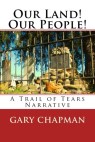
Our Land! Our People! A Trail of Tears Narrative

01 Friday Apr 2016

Posted by chaplines2014 in Books by Gary Chapman, Cherokee history, Faith, Growing up, Racial Prejudice

≈ Leave a comment

Tags

Our Land! Our People!, The Trail of Tears

OLOP Cover Photo 3

Our Land! Our People! A Trail of Tears Narrative
is now  available from:
https://www.createspace.com/6014646
Amazon.com by title
and…
Burlington By the Book

← Older posts

Subscribe

  • Entries (RSS)
  • Comments (RSS)

Archives

  • February 2022
  • May 2020
  • October 2018
  • December 2017
  • November 2017
  • October 2017
  • June 2017
  • April 2017
  • March 2017
  • February 2017
  • January 2017
  • November 2016
  • October 2016
  • September 2016
  • August 2016
  • July 2016
  • June 2016
  • May 2016
  • April 2016
  • March 2016
  • February 2016
  • January 2016
  • December 2015
  • November 2015
  • October 2015
  • September 2015
  • August 2015
  • July 2015
  • June 2015
  • May 2015
  • April 2015
  • March 2015
  • February 2015
  • January 2015
  • December 2014
  • November 2014
  • October 2014

Categories

  • beach
  • Books by Gary Chapman
  • canoeing
  • Caring
  • Cherokee history
  • Church
  • Citizenship
  • Death
  • Disabilities
  • Events
  • Faith
  • Farm
  • fighting fires
  • Forest
  • Garden
  • Growing up
  • Gullibility
  • guns
  • Health
  • Hiking
  • House
  • Innocence
  • Learning from mistakes
  • Life along the River
  • Miracles
  • Nature
  • Patience
  • People
  • Prayer
  • Racial Prejudice
  • rafting
  • Running
  • Seasons
  • Small town life
  • Suffering
  • Travel
  • Uncategorized
  • Vehicles
  • Volunteering
  • Words
  • Yard

Meta

  • Create account
  • Log in

Blog at WordPress.com.

Privacy & Cookies: This site uses cookies. By continuing to use this website, you agree to their use.
To find out more, including how to control cookies, see here: Cookie Policy
  • Subscribe Subscribed
    • chaplinesblog
    • Join 71 other subscribers
    • Already have a WordPress.com account? Log in now.
    • chaplinesblog
    • Subscribe Subscribed
    • Sign up
    • Log in
    • Report this content
    • View site in Reader
    • Manage subscriptions
    • Collapse this bar
 

Loading Comments...