Because of a car with an eagle on the hood…

Tags

, ,

3 Owls

The young man was two years out of high school, making a high wage as he worked in construction on the Clinton nuclear power plant, and proud of his shiny new black Trans-Am with the large eagle design on the hood. He was a brash and mouthy country boy, which was understandable. He was young, energetic, with pockets full of cash, and he came from a small town not noted for open attitudes.

Two young men, about the same age, drove down from Chicago, looking for work, but not finding. They filled out applications, but knew they were filed away at best, often just tossed into the waste can. They had more wishes than experience, and their references were not spectacular. Their car was an old beater, barely held together by Bondo and wire. They were as brash and mouthy as the first young man.

They were on a collision course, randomly, to all appearances, not by clear intent, and they had more in common than they knew, except that one had a good paying job and the other two did not. No one witnessed the event itself. We could only imagine what was said, by whom. It was in Champaign, Illinois, outside a bar. None of the three was operating with his best behavior. Prejudices and resentments fueled their encounter.

A telephone call came to me soon afterward. Would I officiate at the funeral of a young man, killed in an angry altercation, his “pride and joy” car stolen? They didn’t know who had done it, but they had ideas. A neighbor had recommended that they call me. I didn’t know any of them, but I said “yes.” They needed someone.

There was a mob at the funeral, filling the mortuary chapel and its overflow spaces. The directors had “never seen such a crowd,” they said. The young man was well-known, if not always well-loved. Grief held center stage, but it was surrounded by a cast of anger, hatred, and fear.

After conversations with his family, I had plenty to say that appreciated his life and work. I noted the absurdity of dying because of one’s proudest possession, and I named the encounter as a tragic and devastating loss for everyone concerned. I represented a “Savior who died for all,” who loved each person, understanding the mixture of guilt and good that is in each one, and who can be trusted to take what we are and to shape it for  a better world to come. It was too early to expect anyone to understand a call for forgiveness. What did they need to forgive in the young man who was murdered? How could anyone ever forgive the murderers? Mostly the crowd was silent afterward. A few made the special effort to say that they heard what I was saying. Much later, a man said that it was the one sermon that he remembered and pondered.
The Appalachian Trail–Seeing the small things

Tags

,

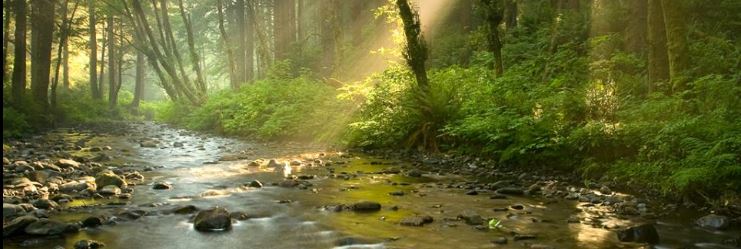
Rock Creek Wilderness, Oregon

Hiking a mountain trail brings to mind distant stunning and beautiful vistas, but smaller sights near at hand can also impress. A tree-shaded slope covered with ferns as far as the eye could see was my first unforgettable vista. On another slope bright red strawberries were growing everywhere; being wild they didn’t have much flavor, and the fact that they were overgrown by a beautiful three-leafed, red-stemmed vine also made me wary to enter the patch.

Look closer and you see the varieties of color in wildflowers, each adjusted to different altitudes in the landscape, and in a seasonal succession. Trillium in red, purple, pink, yellow, and white, in various sizes, some as large as a foot and a half across, are always easily identifiable. The daisy family is well-represented almost everywhere. Others need that reference book that is too heavy to carry on a long-distance hike. What was that 1 ½ inch, four-petaled, red blossom with a yellow center, that stood on a four feet tall stalk, with leaflet whorls every eight inches? I don’t know, but there were a lot of them half-way up Burnett’s Mountain.

The lichens that make their homes on boulders are as impressive on a miniature scale as any multi-acre landscaped garden. Every color is represented in the microcosm, and the boulders appear to be covered with these multi-colorful furs, velvet black underneath where something has peeled a section loose.

From a distance we saw what looked like a kindergarten of plastic children’s toys. The objects were perfect primary colors of red, orange, yellow, green, blue, and purple, in rounded and flattened shapes. As we came closer we saw that they were varieties of mushrooms clustered in this one damp, warm area. We just stood and looked at them in amazement.

The birds deserve attention in the arena of smallness, though the vultures, hawks, owls, and falcons are often sizable. The birdcalls of early morning resonate throughout the woods like an orchestra. Most of the sounds then and throughout the day remain nameless to my untutored ears. Bluebirds, tanagers, pileated and downy woodpeckers, grosbeaks, and warblers were easy enough to recognize, when we took the time to look at them.

A copperhead was the only snake we saw on several trips, though he had been sunning himself on a forest service lane, run over by a truck, and appeared to be dead. We didn’t check too closely. My notes make mention of only one insect—a two inch long, one inch wide, black beetle, that rooted and dug into the ground at every foot of its course, as if surveying the ground; it was headed away from our tent, and I was grateful.

June 22, 1839, at James Starr’s Farm, Western Cherokee Nation

Tags

, ,

  Cherokee Nation laurel and star

 James and all the men of the household were in the hayfield, cutting and forking hay into stacks in the late Saturday afternoon, when Caleb Starr drove his horse at a fast pace up the path in his carryall. Drawing near James he waved his arms for everyone to come near, looking grave and saying nothing in greeting. The boys—family and slave—stripped to their waists and covered in dust and sweat drew close to the grandfather.

“I want everyone to hear this together,” he said, waiting until the farthest workers had hurried near before continuing to speak. “Major Ridge was murdered this morning just a few miles north of here at Rocky Creek.”

James staggered and slowly lowered himself to the ground. A chorus of exclamations and questions followed—Why? Who did it? Why him? Why now? What were they trying to prove? Is Ross behind this? While Caleb continued to sit on the carryall seat, the rest of them sat on the ground around James and waited for their Grandfather to tell them more. He cleared his throat and remained silent for a finger of time.

“I don’t know much. The Major stayed overnight at Ambrose Harnage’s cabin at Cincinnati. He was heading south to Van Buren to check on the slave Daniel. Daniel had fallen ill after Major sent him there on an errand,. The slave boy named Apollo was with Ridge; he’s about your age, Will.  The boy said they were crossing White Rock Creek when several shots rang out, Ridge slumped in his saddle, and then toppled off. When he saw that Ridge was dead, he high-tailed it to Dutchtown, said Ridge had been shot and killed, and he needed help.”[i]

“Poor fellow was probably scared to death,” interjected Sam.

“I suppose so,” Grandfather Caleb continued.  “I don’t know for sure but I think this be an execution for Ridge’s signing the treaty. I don’t know if Ross has anything to do with it, but I’m thinking he does. But What we have to consider is how many more treaty-signers may be in danger, and that list has you on it, James. You spoke out about the need for the treaty long before it was signed.”

“That’s the truth, Father, We all knew the risk we took when we signed it, so I’m not going to run away from it now.”

“Son, you have to take measures to protect yourself. I just want you to be alert. I do not want you to run away. I want you to be watchful and not take risks if you can steer clear.”

“I’ll keep my men around me.”

They talked for two hands of time about the killing of the man who had for years served as the official Speaker for the Cherokee Nation.  His popularity spread far until he began to speak in favor of negotiating a treaty that would make the best terms they could expect. When Grandpa Caleb took his leave, they had no more interest in the hay. No clouds were in the sky to threaten, so they stopped work for the day and began their return to the house and barns.

Sam, Red Wolf, and Will were walking together. Red Wolf said, “I can’t believe the Major is gone. He was like a grandfather for the whole nation.”

Sam said, “I always heard his name spoken with respect. It is a dishonor to all of us.”

“No honor in it,” Red Wolf responded. “I remember there was much talk when the treaty was signed. Some people expected all the signers would be killed. There was a law that no one could sign away the Cherokee lands for their own benefit. The Major had proposed the law himself. On penalty of death, it was said. My grandfather said all the signers knew that some people would bear a grudge—they wanted blood, and now they have it.”

“Grudges can work both ways,” said Sam. “Where will it stop? Will they kill my father too?” They were quiet after that, until they reached the barn to do their chores

[i] This account comes from p. 338, Cherokee Tragedy by Thurman Wilkins.

Labor Saving Devices (Chapter 28, Out of My Hands)

Tags

,

OOMH

Riding the sulky plow and the disk and the harrow behind the horses, I was relieved to be preparing the soil for planting. Earl helped a lot with the disking and harrowing. We used both spring tooth and spike tooth harrows to break up the soil into a fine mix, and we usually had two or even three teams of horses working in the field. Grandpa had bought a “Combined Check Row Corn Planter” made by the Chambers, Bering, Quinlan Company at Decatur, and we had to learn how to use it. The planter used wire-tripped check plates and a wheel driven chain to create a planting pattern that made cultivation in more than one direction possible. If it worked the way it was supposed to, we would not have to follow the cultivator with hoes and clear the weeds by hand in the row near the new stalks. We finally figured out how to use it. When we cultivated we still had to do some hand-hoeing and weed-pulling, but the cultivator did more of the weeding than it could do before.

When time came to cut the winter wheat Grandpa brought home a new McCormick Deering mechanical binder.

“What’s going on, Grandpa? You never bought so much new equipment at one time,” I said.

“I’m looking ahead. If these machines can save half as much labor as they say they can, I’ll be able to keep farming and supporting myself after you boys have gone out on your own. You won’t have to worry about your Grandpa when the machinery does the farming. The farm will take care of me, instead of vice versa.”

“That will be the day, won’t it?” I replied. I didn’t know whether there was such a thing as a labor-saving device. Most of the machines that I had seen working soon broke down and took even more work to fix. Yet machines fascinated me, and I enjoyed seeing new inventions operate.

The mechanical binder looked like a platform on wheels, with a windmill apparatus at the front and on top. In front of the platform, a mowing sickle slid back and forth, as the horse pulled the machine. A chain drive from the wheel-shaft powered several pulleys and steel belts that moved the sickle and cut the wheat stalks. The drive also powered the mill as it laid the wheat neatly onto the platform that moved the wheat back into a collector that rolled and tied each bundle of wheat sideways. The bundle either fell to the ground or a man could pick up a completed wheat bundle at the side of the platform and place it on a rack. The machine, if it worked properly, would eliminate the separate mowing with a scythe or cradle, the raking of the cut stalks, the hand tying of bundles, the forking of the bundles onto a hayrack, and the losing of a lot of wheat grain on the ground.   Three workers could still help—one to drive the team that pulled the machine, one to pick up the bundles and toss them onto the rack with the seed heads pointed toward the center of the rack, and one to drive the team that pulled the rack and stack the seed as high as it could go. In a pinch, one person could operate the machine by himself, and come back later to pick up the bundles, but that was a lot to try to do by oneself.

The machine operated beautifully through nineteen acres of wheat, while Grandpa, Earl, and I worked. Then the tying apparatus began to malfunction, and the twine got fouled and knotted into such a mess that I had to use my pocket knife to cut the knots apart. We finished the last acre with me hand-tying the bundles that rolled up to me on the conveyor, and tossing the bundles onto the rack. That was still easier than the old method.

Two full racks of wheat, with bundles stacked to three times my height, waited in the shed until the threshing machine was available.

Pentecostal Kerfuffling

Tags

, ,

Pentecostal banner

From time to time I like to have the experience of a good kerfuffle. Pentecost seems just the right time. The Holy Spirit is supposed to be available all the time to motivate people, set us straight, remind us of what is important, activate our highest aspirations and enthusiasms. Pentecost not only highlights what the Holy Spirit can do. It provides many opportunities. Our world fills with new life and an environment conducive to activities of all kinds. We can work with hours of daylight. We can feel the warmth of the sun. We can enjoy the invigorating waters. All good opportunities for kerfuffling.

The Spirit brings people together and moves people to face each other and work together openly and honestly. We do not have to hide our feelings or our past failures or our present weaknesses if the Spirit of God is present to help. When we see each other as we are and recognize our need to join in animated confrontations and open exercise of our abilities we have a chance to grow. Just like siblings who must engage in horseplay and rivalries we must work through the things that bother us. Though gentleness and courtesy are always needed, the process may be neither quiet nor relaxing. It can be a kerfuffle.

O.K. Kerfuffle is a word I learned a long time ago, but, good as it is, I seldom use it. Like “googol” that became popular a few years ago when the capacity of new computer memory seemed to be reaching for infinity, or at least to 10 to the 100th power. I first saw “googol” used in Ruth and Lewis Ita’s Christmas letter twenty-four years ago, as they described the number of gingko tree seeds that had fallen onto their lawn during their autumn season. New words can be useful, and they can sound even better than anything we have now.

Worship can be solemn and meditative, thoughtful and centering, all of which are important and useful experiences. It can include one speaker, one performance, one actor, to whom everyone else pays close attention. It can be organized and ritualized to the point that we know what to expect almost every minute. But worship can also be surprising, enjoyable, unexpected, exciting, involving, and out of control– to the point that spontaneous breakthroughs of humor and participation and liveliness engage everyone’s spirits. Then we can be on the edge of a real kerfuffle.

It was a real kerfuffle on that exceptional Pentecost that followed Jesus’ crucifixion, according to the story in Acts. The noise distracted casual observers and some guessed that the kerfufflers gathered there were drunk. Perhaps that was and should remain exceptional in our life with people who may misunderstand and misinterpret what we are doing. But once in a while, shouldn’t we get carried away? Into a kerfuffle?

Lest it be artificially limited to those who consider themselves Christian, let the Sufis, the Hassids, and other people of good will join in, and we’ll have a truly universal kerfuffle.

I can’t say that it will be easy for me. Keeping myself and my emotions and impulses under control has been a major discipline of my life. But if I do not quench the Spirit, and let Spirit take control, I suppose I will create a kerfuffle with the best of them.

Grandma Tien Reflects on the Plight of Her Children

Tags

, ,

TRFBWcover

If I had known what they would be facing I could never have let them go. How could I have a moment’s peace when my youngest son and oldest grandson faced such dangers?  Not that I expected their journey to be easy. I just didn’t expect them to be at the mercy of men so cruel.

When you and Hue named your boy “Long” I did not know he would have to live up to his dragon name so early in his life. He had to be brave and hold onto his life with stubbornness and patience. You must have been proud to watch him, even as your heart was in your throat. Dragons had been so much a part of our Chinese heritage, and when we came to Vietnam we saw how the people drew strength from this symbol for their land. Even the shape of the country reminded people of a dragon. Yet politics had cleaved the land in two. We yearned for it to be whole, and despaired when we remained a broken and wounded people even after the “reunification.”

Through those days when I did not know what had happened to Phuong and Long, I felt such sadness that they could become dragon people only by leaving their home and struggling to find a way out. I looked into the waters of the river nearby, meditating on the flowing Great Mekong itself, always flowing one way and then another, spreading out into the Cu’u Long, the nine dragons of its delta. Though people have lived long by these waters, along which my children were now treading, they have never stood still. They have always been moving, spreading out, and finding new paths to follow.

One day I heard an old folksong carried on the breeze, sung in the pleasant, tired voice of an old woman like me, my neighbor who had lost several people to the war:      “We will go on living,   Though Mother Mekong     Flows out to sea,   Or turns     back to the setting sun.   We will go on loving,   Though thieves and    aiders   Descend from hills,  Or rains flood down from dark’ning skies.   We will go on working,   Though raging fires   Burn roofs from homes,   Or drought dries the rice paddies.   We will go on singing,   Though endless tears   Fall down our cheeks,      Or strong hands try to shut our mouths.   We will go on. We will go on.   We will go on. We will go on.”

I heard her words as if they were sung on my behalf. I realized that all I had left to do was to look out with longing and with love for the children of my heart. All anyone has to do is to love and cherish the people given to her, if only for the little while that she has them and has sense enough to pray for them.

Bootlegging…the Family Business

Tags

,

OOMH

My Uncle Albert Hunsaker had sold his share in the railroad as it was going bankrupt, and I didn’t know how he was making a living. He and Mary had gotten a divorce. She and the four children still at home continued to live where they had at Yale, but Albert rented a room in an old boarding house nearby with three other guys. Grandpa had suspected that he was making his living by bootlegging, and mentioned it to me, but we did not really know what he was doing. He had lost his car, so he approached me for a ride. He said he had a job over in Indiana. “Could you take me in your Model A?”

I wondered what kind of job he was talking about, but he had helped me get to my jobs years ago, and he was my uncle, so I decided I could drive him where he needed to go. He loaded my car with his “gear and tools,” he called them, and we took off on Route 40 headed east. Meanwhile the Cumberland County sheriff had caught on to his bootlegging operation and came after him. He kept looking back at the road behind us, so I suspected something was wrong. Suddenly he ordered me to turn off the highway onto a dirt road, and he told me to look for a hiding place for the car and ourselves in a gravel pit that was at the end of that road.

“What’s going on?” I yelled at him. “I’m not going to break any laws,” I insisted, but he informed me that I already had. His “gear” included bootlegged liquor and, whether I liked it or not, I was an accessory, and the law would treat me as guilty as he was. We hid ourselves overnight. During the night, while we hid in the dark and didn’t dare even to light a fire, he told me about various trips he had made in recent years. He had carried liquor and made enough to support himself. Sometimes it was over the Canadian border between Detroit and Windsor. More often he carried between Illinois and a club in Indiana. He worked with people connected to the Chicago crime syndicates and Al Capone. He would be in worse trouble if he did not complete this delivery, so I continued the trip with him, and made it back without any further incident. I informed him that I was never going to do that again. “Don’t even think about asking!” I told him.

The Forest Continually Changes

Tags

redwood trees

Our Arkansas Ozark house stands on a promontory in the midst of several wooded acres and tree-lined ravines. The area was mostly clear-cut over a hundred years ago, and the old fence-lines and ruts from the lane of a farm still stretch through the land less than fifty steps from the house. The land was mostly abandoned for natural seeding and return of the oaks, maples, cedars, southern pines, sassafras, wild cherries, redbuds, and dogwoods that now dominate the area. Ferns and mayapples cover the forest floor. Where there are small sunlit clearings, black raspberries, tickseed, red poker, and dozens of other wildflowers bloom their hearts out.

The raspberries filled with white blossoms this May, more abundant than ever, although I never saw a pollinator buzzing through all the days that I stayed there. I wonder what kind of harvest we will see from all of those blossoms?

Rains finally came in substantial amounts in May, filling the old valley lake eight miles upstream, when it had previously shrunk to the level of a few small ponds joined by the old course of Little Sugar Creek. The herons seemed to enjoy the return of abundant water, along with a variety of geese and ducks. As I ran around the lake path, all varieties of birds seemed to be singing their gratitude for the water.

The last six years have seen perennial droughts in the area, and the most obvious casualties are the oldest and largest of the oaks. Six red, black, and burr oaks within sight of the house must have sprouted soon after the deforestation years, and stood for the hundred years since. Their progeny surround us with their smaller, younger trunks, six to ten inches in diameter. That the roots of any tree can grab into the cherty clay and grow large seems a wonder.  The drought has left the smaller trees, but each of the older ones have died, leaving their huge trunks as hulking memorials.

Meanwhile, more pines have sprouted, seemingly hardy in spite of the drought. They appear to be saying to us, “We were here first, and we shall return.” The old photos of the valley show the dominance of Southern Yellow Pine, and here and there one stands that must have escaped the ax, but who knows what the next forest will look like, as hotter, drier temperatures intervene?

I would like to have kept the woods just as it was when I first entered it sixteen years ago. Now it is markedly different, and I recognize that nothing that I could have done would have halted the inevitable change that each year brings.

Missed Signals and What They Meant

Tags

,

red footbrigde over lily pads

Many years ago a couple came seeking a wedding at the church I was serving. I had worked with the young man as his occupation crossed paths with mine. The young woman did not know me, except by reputation. They had grown up in nearby villages to the one where I lived and served.

When a couple had no experience in the church which they wanted to host their wedding, I usually asked, “Why do you want to hold your wedding here?” In this case I knew the church where she and her family had participated. It was a recent merger of two friendly congregations, who had built a beautiful new building with convenient facilities, all on accessible ground level, instead of “my” traditional Gothic  two-story building with its many steps. So I asked my question.

The bride-to-be paused momentarily, as if uncomfortable, dropping her eyes. The groom came to the rescue, saying that they planned to move to this community and expected to take part in this church, where they would make their home. She seemed to recover her composure quickly, and the rest of our conversations moved smoothly over many appropriate thoughts about marriage and the wedding service itself.

Still I puzzled about that moment and what it meant.

I knew her minister; in fact, he and I gathered with other ministers of our affiliated denominations monthly in conversation. He was popular due to the successful growth of his congregation during and after their reorganization and building program and also due to his outgoing and attractive personality. When we next met, I let him know that the couple had come to me to prepare for their wedding, and that they had shared their plans to move. He did not respond visibly. To my mind, he seemed unusually uninterested in what they were doing or planned to do.

A year later, several of the young women of his church, several of them being juveniles, accused him of sexual misconduct. He was arrested and held in jail for a few days, much to the embarrassment of his wife and children. He submitted his resignation, surrendered his credentials as a minister, and eventually moved to a distant community and took up another occupation, selling insurance. The case against him fell apart as the women, one by one, decided not to go through the visible public process of a trial.

Old Man Hide and Seek

Tags

, , ,

Bridge in AutumnWhere, but in the ministry, would you find a 50-something old man sitting in the dark under a table in the anteroom behind the chancel, playing a game of hide and seek with young teens at midnight? Yet there I was at a youth lock-in, listening to the amusing echoes of youngsters and adults at play in a cavernous church.  

The room was pitch black, and I found my way into a space whose form I had memorized from previous visits. It was true and remained so—no one would find me there. I was safe. I could even take a nap if I wanted. 

As I sat there, holding knees folded to chest, a single thread of light found its way from the sanctuary through the doorway, and spread its thin light in a cruciform shape along the tile floor, and shot its way unfailingly to my eye. My place in the utter darkness was illuminated with a steady and incredibly bright light, considering that it came from a dim emergency exit lamp a hundred feet away. I was astonished. 

God does not usually find anyone at youth lock-ins. Things that are sublime and ineffable flee from such events. The most that one hopes for are fun and good fellowship, and these often come in full measure. But not revelation. 

There I was, discovered by a cross-shaped light in my utter darkness, with the young people who were “it” not far off breaking the silence with their name-game, “Who are you? Tell us who you are, and we won’t catch you… this time. I don’t know who this is, but I know someone is there. Is it the red-haired girl? What’s her name? Who is it? Tell us and we won’t give you away.” (It was in actuality another fifty-something minister who remained anonymous until he could no longer restrain his laughter.) 

It was a revelation. Not communicable on that night when minds glass over with sheets of youthful energy impenetrable by thought. Barely expressible even now, when I still wonder at the mystery of that moment. We can try, but we never can hide from the mystery.