Another Uninvited Intruder

Tags

,

Monkeys see, hear, speak no evil, Bangra.comAt Camp Quest in 1963, I was a church camp counselor in charge of an open-sided “hogan” full of junior-age boys. I was 16. Recruiting older folks to serve as primitive camping counselors was difficult; I was recruited in the last days before the camp began. I had a lot of camping experience for a 16 year old, but I was still a green recruit. Getting ready for the night’s sleep, I had not reminded the boys to put their candy or foodstuffs into a suspended container in a tree, away from the hogan.

Campfire over and extinguished, last group walk through the dark woods to the latrine accomplished,  boys and girls separated to their own hogans, boys bedded down, lights out, quiet hour imposed first, second, and third times, we entered into what may have been my favorite part of the day—sleep time. Not to say that spending sixteen active hours with 9, 10, and 11 year-olds wasn’t fun, after a fashion. One of the older counselors, a minister in his fifties with a dozen children at home, said that the slow pace of this camp in its rustic natural setting made this week one of his favorite in the year. He had volunteered for it several years in a row. I wouldn’t have described the camp quite that way, but it was O.K.

That night I woke sometime after midnight, as I often did, and lay on my cot quietly, enjoying the soft snores of my nestlings along with the crickets, tree frogs, cicadas, and a distant whippoorwill, when I also heard some rustling under one of the boy’s cots. The moonlight shone into a corner of the hogan, so it was not difficult to see when I peeked out of my sleeping bag over the edge of my bed. The black fur was nearly invisible, of course, but the white stripe was quite obvious. The skunk evidently enjoyed the treat as it rustled its wrapper, and then moved on to another knapsack to find something equally enticing.

If my prayers with the children up to that moment had been rote, forced, uninvolved, and lame, they gained a new fervency. May none of these boys wake up. May the skunk eat its fill and leave as uneventfully as it came. May the children’s dreams all remain blissful and undisturbed. I don’t know how long I remained in that state of sanctified solicitation, but it seemed like hours. Finally, the skunk moseyed away. I added my thanks and relaxed. When the boys woke up the next morning and discovered that an invader had devoured their candy stashes, I had to tell them what had happened.

I didn’t have any trouble persuading the boys or the girls to put their secreted snacks into the tree storage container the next night. Of course that also meant they had to share what they had hidden away.

Fireworks do not make a pretty fire

Tags

Yellowstone Pool

Our town, though small, about 3000 residents, lay adjacent to a town of 43,000, with other small towns nearby. The town boundaries encompassed railroad yards, an Interstate highway, a major automotive foundry, and a variety of industries, businesses, and housing stock.

When the fire alarm came, in the evening after sunset, from the fireworks factory, we expected the night might prove interesting. Knowing how many chemicals and how much explosive material could be involved, the chief did not wait to call for mutual aid from the surrounding volunteer departments. He appealed for help immediately. Memories of the Crescent City propane explosions were still fresh among the crew. Many buildings and several firetrucks had been lost in that conflagration.

Sprawling over thirty acres, the fireworks factory consisted of many small metal buildings widely separated and scattered around a level field. The distance between buildings was a benefit. When we arrived one building had already exploded, leaving small fires in evidence in several places. That looked dangerous. Surely time was short and the prediction of what might happen next, impossible.

Our vehicles provided the light beyond the fires, and we began the fight with the water from the tanker trucks, while we hooked up our hoses to the distant hydrants and ran great lengths of hoses onto the property. We had to position ourselves between the fires and the potential sources of further explosions. A trailer park and more housing sat on lots just beyond the fences. We hurried to put out a score of small fires, and grass fires, and we succeeded. We spent the next two hours combing the grounds for smoking coals and hotspots. With little fanfare, the mutual aid companies and eventually our squad rolled our hoses, packed up, and went our separate ways.

There were no multi-colored displays, no “ooh’s” and “aah’s,” no entertainments of any kind. We were glad.

The first time I was shot

Tags

3 Owls

The first time I was shot was when I was fourteen years old. I survived, obviously, almost unharmed.

It was winter and I was walking to the west barn to feed and water the cattle that we sheltered there. I felt a painful bee sting on my upper arm. Bees don’t show up in winter. I quickly clapped my left hand over the spot, to swat the bee, finding the hole in my heavy winter coat and the bullet that had just barely penetrated my skin. I became angry immediately.

The barn sat fifty yards from the property line. On the other side was a ten acre triangle of woods bordered by our farm, the river, and the highway. An attorney and his family had purchased that land, built a house, and moved in a few months before. They were friendly neighbors and nice people. The two boys, ten and eleven year-olds, had the run of the woods, just as I had the run of the farm. I had heard them shooting their guns before, assuming they were target practicing.

When I was shot, I realized they were just shooting carelessly. Not thinking about the trajectory or range of their guns, not conscious about anything but the power of their toys. That made me angry.

After that, our parents had a talk. I never heard their guns again, and I was glad.

My father carefully controlled who was able to hunt on the land that we farmed. In hunting season we were very cautious about where we were and what we were doing, watchful for the hunters who were in the neighboring fields. Hearing about gun accidents was common. When my father brought out his guns, he used them sparingly and taught us how to use them as we became old enough and strong enough to use them..

I didn’t have much interest in guns. Raising animals to eat seemed both more efficient and kind, since shooting with poor vision and aim was always a poor substitute for acquiring meat for the family table. We considered pistols useless for anything that we needed to do on the farm, whether shooting for food or for protecting farm animals from predators or pests.

That was 1960, a different world, we think, and a different mentality, than 2015, when the typical targets for guns seem to be other people. They are often innocent children who are finding poorly stored guns, or who are watching an adult demonstrating or cleaning his gun. They are people committing misdemeanors, or minor felonies, which, through the confusion of circumstances, receive capital punishment without a semblance of due process. They are people stepping onto porches, knocking on the wrong doors, playing their car radios too loudly, “looking like threats” in the estranged eyes of suspicious people. In 1960, I thought such dangers were reserved to the racists in southern states, organized crime zones in the cities, and the accidents of hunting seasons. I learned  it could be anytime, anywhere, even when I was minding my own business, doing my chores, just like today.

When there were No Deer Left in Central Illinois

Tags

,

pair of deer in snow

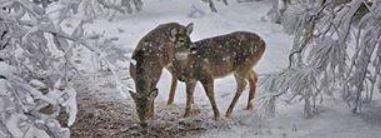
Twenty-one years old and the only deer I had seen were in a zoo and one early morning when I was sleeping with some other guys on the cabin porch at Morgan-Monroe State Forest in Indiana, and a doe came out of the mist to investigate the snores, or something.

Then, according to my father, deer began to show up at dusk at the edge of the woods on the Buck farm, which he leased from the Buck family (hence the name we used). Therefore, every time we visited, we took an evening break to drive the five miles to the Buck farm to see the deer. Although we must have made that trip two dozen times, and my father assured us that he often saw deer emerge from the woods while he was working there in the evening, we never saw the deer.

Then one night, after dark, when I was driving home alone from my summer job, at the speed limit, just a few miles from the farm, a buck deer appeared at the edge of the road in front of me. I didn’t count points on the antlers. A vision of collision appeared before me, and the deer moved into the road in front of me and leaped over the hood of my car, clearing the car completely, leaving me breathless and amazed.

It was worth the wait.

The unexpected guest at the cat bowl

Tags

Monkeys see, hear, speak no evil, Bangra.comWhen visiting the farm, I tried to fit into the family routines and help out with chores as we always did, making our visit less work for our parents, and giving us more leisure time together. This included weeding and harvesting from the gardens, chopping weeds from the soybeans, mowing the yards, painting whatever needed painting, washing dishes, and feeding the animals. The cats were fed at the back door. They fed themselves part of the time of course. Why else have cats except to reduce the rodent population? To keep the cats from wandering away, we had to provide a basic menu of some of their favorite items—mostly table scraps.

One evening I volunteered to take the cat’s portions out to their food bowl. My mother cautioned me that there might be someone else there to greet me, but not to worry, that animal would be happy just to fit in with the rest of the cats. I wondered what animal she might be talking about. They always had some raccoons and opossums nearby, and a neighborhood dog would sometimes come, so that is what I expected to see.

I turned on the light and stepped out the back door to see the circle of cats around the feeding bowl, noting that one cat had an unusual coloring—black with a white stripe down its back. The skunk’s face looked up at me, among the other hungry feline faces, with a friendly dare in its eyes, “Feed me or else.” With some trepidation I tried to act quite casually, and put the food into the bowl carefully, so as not to offend any of them by slopping too much onto their beautiful fur coats. The skunk pretended not to notice that I was new to the task, and helped itself to its share with the rest of the cats, while I slowly and courteously backed through the door, like any proper hired servant.

Lessons on how to keep a skunk from spraying you

Tags

,

OOMH

Walter Wehmeyer and Gerald Golden sat behind me at school, which meant they were a grade or two ahead of me. They were always bragging about something they did or knew how to do.  One day they were talking on the playground about how they were able to disarm skunks.  There was one sure way to keep a skunk from spraying you, they said.  You have to approach very slowly and carefully, not doing anything to scare it, talking softly and all friendly-like. Then you could use a pole to lift the skunk’s back legs off the ground, so the skunk couldn’t use its scent sack to spray you. Then you could do anything you wanted with it.

Later I took the bait and tried out their advice. There was an old broomstick in the shed. Skunks often nosed through the garbage pile in the corner of our yard. We dumped peelings and bones and other garbage there. I snuck up while a skunk was poking through the garbage and eating.  I got that stick under its back legs and lifted it up quickly. For the split second that the skunk’s feet were still in the air, the air filled with the most horrid stench you can imagine. I could stand the strong scent of a skunk from a distance, but up close it took my breath away. I thought I’d die, and mostly I wanted to.

Bonnie (my stepmother) set up a galvanized tub in the yard. My sister and brother took turns hauling buckets of hot water from the stove reservoir, and Bonnie poured on the strong lye laundry soap, but it didn’t help much. The Jenkins gave Bonnie some tomato juice they had canned, and made me wash with it, but I couldn’t tell that it made any difference. We burned my clothes, so I only had one outfit left to wear.  Several days passed before I was allowed to return to school, only to face smirks from Walt and Jerry.

Running for the spite of it

Tags

IMG_0002

I never enjoyed running. Walking was a pleasure. Running was a chore. I hadn’t learned to pace myself. I only knew how to run as fast as I could until soon I was out of breath and hurting. When my cardiologist said that I needed to engage in aerobic exercise for 45 minutes almost every day, I took his judgment as a painful life sentence.

If he hadn’t presented it as a choice between life and death, I wouldn’t have taken the challenge seriously. If the heart pain, palpitations, and the other symptoms had not convinced me that I was dying, I would not have undertaken the agony of learning how to run. As it was, running was painful, forcing me to depend on nitroglycerin for relief and face my mortality every time I exercised. The first steps were to alternate running and walking for short distances, learn how to run slower and walk faster, breathe more deeply and concentrate more on exhaling then inhaling, keep moving even when I felt I must stop, and fight for consciousness when I was blacking out. Of course the weather did not allow running every day. Fortunately aerobic exercise tapes and videos had become popular and provided a workout equally as miserable. As the months passed my endurance grew with the distance that I covered. I always exceeded the target heart rate. At times I was so dizzy that I could barely stay upright.  Especially during the heat of summer, Dr. John reminded me that electrolytes  go out of balance with profuse sweating, and that helped to explain the nausea and vomiting that I frequently experienced.

I continued to run and exercise, enjoying an occasional day off. Nonetheless the benefits of running were accumulating, with growing endurance, breath control, pain control, and the pleasure of getting the workout done. I did not know the meaning of a “runner’s high,” but I did know the feeling of accomplishment.  As the emotional stresses of everyday work also continued, the physical exercise provided the outlet that I had lacked, and the daily break that often put events and relationships in perspective. Running was as good as prayer. Running was prayer, since I had to pray as I ran, using phrases like “run and not grow weary, walk and not faint,” just to keep running, even when I did grow weary and faint.

Thirty-two years later, with many difficult events in between, I am still running. My heart is still beating, not so well sometimes but usually without long episodes of uncertainty. My angina is stable most of the time. Aspirin and nitroglycerin are still the best medicines ever discovered. And I do not enjoy running. I run in order to live.

The Consolation of Being Lost in the Right Place

Tags

, ,

Luna moth

Out of the Streator hospital with the newest calcium channel blocker, I was on my way to see a cardiologist in Pekin. No cardiologist was serving at Streator at the time, and my GP, Dr. John, referred me to Dr. Riaz Akhtar at Pekin, 45 minutes in the opposite direction. I hadn’t been to Pekin in many years and never knew my way around the city, so I got lost. (This was many years before Garmin and GPS, but I did have a little Pekin map.) Jan was not with me on this first visit, she was in school, and, after having survived three events in which I expected to die, another stress treadmill and echocardiogram sounded easy enough to do by myself.

Finding my way around Pekin was not easy, though, and I pulled into the cemetery along the main highway, to look again at the map. There was no parking along the busy highway, and the cemetery provided no traffic and easy parking. I scanned the cemetery, and was surprised to see a familiar name, Glen Sims.

The Sims family was my prior connection to Pekin, and I had visited them there twenty years previously. Before going to Pekin, Glen Sims had been my pastor, and he continued to be my mentor through my years of college and first year of seminary, until a malignant brain tumor suddenly ended his life fifteen years before. That was when I had last been there, in that spot, though I had no memory of where it was. I had just came upon the place when I was lost. Beyond my parents and wife, no one had influenced my life more. I missed no one more. Since events had brought me unexpectedly to this place, and I still had enough time to make my appointment, it seemed a propitious time for him and me to have a conversation, tearful and refreshing. He always had that effect on me, a mixture of tenderness and joy.

Afterward I drove straight to Dr. Akhtar’s office. After the tests, and at a later appointment, Dr. Akhtar gave his advice. He was a no-nonsense cardiologist. My moderate exercise and diet and propensity to let events control my schedule, instead of my doing so, must change. I must gradually build up my heart like any muscle, since it was woefully inefficient as it was.  I must live on a low fat, low carbohydrate diet, no caffeine, no alcohol, and I must run or swim, not walk, six days out of seven, for at least forty-five minutes, or else. Or else, what? They could put in a new heart valve, but he wouldn’t recommend it, since they would have to do it again within a few years, and life would not improve without these other changes anyway. Fortunately he didn’t expect me to jump into running immediately. He advised that I enter into that exercise slowly and steadily, under Dr. John’s care, since he happened to be a runner also. And the other “or else?” A rule of thumb, he said—seven years of experiences like yours and you can expect to be dead, if you’re lucky.

I was very glad to have had that conversation with Glen Sims.

The Surprising Gift of Healing Touch

Tags

3 OwlsAfter four years of relatively stable health, using the mantra of moderation in exercise (mostly walking and bicycling), eating, drinking, and scheduling, I found myself in midwinter trying to fit too many things into a few days when a snowstorm hit. My little Chevette slid into a snowbank, and, being such a little car, I thought I could push it out by myself. That didn’t work. A farmer’s tractor did the job. For several days afterward the physical stress increased, until one night I was again in full-blown distress. It was a night of ice, snow, and wind. Our home in Minonk was thirty miles from the nearest hospital, and driving ourselves was out of the question.

Jan called the local ambulance squad. Two friends, Paul and Jim, responded, with oxygen, monitors, and radio, ready to make the trip, usually thirty minutes, this time more than an hour. Jan stayed home with the children. I prayed and meditated, hoping that the wild pounding of my heart, sometimes racing, sometimes taking an alarming break, would become more regular.

By the time we arrived at Streator, I was much quieter and wondering if we should have just stayed home. My blood pressure and pulse were abnormally high, my oxygen level low, my lungs sounded full, and the ER doctor said he heard a loud “click and blow murmur” that could bear some watching, so he reassured me that I had come to the right place. Again, the blood tests, oxygen mask, IV’s, unknown medicines (no penicillin!), standard protocols. The worst part was being away from my wife and family, knowing that the roads would be closed to traffic for the next day or two, but thankful for the telephone to reassure each other.

The next day went slowly but uneventfully, with stats moving steadily in the direction of normal. Toward evening, into the hospital room came Jan, accompanied by Leslie Barth, one of the Minonk gentlemen who always did more than expected. Leslie was a large, good-natured man, a farmer, who had a suitably large, four-wheel-drive pickup truck with a snowblade attached. He had heard of our predicament and volunteered to bring Jan to Streator.

There were several helping hands during that trip and that hospital stay, not least of all Jan’s, but the most memorable touch that moved me came from the large, warm, gentle hands of Leslie Barth, when he took hold of my cold feet, as they stuck out at the end of the light hospital blanket. He held my feet and warmed them, and his warmth filled me, as he told me to get well, take my time, not to worry about work that other people could do while I was recovering, and remember that I was loved, respected, and wanted by him and many others. Thank you, Leslie, for that and more.

Hospital #2 and the Nurse Who Knew

Tags

,

Monkeys see, hear, speak no evil, Bangra.comDischarged from the hospital, with a clean bill of health as far as bloodwork and the upper and lower GI tests could show, and scheduled in a week  for a cardio-stress test at the hospital across town, I went home with my doctor’s instruction to check back in if the symptoms returned. Five days later in the evening I asked my wife to drive me to the other hospital, where my tests were scheduled, after a few hours of increasing chest pain and arrhythmias, breathing difficulty, dizziness, sweating and nausea. I wasn’t ready to ask my fellow rescue squad volunteers to take me. A fellow has his pride, after all.

The ER doctor checked me in, encouraging me with his words that my heart sounded like a train speeding clickety-clack down the track. It felt that way too. He sent me to a regular room where I proceeded to get worse. In the middle of the night the nurse came in with the news that my doctor had given some orders at last.

No heparin this time, nor intravenous nitroglycerin.  He wanted to know how I handled a regular dose of nitro, in the little tabs under the tongue, up to three if I did not get relief right away. I took three in a few minutes succession, and felt much better. Miraculously better, I thought. There was also something to settle my stomach, which I took, although it already was feeling better.

The nurse sat down at my bedside and told me about her experience with nitro. She told me that she had angina that was stable and benign most of the time, unstable when she became overly tired or stressed, and she used nitro tabs when she needed them. Her situation might not be like mine at all, only tests would tell, but she wanted me to know that people lived with that condition, and it was a good sign that I had responded so well.

When I went home that time, with nitro tabs and beta-blockers, and still non-committal comments from my doctors, until that postponed stress test and more time had passed, the most helpful conversation was that one in the middle of the night with a nurse who had her own experience and the audacity to share it. Her casual suggestions about work pacing, stress relief, rest, limiting caffeine intake, and trusting that answers would be found proved to be the timely help that was needed.