• About
  • Celebrating our decades…
  • Welcoming all and inclusiveness

chaplinesblog

~ everyday and commonplace parables

chaplinesblog

Tag Archives: A License to Preach

Lama, O lama, O lama….sabachthani?

13 Sunday Sep 2015

Posted by chaplines2014 in Caring, Faith, Suffering

≈ 1 Comment

Tags

A License to Preach, Memories

dock at sunset

“My, O my, O my….” Mother cries, not wanting to mimic sacred words if she remembered them. She was always modest and self-effacing, though you might not know that in her dementia, when all self-restraint and impulse control have disappeared with short-term memory. Family remember that her grandmother or grandfather Doane, depending on who is telling the story, used to rock in his rocking chair and moan those same words.

The endurance of the sufferer is rarely exceeded by the endurance of the commiserator. Who can stand by and watch for long when a person is in pain? If there is even the slightest indication that the person in pain craves the attention of the watcher, there is even less tolerance. While this is true of good people, is it true of a good God? If the book of Job provides an indication, who has more patience with a self-pitying sufferer than God? Certainly not Job’s “friends” who in various ways try to persuade Job that his suffering is his own fault.

Mother’s fall and broken neck, while she made her daily trip to the restaurant for a noon meal (and saved half of the food for her evening meal), would by Job’s friends’ accounting be her own fault. Surely no compassionate person would agree, even if they knew the likelihood that a damaging fall would occur sometime. The voice out of the whirlwind might not sound compassionate, but it did not tolerate the victim blamers either. It just voiced the impossibility of understanding the whole picture of life and death, disease and accident and suffering in this world. We do not know the ‘why’ of damaging events, nor of the diseases that rob a highly intelligent, generous, and faithful person of her mind. We must continue to seek healing solutions.

Forgetfulness is not one of the attributes that most people ascribe to the divine. For good reason we hope that there is a storehouse of the memories that human beings often lose, whether that loss is purposeful or not. How many injustices and innocent people disappear under the rugs of history? At the same time we hope that our own errors and failures do disappear in the mercy of divine forgetfulness. Patience and forgetfulness are qualities that God must possess in infinite amounts, even if they are exercised judiciously. They are qualities that belong to a long-suffering God, who listens to the cries and does not turn away out of exhaustion or intolerance.

We pray to that God, just as Aunt Mary Kleinlein urged us to pray, as she remembered many other times that she and her former sister-in-law Mary Alice have done. Even though she also passed the age of 90, she provided a meal for the fellow-sufferers who had not sat down together for a meal in all of the days since Mother fell, while she and her son sat bedside with Mother.

We pray to that God who could remember the cry of the sufferer and speak those words from the mouth of the suffering Christ. Have you forsaken? Will you? Will you leave? No way. Never.


The Different Dogs of Chicago Politics

22 Saturday Aug 2015

Posted by chaplines2014 in Caring, Church, Faith, People

≈ Leave a comment

Tags

A License to Preach, Community Development, Life in the City, Urban Renewal

Chicago skyline 1970Dick Simpson, a political science professor at University of Illinois Circle Campus in Chicago, called Chicago “the most corrupt city in the country, and Illinois the third most corrupt state” in a February 2012 report for the Chicago Journal. “The truth is that the governor’s mansion and the city council chambers have a far worse crime rate than the worst ghetto in Chicago.” http://chicagoist.com/2012/02/17/dick_simpson_study_says_chicago_is.php

I met Professor Simpson in January of 1969, when he was instrumental in organizing the Independent Precinct Organization, and I was a student at Chicago Theological Seminary. The seminary encouraged students to get involved in churches , community and political organizations, and to engage in cycles of action and reflection (theological and ethical) with other students. I had worked, successively but not successfully, with the Eugene McCarthy and the Hubert Humphrey campaigns in 1968. The Chicago democratic machine held no attraction for me, but independent community-based politics was a different matter. Many local churches were involved in our own 5th Ward and in the 43rd Ward on Chicago’s North side, and it was easy to volunteer.

The first campaign for the IPO backed Bill Singer for Chicago Alderman for the 43rd Ward against the democratic machine. Singer had been a protege of Senator Paul Douglas and a friend of 5th Ward Alderman Leon Despres. I admired both of them, so I signed up to help with the Singer campaign, door to door canvassing and poll watching. Against odds, Singer was successful. The most inspiration, however, came from Dick Simpson, and his encouragement of young people and community residents to take part in the political process, in spite of the cynicism and despair that had gripped most reform efforts during those years. When other organizations gave up (the University Christian Movement among them), and others went underground (Students for a Democratic Society), the IPO offered hope to those of us who were inclined to believe that change would eventually come if we just kept working, even if it was only on a small local scale. Where else would it begin?

Change came, and it didn’t. Dick Simpson ran for alderman and joined the City Council for several years. Other independent candidates for mayor succeeded after Mayor Richard J. Daley’s death, and positive results followed, but corruption has continued to dog Chicago and Illinois politics. I and many others can take inspiration from the dogged determination of people like Dick Simpson, who are still involved and working.

Growing Catnip

22 Saturday Aug 2015

Posted by chaplines2014 in Church, Faith, Garden, Yard

≈ 1 Comment

Tags

A License to Preach, Serendipity

park bench in spring

Catnip is one of those weeds that I enjoy having around. I planted some in my herb harden. At former homes in Paxton and Minonk, catnip grew all over the place, and I pulled it out except where I wanted it to grow. Once before, when I lived at Tilton, and tried to grow catnip, the same thing happened. It got a good start and was growing beautifully. One morning I looked out and it had disappeared. In its place was a well-satisfied tabby, new to the neighborhood. She had eaten every particle of the catnip.

Some things are just too good to pass up. Some things attract would-be connoisseurs from a distance. I have dreamt about being that kind of preacher and leading the kind of congregation that would be one of those attractive entities. Some characteristics of ours would simply attract without our having to do the work of listening, relating, interpreting, and living out the faith. Like catnip.

In the real world we must sow seeds with such abandon and in such abundance that there will be plenty to take hold, survive, and grow regardless of who shows up to take voracious advantage of the crop. We cannot hope to grow it in one small space and have it flourish.

I know I could have catnip if I fenced it in, protected it, and really tried to preserve it from contact with the cats who really seemed to need it. Instead I have decided that catnip does better as a weed growing all over the place than as a protected herb, confined to one small garden spot. Even so, most things faithful.

Persistent Welcomers

19 Wednesday Aug 2015

Posted by chaplines2014 in Farm, Growing up, House, Seasons

≈ Leave a comment

Tags

A License to Preach, Memories, Serendipity

Burlington house in fall

They welcomed us in great numbers when we arrived in August, 1988. Throughout the fall they kept coming, sometimes pestering us to the point that we wondered whether we would ever be rid of their nuisance. Even in January they kept moving, popping up at odd times and places, such as on my collar during a children’s sermon at a Sunday morning service. If I had been quick-witted, I would have turned that moment into an object lesson on persistence. When winter came in its fullness of ice and snow, they still persisted, although I saw only one every day or so. Boxelder bugs.

As a child I became acquainted with them. They were more numerous and lasted longer than lightning bugs, so when it was no longer possible to collect the more illuminating lightning bugs, I turned my acquisitive attention to boxelders, seemingly harmless, and only slightly stinky, but certainly persistent and ubiquitous. The worst weather in heat and dryness brought out the best in them, but they made themselves known even in cold and icy times in the warm comfort of the house. In Burlington the bugs had occupied the soft maple trees that grew along the berm immediately north of our house. On the farm they had occupied the namesake boxelder trees that grew along the river bank not far from the house. In both cases they moved inside when they decided the conditions were better there. For whatever reason the bugs left our Burlington house the next spring and have never returned.

I want such long-lasting determination, such unexpected perseverance, for my faith. When I am caught in mundane, day-to-day tasks that seem to drag on endlessly, I need the unexpected reappearances of joy and surprise that persist in spite of all I do to suppress them or tame them or forget about them. When I am overcome by the scale of problems that seem insurmountable, I need the confident will to see a victory that gives meaning to my feeble and uncertain movements. Sometimes such faith does appear in solitary heroic figures battling all odds. Sometimes such faith comes in masses of individuals filling every corner and space with their relentless march of life conquering death. Even such lowly creatures as the boxelder bug encourage us by the nuisance of their example.

You have to be “on the inside”

18 Tuesday Aug 2015

Posted by chaplines2014 in Caring, Church, House, Learning from mistakes

≈ Leave a comment

Tags

A License to Preach, Serendipity

Burlington house in fall

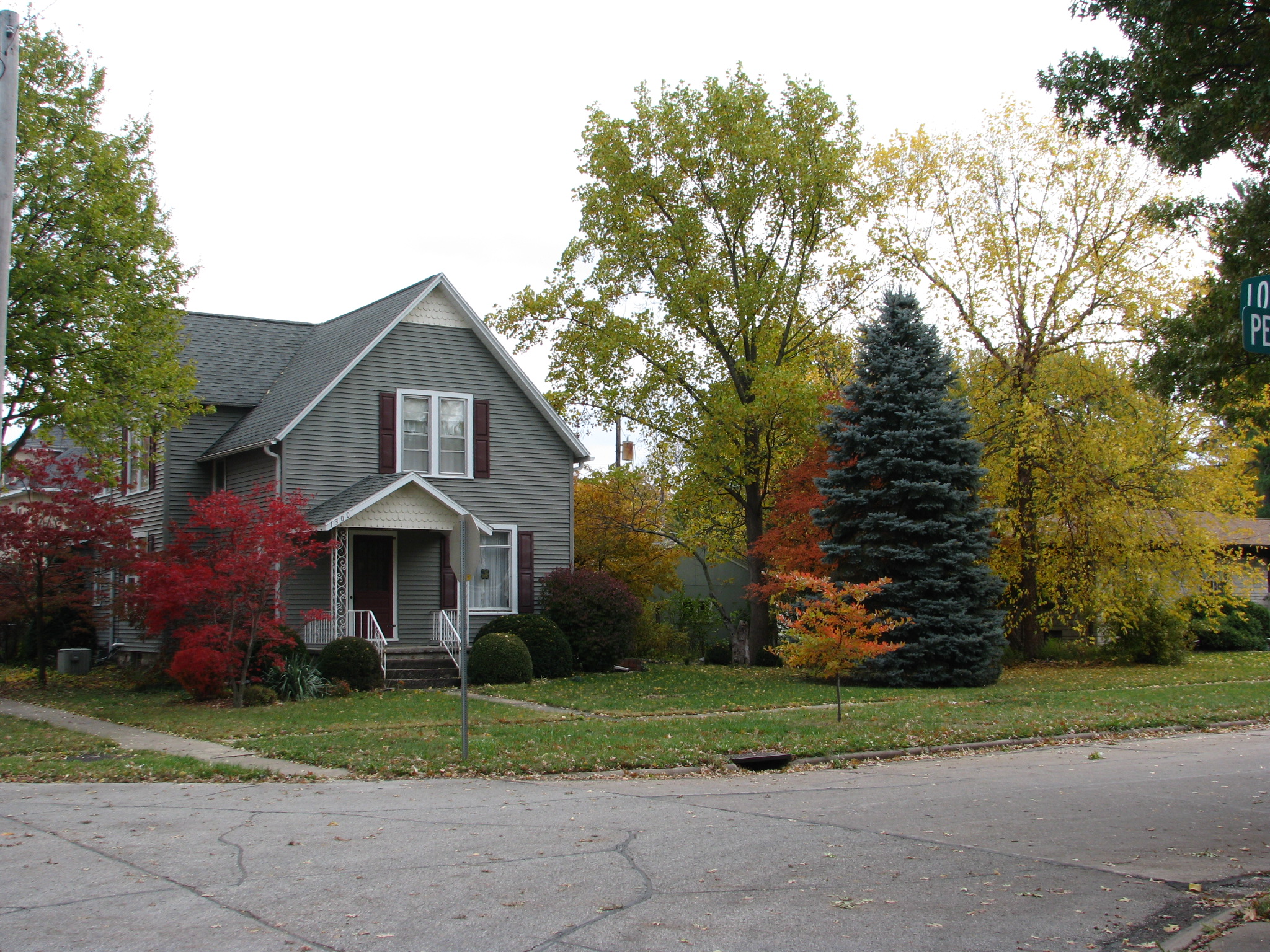
We moved into our old house in Burlington in August of 1988, twenty-seven years ago. Friends helped us to move from Minonk, Illinois, and we sat together on folding picnic chairs on the back porch and had lunch. They noticed that there was a doorbell on the back porch, just outside the kitchen. It worked well, making a “dong” sound, and when the front doorbell sounded it made a “ding-dong” sound.

The doorbell location presented a problem. You had to go through the rear door of the house to get to the doorbell. By the time you made it to the kitchen door, you were already inside the house, and since the kitchen was usually the center of activity in the house, most of the time you could just say hello to anyone who was working or sitting around the kitchen table. You wouldn’t need to use the doorbell.

Like many old farmhouses, most people who know us come to the back door anyway, but the fact is that, unlike when we lived in the country, we usually lock the back door, so getting to the doorbell presented a challenge. You would have to knock on the door in order to get us to let you in so that you could press the doorbell.

Many years ago the back porch was really an open porch. There was no door because there were no walls. The kitchen door was the back door. Sometime in the 1960’s, the Nelsons hired a young Jim Wilson to enclose the back porch, build walls, and put in a row of casement windows to make a three season unheated room. (We liked it so much that we added insulation and a heating vent and made it into an all-season room.) But no one bothered to move the doorbell.

Maybe the previous residents were so friendly that people could just open the door and walk in. Ideally we would like to live that way, but we tend to live a bit more privately, even though the large windows on all sides of the house make it a see-through first floor when the curtains are pulled to the side.

We don’t always make it easy for people to get inside. With the door locked, you had to raise a ruckus to get our attention. It would be a lot more welcoming to place a doorbell in a convenient location, so that is what I did, among one of the top items on my “to do” list.

We don’t always make it easy for people to get inside other things either, but hospitality means making the changes that make it easier to get in.

Loads in Need of Redistribution

17 Monday Aug 2015

Posted by chaplines2014 in Caring, House, Learning from mistakes

≈ Leave a comment

Tags

A License to Preach, Serendipity

Burlington house in fall

My house in Burlington is now 115 years old, but I installed a new 200 amp circuit box several years ago, and the panel of circuit breakers was impressive—23 circuits with room for 28. Only one circuit kept blowing, and when it blew just about everything went with it. The television, the dishwasher, the electric heater, lights and outlets all over the place—all went out. Since something was amiss, I put on my electrician’s sleuthing hat.

The air conditioner, refrigerator, freezer, furnace, clothes dryer, electric range, hot tub, and the clothes washing machine each had its own own circuit. They were dedicated circuits serving major appliances and ones that had enough of a load to justify their single purpose and that was appropriate. They kept doing their own jobs even when the other circuit blew. That totaled eight dedicated workhouse circuits—four of which were double or 220 circuits, so those and the one that blew accounted for thirteen spaces in the box. What about the other ten?

One took care of the outlets and lights in three rooms upstairs. We didn’t use them a lot, but there were times when the whole family came to visit, and then they got put to use. They were there, ready to serve, even when the rest of the house shut down. Then there was one circuit serving one outlet in the half-bath downstairs, and one serving an outlet in the kitchen corner, and another serving another outlet behind the antique Hoosier in the kitchen, and another serving one outlet in a corner of the basement. They seldom served any purpose, so it was plain that they were far from being overloaded. They were seriously underloaded. There was one serving a small fluorescent light fixture above the kitchen sink, which explained why it continued to shine when everything else went dark, but in spite of its perpetual and faithful shining, it was definitely an underused circuit. There were two circuits available for the garage, which took a few years to put into service. Then there was one that went upstairs to the master bedroom where a window air conditioner used to sit. Every one of these circuits was added when someone wanted to add one more light or outlet or appliance to the house. The tenth one served the lights, ventilating fan, and outlets in a new addition that was added several years ago.

Yes, something was amiss when over half of the available circuits were completely idle most of the time, and when one—obviously the original house circuit—was trying to carry too much of the load. I had to spread the load around so that the underused circuits could carry their share, before the breakdown of the one circuit led to more disastrous results.

It made me wonder how much of the power distribution in the organizations and churches in which I have taken part resembled my old house. Perhaps some load redistribution has been in order in other places too?

Alone in the Dark

09 Sunday Aug 2015

Posted by chaplines2014 in Events, Growing up, Gullibility, Learning from mistakes, Running

≈ Leave a comment

Tags

A License to Preach, Community Development, Life in the City, Memories, Urban Renewal

Chicago Old Town

In 1969, working for the Independent Precinct Organization [IPO]in Chicago’s north side Lincoln Park neighborhood, we canvassed door to door to build support for community-based initiatives instead of the urban renewal plans of the democratic machine and Mayor Richard J. Daley’s administration. The city plan called for bulldozing entire blocks of housing, displacing hundreds of poor and elderly families of many races and ethnic backgrounds, and building apartment buildings and condominiums that would cater to wealthy, upper class, largely white people. The area needed rehabilitation and preservation, from our perspective, not destruction and replacement. In canvassing , we met many wonderful people of various backgrounds who would be forced to move, priced out of the neighborhood.

We organized meetings, rallies, and took part in city-sponsored meetings that were supposed to give the people a voice, but largely consisted of city spokesmen telling the residents what was going to happen, whether they liked it or not. The city’s only authentic German beer garden became a center of attention, when the city planners decided it had to go the way of every other building of historical, ethnic, or cultural significance in the urban renewal area. What would the new neighborhood look like? An uninspired collection of modern boxes of uniform size, shape, and costliness, with little attention to amenities that existed in the previous community, because Lincoln Park would be considered a residential extension of the downtown. “Little boxes…full of [just more expensive] ticky-tacky,” anyone?

One night I had to park three blocks from the meeting –place at the edge of an already bull-dozed three-block strip, where the citizens were confronting city planners. Parking was scarce because we had generated a lot of interest in the meeting. The people present were angry and eloquent, expressing their grief at the prospect of losing homes and businesses and facing an uncertain future with below-replacement value appraisals and no help in relocation. The IPO presented alternative plans and proposals that had the backing of much of the resident community. When the meeting ended we felt that we had done well in getting both citizen-involvement and the important media attention.

I walked out of the building after a brief feedback session with my co-volunteers, needing to get back to my apartment on the south side and ready for seminary coursework the next day. The street was empty and dark; many of the street lights were removed with the destruction. I didn’t see anyone around, until I had walked a block, but then I heard from a distance when a gang of Spanish Disciples had spotted me. I didn’t understand all that they were saying, but I knew from a few words and phrases that they had recognized a lone target for their resentments and rage when they saw me. It didn’t matter that I thought I was serving their interests in being there. Their street sophistication did not extend to political disputes between the city and local white liberals.

They were coming at a run, and I decided that I needed to be faster, and so I was. I unlocked my car, jumped in, and sped off just as they were arriving. I didn’t wait to see whether I could persuade them that I was a good guy just trying to help out.

I returned to that neighborhood, continued to canvass, participated in other meetings and demonstrations, but I made sure that I was not alone in the dark after that.

No Waiting

05 Wednesday Aug 2015

Posted by chaplines2014 in Faith, Growing up, Learning from mistakes, Running

≈ Leave a comment

Tags

A License to Preach, Serendipity

IMG_1187

After college I swore that I would never stand in a waiting line again. Cafeteria lines, registration lines, textbookstore lines all had eaten up more time than the studies themselves, it seemed. It was a vain resolution.

Lines and waiting rooms became a prominent feature of my career as a minister. Hospital waiting rooms, court house lobbies, city council chambers, and jailhouse waiting rooms took the place of earlier lines. In retirement, road and traffic delays and outer office sitting areas have continued to devour time.

Early line training introduced me to the art of starting conversations with strangers, if they were amenable, or preparing sermons, letters, or work outlines without the benefit of notepaper. Thinking through concerns in empty spaces of time also helped with the daily exercise of running. Regardless of work being accomplished and acquaintances being made, waiting is still waiting.

“Those who wait upon the Lord will renew their strength.” It is a running mantra that I used sometimes. I would say that waiting saps strength and waiting rooms are more tiring exercise chambers than gymnasiums and running tracks. What makes “waiting on the Lord” any different? While most waiting involves anxiety, is there at least the possibility that waiting on the Lord can involve faith, trust, confidence, and some assurance that all things work for good for those who love the Lord? Perhaps waiting on the Lord involves more serving time than leisure time.

Practicing patience and endurance is good for you, my significant other says. Where do these gifts fall in the series of spiritual gifts? Between suffering and hope, with one experience making possible the next, according to Romans 5.

“No waiting” is a good advertising ploy, but I have not found a commercial establishment that yet lives up to that claim. No waiting will be heaven.

Shoestrings

01 Saturday Aug 2015

Posted by chaplines2014 in Caring, Learning from mistakes, People, Words

≈ Leave a comment

Tags

A License to Preach

3 Owls

Shoestrings are those things that some people live on, some people trip over, and some people tie more or less successfully. My wife has observed that unsuccessful tying seems to be my habit. Using some of the more advanced techniques does not always seem to help. Eventually they come undone and trail awkwardly, close to and akin to an Achilles heel.

The fancier types of shoestrings are the worst. Finished leather, polished and decorated shoestrings slide out of knots like sleight of hand. Plain old cheap ones hold the longest. Bending down and retying regularly would seem the obvious solution, but there are so many other things to do. Why allow such a distraction to interrupt the more important things, that is until the shoes themselves threaten to slip off.

Shoestrings have a life of their own, which makes “living on them” slippery indeed. Pity those who must. Pity the poor. Pity the state and national governments who must, and who find the easiest place to tighten their belts (mixing metaphors) is to cut programs that assist those who already live on shoestrings. That is slippery! Those who make such decisions are far enough away that they do not have to worry about tripping over those shoestrings, more’s the pity.

Living on shoestrings among people who also live on shoestrings, in a society of people who willingly live on shoestrings so that everyone can have shoes, is much to be preferred to the alternative—loafers, whether they are expensive fancy loafers or not.

Best Laid Plans

19 Sunday Jul 2015

Posted by chaplines2014 in Church, Learning from mistakes, People

≈ Leave a comment

Tags

A License to Preach, Serendipity

Monkeys see, hear, speak no evil, Bangra.com

Few things end as we expect. This is the lesson of the huge cost overruns that have become a way of life in our Department of Defense. Sophisticated and ambitious plans are drafted, limited numbers of production experts make bids on the plans, bids are awarded to one of the few competitors, greater than expected difficulties in production are encountered, additional intricate specifications are added to the original design, and cost overruns escalate. No end is in sight for such costly miscalculations, and the tendencies remain in human character as well.

Too many factors must be considered in most of our decision-making. We want to stop thinking about it and just make a decision. Consider the choice of a mate. A million qualifications could be appropriate. The chances for error are large. Success in marriage becomes a daunting prospect, and people are generally waiting longer to decide.

I worked for a church that spent sixty years trying to eliminate pigeons from nesting on top of the belfry. The flat belfry roof provided an excellent roosting place. Pigeon guano piled up and had to be removed every six months. Church attenders had to duck the droppings of pigeons as they flew in for a landing. Rainwater leaching through the manure digested the roof shingles and corroded the drain pipes. They tried many solutions. Many solutions! Finally they built a steeply sloped pyramid roof on top of the belfry. Pyramid power. No more pigeons.

The same church had an embossed metal ceiling in its sanctuary which had been painted a dozen times in eighty years, until paint would no longer adhere to the metal, but kept peeling off and falling on the congregation in large patches. Talk about the roof falling in when someone comes to church! Ideas were abundant. Cover it with acoustical tile? That would ruin the acoustics of the room and look drab in due time. Sandblast the paint off the metal? That would condemn the building to sandy surfaces and paint fragments for generations. Finally they checked to see what was underneath the metal. A beautiful carved wooden ceiling, dirty but paintable,  hid under the metal. Removing the metal left a result that was both cheaper and more attractive than any of the alternatives considered. We cannot always be so fortunate.

When making plans or watching other people’s plans unfold, what do we need to do? Take as many facts into consideration as we can.  Test as many assumptions as we can. Be prepared to change course when either facts or assumptions prove inadequate. One way or another they will be.

← Older posts
Newer posts →

Subscribe

  • Entries (RSS)
  • Comments (RSS)

Archives

  • February 2022
  • May 2020
  • October 2018
  • December 2017
  • November 2017
  • October 2017
  • June 2017
  • April 2017
  • March 2017
  • February 2017
  • January 2017
  • November 2016
  • October 2016
  • September 2016
  • August 2016
  • July 2016
  • June 2016
  • May 2016
  • April 2016
  • March 2016
  • February 2016
  • January 2016
  • December 2015
  • November 2015
  • October 2015
  • September 2015
  • August 2015
  • July 2015
  • June 2015
  • May 2015
  • April 2015
  • March 2015
  • February 2015
  • January 2015
  • December 2014
  • November 2014
  • October 2014

Categories

  • beach
  • Books by Gary Chapman
  • canoeing
  • Caring
  • Cherokee history
  • Church
  • Citizenship
  • Death
  • Disabilities
  • Events
  • Faith
  • Farm
  • fighting fires
  • Forest
  • Garden
  • Growing up
  • Gullibility
  • guns
  • Health
  • Hiking
  • House
  • Innocence
  • Learning from mistakes
  • Life along the River
  • Miracles
  • Nature
  • Patience
  • People
  • Prayer
  • Racial Prejudice
  • rafting
  • Running
  • Seasons
  • Small town life
  • Suffering
  • Travel
  • Uncategorized
  • Vehicles
  • Volunteering
  • Words
  • Yard

Meta

  • Create account
  • Log in

Blog at WordPress.com.

Privacy & Cookies: This site uses cookies. By continuing to use this website, you agree to their use.
To find out more, including how to control cookies, see here: Cookie Policy
  • Subscribe Subscribed
    • chaplinesblog
    • Join 71 other subscribers
    • Already have a WordPress.com account? Log in now.
    • chaplinesblog
    • Subscribe Subscribed
    • Sign up
    • Log in
    • Report this content
    • View site in Reader
    • Manage subscriptions
    • Collapse this bar
 

Loading Comments...