• About
  • Celebrating our decades…
  • Welcoming all and inclusiveness

chaplinesblog

~ everyday and commonplace parables

chaplinesblog

Tag Archives: events

The Deafening Silence

05 Sunday Nov 2017

Posted by chaplines2014 in Farm, Nature

≈ Leave a comment

Tags

events, life experiences, Serendipity


Nathan, Sullivan and Tulip May 2017 (2)   Midsummer, Jan and I were at the farm with Nathan’s two Golden Retrievers, Sullivan and Tulip, while Nathan was attending a reading conference. This was their first visit to the farm, and the open space and new surroundings obviously stimulated their already super-energized spirits. Sullivan at two and a half years has just begun to settle down into his young adulthood; Tulip at one year is nowhere close to settling down. Jan regards her as a classic case of attention-deficit hyperactivity disorder.

They seemed to enjoy their first experience of the farm. At home in Burlington they have a good-sized yard to romp in, and are surrounded by the noises of the neighborhood, the street traffic of busy Agency Street and the nearby HyVee grocery and shopping areas. They rarely see such wide-open spaces.

I tried to keep their routines as typical as possible. In Nathan’s absence I knew that they were missing him, and this was the first time that they had spent a significant length of time with me. Knowing that they usually stayed the night with Nathan in his bedroom, I brought them into our bedroom, instead of shutting them in their kennels. No surprise then that in the middle of the night I was awakened by Tulip actively nuzzling me, whining, and wanting to go outside for her usual duties.

I put her and Sully on their long leashes and headed them downstairs and outside through the south porch, out onto the lawn, expecting them to act as usual, randomly running and tugging in all directions. At first they did as I expected. Then they both slowed down and came back to my side, sidling close to my legs, still as can be, and looking up past me toward the sky, where the stars were shining on a clear moonless night.

This was the time of night, or very early morning, when the crickets, katydids, and locusts are silent, no toads are croaking, and the birds have not yet begun to herald the dawn. Perhaps the dogs could hear something. I could not. I listened for the sound of coyotes or racoons or the smaller creatures of the night, but I could not hear any rustling of any kind. Ordinarily the wind makes noises in the trees on that rise on which the house sits, but on this night the wind was still.

I cannot read the canine mind, and should leave that to our granddaughter Symphony, who seems to have the knack. But, to all appearances, both Sully and Tulip were in awe of the silence and the sky, and not a little afraid of this new and unfamiliar world that is so deeply silent, so unfathomably infinite. Smart dogs.


July 13, 2017, Tornado Warning!

27 Friday Oct 2017

Posted by chaplines2014 in Events, Faith, Farm, Miracles, Nature, Prayer

≈ Leave a comment

Tags

events, life experiences, Serendipity, Synchronicity

funnel cloud photo
Two previous storms did significant damage to our Chapman farm near Paxton. The first came from the southwest, around 2000, and ripped a roof off a lean-to shed on the west side of the corn crib, and laid that roof on the ground next to the then-new machine shed. That wind also toppled half of the concrete block south wall of the three-car garage. Brother David and I spent a week dismantling the rest of that lean-to, learning how our father had built it with heavy timbers and 7-inch nails, and making ourselves more tired than we could remember. We hired the repair of the garage.
The second storm, five years later, brought a straight-line wind from the north, that blew a window out of the master bedroom, irreparably damaged the vinyl siding on the north side of the house, blew down the large hackberry tree between the house and the old shed, which our father had built out of full-dimension lumber from the original 1860 farmhouse. That shed stood undamaged, but the power lines supplying it came down with the tree. The wind also toppled half of the north wall of the three-car garage. I cut up the tree, except for the massive four-foot diameter trunk. For the rest of the work I hired the Sutton brothers.
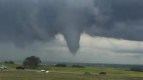
Since last October Jan and I have worked regularly to clean, fix, rehabilitate, and refurnish the 1915 foursquare house. It’s been a lot of work, and much remains to be done before we call it finished. This July we looked across the broad river valley west of the house and saw a dark wall cloud coming ten miles away that the weather radio warned us about—a tornado was coming, located between Elliot and Melvin, headed our way. We saw it at a distance as it formed a perfect funnel and began to raise a debris cloud from the ground. The next twenty minutes passed like lava, as the storm clouds seemed to stand still. Jan and I headed for the basement, taking our warning radio and cell phones with us. While Jan took a seat in a camp chair in the inside corner of one basement room, I watched the storm approach through a ground-level window in another basement room. I watched the tornado coming and a second funnel forming alongside the first.
Of course I prayed, thanking God for the relative safety of a full basement with thick brick walls that had withstood storms on this “hilltop” for a hundred and two years. If the rest of the house would be removed, and Jan and I could survive, then I would be even more thankful! In the face of that tornado, we could willingly say goodbye to the house even with the precious memories it contained. There was nothing between us and the two funnels, as they appeared to be missing our neighbor’s farmstead by a few hundred yards, still heading straight toward us.
Wall clouds and funnels are extremely interesting to watch, as well as terrifying. My heart was pounding and my excitement level jumping as I watched the bases of the two funnels dance, away from each other and toward each other, in a powerful tango. When they were about a quarter mile away, still coming slowly, and I was ready to abandon my post by the window for the safety of the other room with Jan, I saw the two tornado funnels move into each other and lift off the ground. As if one funnel canceled the other, within seconds they lifted from the ground and disappeared into the black cloud above. The house was peppered with dime-sized hail, small branches, dirt, and light field debris.
A few minutes later, as the rain continued but the winds began to subside, we moved upstairs and watched the darkest clouds move farther to the east. The tornado warning continued over the radio, but, to my knowledge, no significant damage was done. We looked around the house and the yard, and there was still work to be done, but it was not the work of picking up the pieces.

“Here I Stand”

25 Wednesday Oct 2017

Posted by chaplines2014 in Church, Citizenship, Events, Faith, Learning from mistakes

≈ Leave a comment

Tags

events, life experiences, Memories, Serendipity

Luther at Worms   “Here I stand. I cannot do otherwise.” So spoke Martin Luther in 1521 at his fateful trial in Worms (pronounce that ‘Voorms’). His words during that formative period of the German Evangelical (Lutheran) Church signaled an emphasis on individual conscience that has remained a part of our identity to this day.
We visited Worms in 1987. My family indulged my appetite for places and events that heretofore had meant little to them. We found a clean little pension house (cheap family rooms) underneath the great tower of the Dom of Worms (the cathedral). All night long the deep reverberating tones of the huge bells awakened us marking each hour. Allied bombs had demolished the immense cathedral during World War II. The painstaking reconstruction was displayed in many photographs along the walls of the nave, like stations of the cross.
The same thing happened to Luther Memorial Church two blocks away. It also was rebuilt in detail from the ruins. Significant words from Luther are inscribed on the walls of that church, and in the small chapel a crucifix depicts Jesus reaching down from the cross to embrace both a German civilian and a German soldier prostrate on the ground. The bulletin boards of both churches stressed Catholic-Protestant cooperative activities ongoing in their current lives.
A few blocks away on the Judenstrasse (Jewish Street) is the ancient synagogue of Worms, home of one of the first Hebrew congregations in Northern Europe, where Rashi, one of the greatest interpreters of the Hebrew scriptures of all time, studied as a child. Nazi thugs burned the synagogue on Kristallnacht, November 9, 1938. Members salvaged what they could and sent sacred articles as far away as California to preserve them against the Holocaust that was coming. Now the synagogue building is fully restored, although it serves mostly as a memorial to the hundreds of its members killed in the Holocaust.
Still a few more blocks away is the church of Martin of Tours, on the site where, according to local belief, the fourth century saint was imprisoned for a time after his conversion to Christianity and his leaving his youthful occupation as a Roman soldier.
We visited and meditated on these landmarks of human conscience. We sat in the town square by the fountain with its fanciful sculpture in honor of another local product—the smooth German wine called Liebfraumilch, “Mother’s Milk.” Indeed as we rested, a woman strolled past, nursing her baby.
The best and the worst of human behavior is represented there. Intolerance and steadfast conscience exist side by side. Can we tolerate the differences of opinion and attitude that make life difficult? Like mother’s milk, may the wine of tolerance, kindness, mutual acceptance, assent, and dissent flow.

Sunday Evening on the Road Home, October 22, 2017

24 Tuesday Oct 2017

Posted by chaplines2014 in Events, Faith, Nature, Travel

≈ Leave a comment

Tags

events, life experiences, Serendipity, Synchronicity


sunset 2
We were driving through rain, rain that had filled two hours of the afternoon, on I-74 toward Galesburg, when we began to see the bright band of open sky on the western horizon. The contrast with the blue and gray bands of the sky above was stark. We welcomed the prospect of turning west toward Burlington. As sunset was approaching and the sun would soon be edging into that bright space, the open sky brightened into solid yellow, then startling gold. Soon the sun spread its blinding light under the blue clouds, sending golden rays shimmering across the whole landscape, highlighting the deeply scalloped row of clouds above the horizon, and fanning the bands of light in angles against the varying blue and gray tones of the clouds above.
I thought, “God’s grandeur…while all other arguments for God fail or come up short, the beauty of the earth still makes the case.”
The intensity of the gold light against the blue bands of sky increased, far surpassing any goldsmith’s skill, on a scale of magnitude infinitely greater in the whole gold bowl of the firmament. Then it grew even brighter. Our eyes had been fully occupied with the drama in the west. We were turning east into the cloverleaf onto US 34 when we saw the full rainbow spread across the eastern sky against a dark blue background. Before a moment’s thought I heard myself ask, “Who needs a pot of gold at the end of a rainbow when we have a sky full of it?”
It had been years since I had remembered that favorite poem of Gerard Manley Hopkins, “The world is charged with the grandeur of God. It will flame out, like shining from shook foil; It gathers to a greatness….”

We faced the western sunset, as the top edge of the sun slipped below the horizon, and the fan of colors shining across the clouds out of that white blue band of open sky on the horizon began to soften gradually from blinding gold into yellow, pink, mauve, red, and burgundy against the cloud ridges of blues, purples and grays. A bright reflection of the sun’s orb appeared on the western sky above the point where the sun itself had disappeared, and remained for several minutes mirrored on the distant clouds. While the ceiling of clouds darkened overhead, the silhouettes of trees and land stood black against the western brightness.
As the colors in that band of light shaded into intensely deep yellow and red, the sky appeared to flame behind the sharp silhouettes, as if the fires on the Californian coast had finally reached and filled our midwestern skies, yet they did not alarm. They impressed with overpowering awe.
Gradually, as we approached Gladstone and Burlington, the lights above dimmed into the blackness of clouds. The clouds were still overhead, no stars could shine through, and the bright band of light blue still appeared distant, although it stretched across the whole length of the western horizon as we took in the steepled lights of Burlington’s downtown.
“And though the last lights off the black West went
Oh, morning, at the brown brink eastward, springs —
Because the Holy Ghost over the bent
World broods with warm breast with ah! bright wings”

Seeing Jesus

11 Tuesday Apr 2017

Posted by chaplines2014 in Church, Death, Faith, People, Prayer, Suffering

≈ Leave a comment

Tags

A License to Preach, events, life experiences, Memories, Serendipity

Pentecostal banner

Lillian lived a rough life. She had been married a short time, but she got out of it because she saw quickly that it had been a mistake. She made a living as a secretary, in an assembly line, and finally as a clerk in a package liquor store. She was a chain smoker for many years, so it was not a surprise when Chronic Pulmonary Disease took over her final years.

Her older sister, Margaret, on the other hand, lived a comfortable life, married to Bob for over fifty years, mother of two daughters, who were also married and raising families. With her husband, Margaret was active in her church and as a volunteer in the community, but she never had to earn a living outside of the home. Margaret always worried about her little sister, and when Lillian became sick and lived by herself, she made sure that her sister had a comfortable home near her own, had help when she needed it, and that her pastor would visit Lillian and, with the Elders, offer her communion as they did for other shut-ins in the community.

That is how I met Lillian. She didn’t resemble her sister, until she shared a picture of them together as young women. When I met her, Lillian was extremely thin, wrinkled, and leathery, while Margaret was plump, relatively youthful-looking, and often smiling. They were a study in contrasts in appearance, temperament, and life histories.

Underneath the obvious differences, they did share not only their childhood history, but other characteristics as well. They both had worked hard in their own ways and neither took an easy route when the harder route appeared better. Both were questioners and somewhat skeptical, not accepting a superficial answer, but digging deeper. In spite of the different paths their lives had taken, they shared many values underneath the surface.

Lillian did not respond immediately when I first visited her. She seemed a little irked that her sister had asked me to come. She was distant and unresponsive, but I persisted, saying that I liked to keep in touch with the people of our village, whether they were church members or not, just to see if there were needs that we could fill, which was part of our purpose as a church, and Margaret was one of those who made sure that we served that purpose. It was my usual spiel when talking to our non-member and indifferent neighbors. She allowed me to come and eventually to bring the communion elements that she had not received since she was a young woman.

Eventually her health deteriorated to the point that she no longer could stay at home and use oxygen there. She made several trips back and forth to the hospital and spent her final year in a nursing home, where I continued to see her about once a month. It was likely in her last trip to the hospital that she would not be discharged back to the nursing home. She seemed to be slipping deeper into unresponsiveness every day.

Then one day it was different, and she seemed to be unusually bright and alert. After a few light comments, she announced that she had a wonderful experience the night before. Jesus had come to visit her. She saw that I was taken aback, for she continued, “No, really. I know that you were here earlier, even though I didn’t feel like talking. And I know what you’re thinking—that I mistook you with your beard for him, but it really was him. I know the difference between you and Jesus! Don’t think I don’t!”

By this time we both were smiling, for this was the old plain-spoken Lillian that I hadn’t seen for a while. “Well, then, what did Jesus say to you, that made such a difference in you?”

 “He said, not to worry, that I would be coming home with him tomorrow night, and I would be able to breathe again. We had a wonderful talk, and then I relaxed and fell asleep. When I awoke he was gone.”

I don’t know what else we said about that visit with Jesus, but soon I was praying a thank you prayer with Lillian, and telling her that, one way or another, I expected to see her again. That night she fell asleep for the last time.

Part 1: “I sought the Lord, and afterward…”?

15 Wednesday Mar 2017

Posted by chaplines2014 in Church, Faith, Growing up, Gullibility, Learning from mistakes

≈ Leave a comment

Tags

A License to Preach, events, life experiences, Memories, Serendipity, Synchronicity

Pentecostal banner

In the first semester of my freshman year at Illinois Wesleyan University I wrote an essay and titled it “Is God a Teddy Bear?” I was exploring the psychological roles of anchoring for personal security in a god and the projection of good and bad attributes onto one’s idea of god. This was based naturally in the different characterizations of gods as judgmental, oppressive, vindictive at one end of the spectrum to loving, generous, and forgiving at the other end. These seem to be tied to personal experiences with parents, leaders, and others, to degrees of stress in environment, and the coping mechanisms we adopt for dealing with them and for understanding ourselves. The result for me was not only an “A” on the paper, but also a crisis in my own faith that lasted throughout the year.

If I was only praying to and worshipping an aspect of myself projected onto an idea of a personal being, there was not much power in my activity. If I was refusing or delaying the mature behavior of taking responsibility for myself and for my own potential, even when connected to other people, then such worship provided no service that could be characterized as healthy, “saving,” or mature. Worshipping oneself, even as a projected self, is a dead end. I began to think of the practices of devotion that I had exercised increasingly during my adolescence as an echo chamber that simply revealed to myself what I was thinking. Obviously I was on the wrong track in planning to be a minister, and I began to think of a career in psychology instead, or perhaps I should return to my earlier interest in anthropology.  The immediate dilemma was practical—my scholarship was tied to my status as a pre-theological student, and IWU had a psychology department which was devoted to behavioral psychology only, with its theoretical foundations in B. F. Skinner, whose work did not inspire me in the least.

I wanted to believe. The means to that end seemed to be retreating, and the awareness of my practical and psychological needs only accelerated the retreat. Even the fact that my own projections were positive, based in loving parents and family, and helpful, intelligent advisors and mentors, did not provide the answer if they were only projections. Relying on the faith of others does not provide a substitute for one’s own faith. My advisor for my work with the Illinois Conference Methodist Youth Fellowship noted that sometimes we “act our way” into belief. We continue to do as much as we know how to do until the ultimate goal becomes real for us. I knew “how to act” but the advice did not deliver me from the circle of my own subjectivity. The college chaplain suggested that the analogy of projection relied not only on a projector but also on a screen; something had to be there to receive the projected image, or something had to be “behind the screen” that was true. While I agreed with the analogical point, it did not construct anything more than an idea of god, not God-as-personally-known-in-the-universe.

I had no idea about what could deliver me from this conundrum, but I continued seeking an answer.

Which John Bell?

09 Thursday Mar 2017

Posted by chaplines2014 in Books by Gary Chapman, Citizenship, Events, Learning from mistakes, People, Racial Prejudice

≈ 3 Comments

Tags

Books by Gary Chapman, events, life experiences, Memories, Our Land! Our People!, The Trail of Tears

OLOP Cover Photo 3

John Bell was such a popular name in the 1800’s that hundreds of references to that name show up in southern and Midwestern records. Many can be eliminated as related to one another because of birthdates, locations of death, and other indicators that they are not related to the John Bells that are part of our own family, but many remain single references that are unconnected to any other data.


We began with confidence in our own closest ancestors with that name, the great-uncles and great-great-father who are buried in the family cemetery near New Salem, Illinois. From where did that Great-great grandfather come? There were other Bells and even John Bells in the immediate vicinity and surrounding counties who could be easily disregarded because there were no plausible family connections.


You can imagine my excitement when I found a ‘John Francis Bell’ born in the Cherokee Nation with the same birthdate as the Grandfather John F. Bell, reported by his grandson (our Grandpa Hillmann) to be raised among the Cherokees with twenty-one siblings. Then I found a maternal uncle, James Starr, traditionally responsible for his nephews’ upbringing, with twenty-one children of his own. The name ‘John Bell’ also appeared as one of the youthful protectors (or was it a gang?) of the Cherokee Nation’s eastern border, along with Starr’s own sons and several other relatives and neighbors. These instances provided a connection to a full line of John Bells well-documented in Cherokee records. John Francis Bell also disappeared from Cherokee Nation records in 1848 just after the murder of his father, and just before our John Francis Bell appeared in the New Philadelphia-New Salem area.


It was not the case that the records were entirely in agreement with each other. Sometimes two John Bells in the same Bell family appeared in each generation. John Francis Bell had a younger brother named John Martin Bell. They had an uncle named John Adair Bell who had first cousins named John Bell. Often the middle names were not used in separate records.


John Adair Bell was the most famous among them since he and his brother Samuel Bell signed the New Echota Treaty with the Federal Government in 1835. John Adair Bell led one of the large detachments of Cherokee people in the 1837-38 Removal, usually called the Trail of Tears. Members of the Bell detachment were mostly residents of the ancient city of Coosawattee in Georgia, and John Adair’s father, and his brothers, including David Henry Bell, and David’s son, John Francis Bell, were probably among its numbers. I must add ‘probably’ because no full listing of the detachment members has been recovered, and other circumstantial information has been assembled that points to their presence.


The John Bell who was the grandfather of the grandfather of our grandfather, in other words the father of John Adair Bell, has often been mistakenly identified as the signer of the New Echota Treaty and the leader of the detachment, instead of his son. To add to the confusion, his middle name may or may not be the John ‘Christopher’ Bell, born in Greenville, South Carolina, in May 1, 1782, although that date seems to be firm as the grandfather’s birthdate, so I will use that name for the sake of identification. John C. Bell married Charlotte Adair, the mixed Scot and Cherokee daughter of John Adair (the founder of Adairsville, Georgia), and their children included John Adair, David, Samuel, and Devereaux Jarrett, as well as several other well-documented men and women.


John C. Bell’s 1842 Registered Claim clears some additional confusion about his life. He gives reasons for his 1833 move from Coosawattee to Alabama, where his brother Francis Bell was residing in that part of the Cherokee Nation, and the claim clearly indicates that John C.  Bell was ‘white,’ although his family is Indian. John C. Bell is a member of the Cherokee Nation because of his marriage to Charlotte, not because he was born into it. The Georgia legislature’s claim on John C. Bell, later declared unconstitutional by the Federal Court, was a claim on him as a white man and citizen of Georgia. This is interesting because many Cherokee records, dating from around 1900, claim that John C. Bell was half-Scot and half-Cherokee, like his wife. They often say that John C. was the half-blood son of John Bell, the Scotsman, who married a Cherokee woman of the Deer Clan.  This would make John C. commit incest, according to Cherokee tradition, when he married Charlotte Adair, who was also a member of the Deer Clan. I account for this lapse in Our Land! Our People! with the documented incidents later when families in the next generation disregarded clan membership when marrying, as the clan system was breaking down, and people were adopting the English familial system and different definitions of incest, but there was no corroboration of this with regard to John C. Bell and Charlotte Adair, and it is more likely that people later just got confused about which John Bell was which. John C. Bell, a Scot, married a woman of the Deer Clan, Charlotte Adair, and their children, observed the clan traditions and married spouses of the Wolf Clan, or other clans that were not Deer. John C. Bell’s father may have been named John Bell, or he may have been another David Bell; this is where the lines become unclear again, but neither married a Cherokee woman.


If I were to rewrite Our Land! Our People! I would consider John C. Bell as a full-blooded Scotsman, still with his Scot accent, who was one among several men who married Cherokee women and were adopted into the Nation. He was a well-known traveler, trader, farmer, and blacksmith who fell in love with a Cherokee woman, who was the daughter of another well-known Scot trader and traveler, John  Adair. That was enough of a challenge for their lives at the time without the additional burden of an accusation of incest.


It would have been a lot easier if there were not so many ‘Johns Bells’ in and out of the family.


Where Was Chicken Trotter and When?

24 Friday Feb 2017

Posted by chaplines2014 in Books by Gary Chapman, Cherokee history, Citizenship, Death, Events, Learning from mistakes, People, Racial Prejudice, Small town life, Suffering, Travel

≈ 2 Comments

Tags

Books by Gary Chapman, events, life experiences, Our Land! Our People!, Serendipity, The Trail of Tears

OLOP Cover Photo 3

Recently I was presenting Our Land! Our People! at the Talbot Library and Museum in Colcord, Oklahoma. I did not expect to find much in the little town of Colcord, Oklahoma, but I was wrong. Talbot publishes some significant works on Cherokee history, and their facsimile editions of the 1843 Claims were illuminating on the John Bell family in several respects. For the first time I could actually see the English and Cherokee handwriting of four key family members—John Bell, the father, and three of his Bell sons—John Adair, David Henry, and Devereaux Jarrett (better known as Chicken Trotter).

The 1843 Claims record unreimbursed losses prior to the Cherokee Removal in 1838-39, usually due to thefts or confiscations of property by non-Cherokee white men. They were submitted to recover those losses, and they had to be witnessed by at least two other reputable citizens. The Bells served as reporters of their own claims, witnesses to others, and, in the case of Chicken Trotter, an official recorder of several dozen claims by others.

Chicken Trotter’s reports are some of the clearest and most beautifully written in all of the volumes. Deciphering other writing was sometimes impossible, but “D. J. Bell” provided some of the best. That surprised me, because in other places he is recorded by the simple notation “his mark,” and I never found evidence that he had attended any of the Cherokee schools. It is no wonder that he didn’t sign his work “Devereaux Jarrett” but “D. J. Bell” works well, and there is no competitor for the use of those initials among the Bell family. David Henry Bell would be “D. H.” and he just signed as “David Bell.” As these claims were recorded in the first few months of the year, there was enough time for Chicken Trotter to get back to Texas in order to work with Governor Sam Houston to conclude the Treaty of Bird’s Fort on September 29, 1843, which ended the four years of conflict between the Texas government and several tribes. Conflict followed the second Texas governor, Mirabeau Lamar’s attempt to eradicate the native population. Sam Houston, the first governor, an official Cherokee himself,  had tried to grant reservation status to the Cherokees among others. From one administration to the next, the policies reversed from welcoming people of different cultures to trying to destroy them, and back again.

Chicken Trotter, according to the records of the Texas Cherokee population, had come to Texas during the mid-1830’s, when Chief Duwali (or Bowle, as he was also known), led the tribe. They were and continue to be located in Rusk, Cherokee and Smith Counties, as the areas are known today. When in 1839 Governor Lamar and the Texas militia killed Duwali and at least half of the tribe in a genocidal attack, Chicken Trotter soon became one of the remaining leaders.

Because of the Texas Cherokee account I rewrote Our Land! Our People! removing Chicken Trotter from Alabama, where his father lived, and from the Bell Detachment on the Trail of Tears, and putting him in Texas through the late 1830’s. After publishing, I found evidence that Chicken Trotter served his brothers in the Bell Detachment as a treasurer paying bills along the route. If he accompanied the group the whole way, he was travelling to Indian Territory from September 1838 through early January 1839, before returning to Texas in time to be in danger during the massacre of Duwali and the Cherokees in July.

When a group of Cherokees, including John Adair Bell and David Bell travelled to Texas in September and October of 1845, accompanied by the diarist and newspaper reporter William Quesenbury, they visited the northeast Texas Cherokee settlement, and Chicken Trotter was there leading the group, having established a community farm, including watermelons and pumpkins as Quesenbury notes, because some of their horses got loose and tore up the patch.

In 1848, Chicken Trotter was again in Indian Territory, joining his brother Sam and other Cherokees planning a journey to California to prospect for gold. Sam died on the way but Chicken Trotter and his wife Juliette got there before returning to their people in Texas a year or so later. There is no record about his success or failure in finding gold.

Chicken Trotter was a busy man, travelling back and forth quickly in days when travel was difficult. Maybe that is how he acquired his name.

In and Out of the Delivery Room

13 Monday Feb 2017

Posted by chaplines2014 in Caring, Events, Faith, Health, Learning from mistakes

≈ Leave a comment

Tags

events, life experiences, Memories, Synchronicity

Chicago skyline 1970

We were anticipating the birth of our first child and preparing for it by taking classes in the Lamaze method of natural childbirth, as were other families in the Chicago Theological Seminary student community. Our obstetrician, Dr. James Jones, was popular in our Chicago Southside neighborhood. His office was always packed, yet he had time for each of his patients. He was a tall, handsome, personable African-American gentleman. No wonder his patients adored him. He also made time to fly to Haiti regularly to donate his services to expectant mothers there.

With Lamaze comes the expectation that husbands will be assisting their wives throughout labor and delivery, and Chicago had a law on the books banning husbands from the delivery room. We made a loud protest to the City Council, and the law was suspended. Having assisted in large animal births and trained in emergency human delivery practices, I had a vivid sense of what I could expect in the delivery room, and the Lamaze classes refreshed my previous experience with movies of deliveries with the aid of the Lamaze method. Jan and I had agreed that we would use Lamaze as much as we could, but we would not be afraid of using anesthesia if that proved necessary. Dr. Jones was on board with those ideas.

The due date was April 20, or so. Early in the week the city reversed its position and again banned men from the delivery room. The case went to court.

During the week of April 30th, the sleeplessness of end-of-term pregnancy was accompanied by the University of Chicago campus demonstrations following the killing of students at Kent State. An all-day and all-night vigil continued for the next week in the open lawns just half a block away from us.

Our first baby was typically late in coming, so we still had hope that a ruling in our favor would come out in time. One week overdue and Dr. Jones was gone to Haiti for a week. Two weeks overdue, with Dr. Jones due back the next day, we were just hoping that the baby would come out, sooner rather than later.

It was Mother’s Day, May 10, 1970, a beautiful sunny day. Our next-door neighbors in the apartment house, Sid and Arnie, were planning to make dandelion wine. We decided to help by picking blossoms on the Midway Plaisance lawns where the dandelions flourished. One way or another we were going to induce the coming of this baby.  Sid was a nurse at Chicago Lying-In Hospital nearby where we were planning to go. Sure enough, while we were picking dandelions, Jan experienced her first labor pains. Dr. Jones was due t in the next few hours, and the court was due to make its ruling.

Jan’s labor turned into a twenty-four hour ordeal. We went through all the breathing patterns. Jan was spent; so was I for that matter, with less justification of course. Dr. Jones was in the hospital, delivering a baby for Mrs. And Mr. Dick Gregory (the comedian), whose room was across the hall from ours, and filled with baskets of flowers. No court ruling came until a few days later, after Alicia was finally delivered, when the court ruled in favor of husbands in the delivery room. Too late for me. I was too tired to care anyway.  Jan had been whisked away. There was nothing for me to do except worry and pray about for my overly tired wife.

Jan remembers seeing Dr. Jones enter the room wearing a neck brace. (It was heavy duty bringing all of those babies into the world.) A few minutes later out came our baby. Later they all emerged from the delivery room, with my exhausted Jan holding a red-faced bald-headed, one-eyebrowed baby, who was not yet, but soon would be, the most beautiful little girl in the world.

I still wonder why the men of the city council thought it was their duty to keep other men out of the delivery room, but for us more important matters needed to be addressed—diapers, feedings, schedules, and finding our way as new parents.

After the Failed Bi-Pap Experiment

07 Tuesday Feb 2017

Posted by chaplines2014 in Disabilities, Health, Learning from mistakes, Uncategorized

≈ Leave a comment

Tags

events, Serendipity, Synchronicity


psspectacledowl1

From their own positive experiences, several people were helpful and encouraging to me about the use of C-Pap or Bi-Pap machines, and I am grateful for that. We learn along the way much about ourselves, minds and bodies, and sometimes we learn that one size does not fit all.

Shortly after my last blog report, I learned more about my failure. I had “complied” in every respect with the advice to use my Bi-Pap machine, averaging seven hours of use per night at the end. The result was paradoxical. I was suffocating, and my blood oxygen level was declining, resulting in the 70% levels referenced in my last report, and increasing unstable angina during the night. I began with a moderate obstructive apnea, aggravated by chronic sinus problems. I ended with a serious central apnea, in which the connection between brain and breathing diminished. That is not desirable. I asked that question when the process began, “Does the use of a C-Pap machine sometimes replace the body’s own natural automatic impulses to breathe?” and I was told “No; that does not happen.” As it turns out, in special cases, it does. I am special.

Maybe it has something to do with the odd electrical wiring of my heart, which has two blocked fascicles, the electrophysiologist tells me. That has probably been the case almost all of my life, and it is not easy or safe to change. The nerve blockage at least complicates the issue of brain to heart and pulmonary system operation. I am all for easier solutions.

Finally, I was told to stop using the Bi-Pap device entirely. After a few nights I returned to the earlier pattern—no central apnea, and moderate obstructive apnea. Meanwhile I had gone to a dentist who was trained in fitting “oral appliances.”   (She was very kind and sympathetic.) The process is similar to fitting a set of dentures or braces—molds are taken of the existing teeth. A device is prepared that covers both upper and lower teeth, and the covers are connected so that the lower jaw can be gradually moved forward, using the upper and lower teeth as the anchors. Moving the lower jaw and tongue forward opens the airway in the throat. Combined with simple inserts for expanding the nostrils, this old “mouth breather” suddenly became a nose breather with expanded access to my windpipe. Adapting to the device was relatively simple, compared to the Bi-Pap machine. The oral appliance fits securely, so there is no problem with ever-shifting masks. The oral appliance is also very quiet. Gradually over the past four months the airway space has enlarged from my natural relaxed position to 7 mm larger in diameter. The resulting beneficial impact on apnea has been substantial.

I returned the BiPap machine. No hard feelings. Someone else will benefit from it—maybe even you. But if you feel like it is trying to suffocate you, even when the technicians increase the settings for the machine to work harder, it probably is.

← Older posts

Subscribe

  • Entries (RSS)
  • Comments (RSS)

Archives

  • February 2022
  • May 2020
  • October 2018
  • December 2017
  • November 2017
  • October 2017
  • June 2017
  • April 2017
  • March 2017
  • February 2017
  • January 2017
  • November 2016
  • October 2016
  • September 2016
  • August 2016
  • July 2016
  • June 2016
  • May 2016
  • April 2016
  • March 2016
  • February 2016
  • January 2016
  • December 2015
  • November 2015
  • October 2015
  • September 2015
  • August 2015
  • July 2015
  • June 2015
  • May 2015
  • April 2015
  • March 2015
  • February 2015
  • January 2015
  • December 2014
  • November 2014
  • October 2014

Categories

  • beach
  • Books by Gary Chapman
  • canoeing
  • Caring
  • Cherokee history
  • Church
  • Citizenship
  • Death
  • Disabilities
  • Events
  • Faith
  • Farm
  • fighting fires
  • Forest
  • Garden
  • Growing up
  • Gullibility
  • guns
  • Health
  • Hiking
  • House
  • Innocence
  • Learning from mistakes
  • Life along the River
  • Miracles
  • Nature
  • Patience
  • People
  • Prayer
  • Racial Prejudice
  • rafting
  • Running
  • Seasons
  • Small town life
  • Suffering
  • Travel
  • Uncategorized
  • Vehicles
  • Volunteering
  • Words
  • Yard

Meta

  • Create account
  • Log in

Create a free website or blog at WordPress.com.

Privacy & Cookies: This site uses cookies. By continuing to use this website, you agree to their use.
To find out more, including how to control cookies, see here: Cookie Policy
  • Subscribe Subscribed
    • chaplinesblog
    • Join 71 other subscribers
    • Already have a WordPress.com account? Log in now.
    • chaplinesblog
    • Subscribe Subscribed
    • Sign up
    • Log in
    • Report this content
    • View site in Reader
    • Manage subscriptions
    • Collapse this bar
 

Loading Comments...