• About
  • Celebrating our decades…
  • Welcoming all and inclusiveness

chaplinesblog

~ everyday and commonplace parables

chaplinesblog

Tag Archives: Memories

The Church between the police and the hood

23 Saturday Jan 2016

Posted by chaplines2014 in Caring, Church, Faith, guns, Learning from mistakes

≈ Leave a comment

Tags

Life in the City, Memories

 cropped-chicago-skyline-1970.jpg

We smelled smoke as soon as we entered the church. It was the fall of 1968, and the fourth Sunday that we went to worship at First Presbyterian Church of Chicago, located in the middle of the south side community of Woodlawn, a few blocks from our apartment. The usher said that someone had firebombed the church office, and many of the records had been removed before the fire, so it was clearly an effort to cover the theft of the records; more than likely it was the Red Squad, a unit of the Chicago Police Department. Fortunately, the fire had been reported and firemen had arrived to put out the fire before a lot of damage occurred.

The Chicago Police had entered the church a few months before and confiscated the weapons that the church had collected from members of the area gang that had taken the name “BlackPStone Nation” as part of an agreement to trade weapons for jobs and opportunities. The “P” in their name supposedly meant “Peace,” but not everyone was persuaded of their intent. The church had objected to the way the police had acted, but not the idea of removing weapons, because that was their plan all along, and they hadn’t decided what how they were going to eliminate the weapons in their possession.

Whatever the church had tried in order to create peace in the neighborhood and that necessarily involved working with the neighborhood gangs, had come under suspicion by the police and some of the political leaders of the city, although other leaders had encouraged their efforts; the church and its pastor, John Fry, kept trying. If the gang leaders ever had good intentions, in cooperating with the jobs and opportunities programs, some of which were funded through the federal government, they eventually gave up when the church came under relentless criticism and was subjected to warrantless searches and fire-bombings.

So we worshipped, prayed for peace in the neighborhood and jobs for the young people, and listened to amazing and prophetic preaching from Pastor Fry. Fry published some books about the issues, notably, Fire and Blackstone, testified before a Congressional Committee, and lectured around the country on efforts to work with one’s neighborhood.

Months later Jan got a job as interviewer with the Illinois State Employment Service on 63rd Street, and she tried for a year to combat the hurdles of inadequate resources, job discrimination, and miles to go within the city environment for people to get to job interviews, much less to land a job that paid enough to keep making the trip. By that time, I was working on projects that took us to other churches within the city. Pastor Fry moved on. Efforts to establish peaceful work and education programs for the young adults of the South Side largely fell apart. Gang leaders and many of its members eventually landed in a cycle of prison, release, and more prison, until they either died or retired. Last time I checked, First Presbyterian was still there, smaller and older, trying to serve the neighborhood, gangs are still operating in the neighborhood, and politicians still are covering their….

Becoming a Draft Counselor

18 Monday Jan 2016

Posted by chaplines2014 in Citizenship, Events, Faith, Growing up, Learning from mistakes

≈ Leave a comment

Tags

Books by Gary Chapman, Memories, Out of My Hands, The River Flows Both Ways, Vietnam and Cambodia

Chicago skyline 1970

I was almost finished with applications for conscientious objector status when a physician informed me that the question had no personal significance since I would not pass the physical examination anyway, even if I wanted to serve in a non-combatant role. Since I was opposed to the U.S. involvement in the war in Vietnam, I looked for other constructive ways to be involved. In the fall of 1968, as we took up residence in Chicago and I continued graduate studies for ministry, I entered the American Friends Service Committee training for draft counselors.

Having training in law would have been an advantage in dealing with the selective service system and legal precedents in the cases that we studied, in order to give helpful information to people who came with concerns, both draft-eligible men and their families. Having more experience in counseling also would have been useful, but some of that came with the counselees as they presented their questions. Motivations and concerns varied greatly, and responding equitably and sympathetically to people who held different beliefs and values was challenging. Enough trained people participated as counselors that it was not overly demanding for each of us who entered the volunteer AFSC network, and that was important as I tried to balance all of the requirements of study, work, service to others, and being a new husband. It could have been much harder, and I still would not have faced a fraction of the hardships that several of my friends and family, and especially my family-members-to-be, were facing in Vietnam.

Those who came with questions included people who were conscientious objectors, people who were simply draft avoiders, people who wanted to help others in their family or friendship circles who were having trouble dealing with the variety in draft boards and their practices, people who were in the military service but unwilling to fight in Indochina, people who were already in trouble one way or another, and those who were interested in all the options that were available before they committed themselves. We all had a lot at stake, and, although I was glad that an all-volunteer force replaced the selective service system, finding ways to serve our country as good citizens was in front of all of us in ways that have not been matched afterward.

Serving our country as citizens remains a universal duty, but being willing to kill people who differ with us in perspective, who are not threatening us, as persons or as a nation, in any direct or meaningful way, is not justifiable. Often personal judgment must be set aside, but too often conscience has been set aside as well, in responding to the orders that come from a chain of command.

We are now in the gap between the Vietnam War’s foggy beginnings and ignominious ending fifty years ago. I still puzzle about how to honor those who served their country as soldiers and those who served their country as resistors, then and now. The phrases “serving our country” and “defending our freedoms” pass easily off the lips of many people. The reality is much more complicated and difficult.

The Youth Trip of a Lifetime

14 Thursday Jan 2016

Posted by chaplines2014 in Church, Citizenship, Events, Faith, Growing up, People, Travel

≈ Leave a comment

Tags

Memories, Serendipity

cropped-great-river-bridge-sunrise-january-2015.jpg

Last night I dreamed about a youth trip that didn’t turn out so well, but often I think about the scores of trips that I led (with the assistance of many helpers!!) that went better than I had any right to expect, and the first trip (led by others when I was seventeen) that set the stage for all of the rest. It was 1963, and a couple of Methodist minsters had a brainstorm that the Central Illinois Conference would send a bus-full of high school juniors and seniors to New York City and Washington, D.C., in January of 1964, to experience a seminar on religion and current events.  With their plan, they were braver than I ever became, but I was privileged to be on the bus. This was entirely due to the benevolence of my pastor at the time, Rev. Glen Sims, and a generous older member of my congregation at Paxton Methodist Church, Gladys White.  All of my expenses were paid.

Many of the teenagers on board that week knew each other from camps and youth fellowships, but we all got to know each other, and at least one became a friend for life. The bus travelled all day and night, and those couples who knew each other found not-so-quiet corners of the bus to expose their raging hormones during the long dark hours, but that was not me (or the aforementioned friend). I just noted the consternation of some of the adults who didn’t foresee this aspect of packing so many teens so closely together for so many hours.

We arrived in New York in time to attend worship and the site chosen was Marble Collegiate Church where Norman Vincent Peale was continuing to share his “power of positive thinking.” Peale’s center-stage style and the white-gloved, tuxedoed ushers made an impression.  There, too, some of the adults had preferences in other directions that were fulfilled when we visited Riverside Church and the Interchurch Center, headquarters at the time of the National Council of Churches and several denominational offices, and a Methodist Church in Manhattan that sponsored many outreach services to needy people.

The next two days saw us spending time at the United Nations and the Church Center for the United Nations, where we heard presentations and engaged in discussions about current affairs involving church interests, especially the Conventions on Human Rights that were in the process of development. We stayed in small crowded rooms in a hotel just off Broadway, and we must have eaten somewhere, but, surprisingly for me and my appetite, I do not remember any food. I do remember our exposure to Charles Wells, a Pennsylvania Quaker who posted a newsletter to which I promptly subscribed until he retired years later and my subscription transferred to his compatriot , I. F. Stone.

We again boarded the bus for the shorter trip to Washington, D.C., where our itinerary took us on a tour of the White House and several sights—the Lincoln Memorial, of course—and we listened to church lobbyists at the Methodist center across the street from both Capitol and the Supreme Court. Desegregation, plans for the war on poverty under the new president, Lyndon Johnson, and international affairs in the Cold War were high on the agenda. We went across the street for a meaningful discussion with Illinois Senator Paul Douglass, who supported the U.N. Conventions, but did not see a path for their early approval, and another but less meaningful meeting with Senator Everett Dirksen, whose memorable words focused on his sympathy for us being there in winter and missing the cherry blossoms in bloom. The Soviet Embassy provided an interesting stop, and I was impressed with the many publications in English and the ambassador’s efforts to impress us with how friendly and progressive Russians could be. In the light snow of a gray afternoon, we visited Arlington Cemetery, the Tomb of the Unknown Soldiers, and freshly turned earth and eternal flame of President John F. Kennedy, whose efforts I had just begun to appreciate when he was assassinated.

I did not realize at the time how much of my world shifted during that week, how much larger it became, how many of my thoughts about church, state, national and international concerns began. We talked for a while as the bus turned toward Illinois, but mostly we slept. We were very tired.

[C1]

Mumps the Second Time Around

09 Saturday Jan 2016

Posted by chaplines2014 in Growing up, Learning from mistakes

≈ Leave a comment

Tags

Memories

Bridge in Autumn

We had lived in the Paxton area for several months but had not yet established a family doctor. Doctor Hilgenberg at Tolono, Illinois, had served our growing family for twelve years before we moved to Paxton. He had delivered two babies, David and me, and seen my family through a multitude of young adult and childhood illnesses, but we needed a doctor close to our new home. Our neighbors recommended Dr. Peterson, who had earned their loyalty through many years of sacrificial service.

I had been ill for a several days with an increasingly severe sore throat. Dad and I climbed the long dark stairway to Dr. Peterson’s office on the second floor of a downtown business—he carried me the last half of the stairs. We entered a crowded waiting room and sat for what seemed like an eternity to my seven year old internal clock. Finally the nurse called us into the doctor’s examining room, and Dr. Peterson gave his diagnosis. It was a simple case of the mumps.

“He’s already had the mumps,” my father answered. He had them a year ago when his brother did.”

Dr. Peterson was not perturbed. “He has them again. It happens sometimes.”

We went home and resumed the waiting for the mumps to take their course. As the days wore on, the fever increased, as did the swelling and pain, not only of my throat, but in my chest and in the joints in arms and legs. Mom and Dad became more anxious as I became sicker, and they decided to try the new clinic that had just opened with some physicians new to the community.

Dr. Noble was not well-known, as Dr. Peterson had been, and he was exceptionally sober and reserved. “Not mumps.”  I recall that he mentioned two more words—penicillin and hospital, which led to a conversation about how to care for me at home and come in for a shot and exam every day for the next as yet undetermined number of days.

That is how I began second grade, at home, making regular trips to the clinic for shots in my sore butt, and doing homework assignments while lying on the couch, with occasional drawings and letters from my classmates that my teacher, Mrs. White, included with the assignments  sent home with Mom. As I gradually began to feel better, it was a treat to receive the attention of classmates from a distance. I was ready some weeks later to go back to school, but I soon learned that I was behind everyone else in my class and had some catching up to do. When reading aloud I was the slowest and far from the smoothest.

Dr. Noble listened to my heart everyday and told me that I had developed  a murmur, but it wasn’t too bad. From that point on I could always feel my own heartbeat and assumed that everyone else could, too.  

Sneaking into the Christmas Gifts

16 Wednesday Dec 2015

Posted by chaplines2014 in Events, Growing up, Learning from mistakes, Seasons

≈ Leave a comment

Tags

Memories

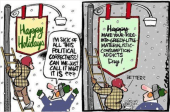
Happy Holidays.

My brother and I never had a reason to be in my parents’ bedroom when they were not there. The room was upstairs in a ‘newer’ wing of the hundred-some year-old farmhouse where we grew up. We gained access to the bedroom by going through the bathroom that replaced one of the three tiny bedrooms of the original story-and-a-half cabin. (You might say that it became the ‘Master Suite’ except that there was only one ‘inside’ bathroom in that house, and everyone used it when it worked, which was only part of the time.) Obviously my parents were not at home when we went into their bedroom. My older brother, David, must have been about thirteen, and me, eight, when this event occurred. We felt safe in sneaking in.

David thought he knew where the Christmas gifts must be kept—in the little closet at the far end of the bedroom. He opened the door and rummaged through the clothing and shoes to get to the hidden part of the closet, and he said that—sure enough—there were packages back there. Did I want to see what I was getting?

Of course, I wanted to see. What was I doing in that room with him if I didn’t want to see what I was getting for Christmas? What eight year old boy wouldn’t want to know ahead of time? At that moment something told me not to look and not to ask and not to let him tell me. I shrank from knowing ahead of the time how my parents wanted to surprise me.

My brother became a generous man. Perhaps it was an early manifestation of his generosity that he was sharing with me this escapade into sneakerdom. He certainly didn’t have to include his bothersome little brother in this opportunity. He didn’t need me as an accomplice either. It is not clear in my memory that my mother discovered this intrusion into the back corners of her closet, but she was observant and she probably did, and my brother probably paid for the infraction of unwritten Christmas rules with the humiliating insight that he could not be trusted in that day’s responsibility.

Among the many gifts coming from my parents that I do remember from those childhood years, I do not remember what I received on that particular Christmas, except the knowledge that I could be tempted, and that finally I could resist the temptation of knowing what I wasn’t supposed to know ahead of time. I could wait and be patient and learn in due time. That, and what my brother learned, were the most important and memorable gifts from that Christmas.

Too Eager to Get to Christmas

13 Sunday Dec 2015

Posted by chaplines2014 in Events, Growing up, Learning from mistakes

≈ Leave a comment

Tags

Memories

3 trees lighted in different colors

Like most families we had some Christmas morning rituals when I was a child. We arose early, full of excitement, but several steps preceded the first glimpse of the Christmas stockings and the gifts under the tree. We had to put on our clothes for the day, check to see if Santa had found the cookies and milk left on the kitchen table, and, of course, he had. Then we had to finish a full breakfast, which, for me, was probably my favorite—orange juice, and toast with mayonnaise—I wasn’t much of a breakfast eater in those days. If there were any chores that needed to be done before we gathered around the tree, they were done, like milking the cows or checking on the waterers, to make sure that they were open and not frozen. Finally, all together, my two brothers, Mom and Dad, and I got to go into the living room, and open the stockings first, the oldest going first, and then the wrapped presents under the tree, again starting with the oldest among us. We were naturally eager to get everything out of the way, and on with the business of opening the presents.

On one Christmas morning, when I was probably six or so, when my brothers and I were rushing down the narrow stairway that ran from the second floor bedrooms down to the kitchen, I tripped near the bottom step, fell, and ran my knee right into the metal grate at the base of the stairs. It was a nasty little gash that bled enough to need cleaning and bandaging, further delaying the goal of our hurried descent. I don’t know which hurt more, my knee or the delay.

I should have learned then not to hurry through the steps that approach the gifts of Christmas. I should have learned.

Beginning work as a pastor at Wapella

14 Saturday Nov 2015

Posted by chaplines2014 in Caring, Church, Learning from mistakes, Small town life

≈ Leave a comment

Tags

A License to Preach, events, Memories

Pentecostal banner

During my senior year in college I served my first appointment as supply minister for the sixty members of the Wapella Methodist Church. It started out as a summer job, and extended month by month as the District Superintendent said that he could not find a permanent replacement. Wapella had been part of a five point “larger parish,” but they grew tired of sharing a minister with so many other congregations. They wanted a minister of their own. They welcomed me enthusiastically, at least until I stated why I opposed the war in Vietnam, and they even tolerated that as long as they could keep me. At the end of seven months I had to end my service to them, giving the superintendent and the congregation a month’s notice. I had college work to complete, and I had trouble keeping my car running the eighty mile round trip two or three times a week. The superintendent said he would find someone else to serve them temporarily, but he didn’t for several weeks. They continued to meet for worship anyway.

Three months later a tornado tore through the town one late afternoon, and several college friends joined me in returning to what was left of Wapella. A friend drove, since my car was not working. We arrived after dark, and learned that the first task was to locate people across the countryside. Since I knew where people lived, and telephone lines were down, we drove out to see whether people were safe and sheltered. Heavy rains continued, and at one point we found ourselves driving on seemingly flat land with water above the floor boards of the car, so we didn’t get to all of the people we wanted to check. By the end of the night, one way or another, everyone was accounted for, and few injuries were reported.

Daylight showed the carnage of the disaster. We returned to be part of the clean-up crew and the job appeared to be insurmountable with the remains of houses and buildings scattered over a wide area. I saw few of my former parishioners, as those who lost their homes had sought refuge elsewhere and had little left to salvage. We put in a day’s work, but many more would be required before the town would be ready to start rebuilding.

At one point in the day we looked at the church. The large stained glass windows were gone. The tornado had lifted and moved the structure a few feet, and it sat at a crazy angle on the foundation. It was a total loss. Later I learned that the congregation had used their insurance money to buy a house as a meeting place. They were determined to continue as long as they could in spite of all the difficulties they faced. Neither my poor service nor an “act of God” would close them down.

All in all it was a revealing but not an encouraging beginning to my service as a pastor.

An Incident on the High Road

23 Friday Oct 2015

Posted by chaplines2014 in Miracles, Travel

≈ 1 Comment

Tags

events, Memories, Serendipity, Synchronicity

Gold Camp RoadWe were driving the high road from Cripple Creek to Colorado Springs, named the Gold Camp Road, nine miles following an old narrow gauge railroad bed. Actually Jan was driving, since she didn’t trust me to drive and sight-see at the same time. I do love the scenery, and it doesn’t get any better than the Gold Camp Road. It was a one way, one lane road beginning at Cripple Creek until a tunnel collapsed in 1988, and now it is a hiker and biker trail, so this event occurred before 1988.

The Alpine flowers were in multi-colored full bloom in mid-summer, the clouds were high and sparse for a rare rain-free July day, and the views of the mountain terrain and the distant foothills and high plains were forever. No one else was ahead or behind us for miles, and Jan was driving about 10 to 20 miles per hour on the loose gravel, since one side of the road was cut from the mountain rock, and other was a steep fall that had no visible bottom. Once in a while she would stop so that she could enjoy the scenery, take a break from a nervous hold on the steering wheel, and we could walk through the flowers.

In a few places the mountain rock was cut so that the single lane ran through a narrow canyon with rock on both sides. That would seem to be a secure place, but as we were driving through one of the longest of these narrow one –way passages, we saw a large dump truck barreling toward us at high speed. You could see the gravel dust billowing out behind the truck. It was not slowing down, although it was plain that there was not room for both the truck and our little Dodge Colt station wagon inside the defile at the same time. There was not time for Jan to back up, nor was there room on the shelf behind  us for two vehicles side-by-side.

Jan didn’t even have time to brake to a complete stop. The truck just kept coming at full speed.

This was one of those moments that seem to last a long time, because you know you’re going to die. You have time to review your whole pathetic  life in an instant.

Jan pulled the car against the right side until you could hear the panels scrape against the rock, and we both let out a loud groan in our prayers—not to become a can of sardines squished against the rocks by a truck that was large and heavy enough to destroy us without leaving so much as a dent on its bumper.

I don’t know how the truck managed to squeeze past us with just a scratch on our rear view mirror. I think it was divine intervention. We had some time left to mend our ways.

“I never saw a cross-eyed preacher…but I’d rather see than be one.”

21 Wednesday Oct 2015

Posted by chaplines2014 in Disabilities, Growing up

≈ Leave a comment

Tags

A License to Preach, Memories

Self-potrait 1988

I was seventeen when I had the opportunity for a surgery that would either correct or confirm a visible defect. By that time I had worked for years to overcome the “diploplia” that was gradually making my right eye, the near-sighted one, more and more dominant, and my left eye, the far-sighted one, less and less effective. I had worked on muscle control exercises, used more and more prisms in my eyeglasses, changed lenses every few months, and tried bifocals, but I was still losing ground steadily in the muscle control of my eyes. Surgery was the only option left, if I was to avoid being cross-eyed and losing the use of my left eye.

Many people have had to deal with that physical defect at a younger age than I did, and many have not had an opportunity to correct it, but, whatever age a person is, the social costs are present, and a teenager, hoping for a public career, finds those costs daunting. I was not looking forward to eye surgery, which came at the end of my senior year in high school, but I was dreading the loss of eyesight and visible attractiveness more.

Eye surgery to correct the muscle arrangements for both eyes involved a three hour procedure with my eyes removed from their sockets, the ophthalmology surgeon reported, a two-day stay in the hospital, and a three to four week recovery with my eyes bandaged.  It was my first surgery. I remember being nauseous afterward; my reaction to the sodium pentothal used for anesthesia was extreme. I don’t know what I said to the nurses, but I’m sure it was the truth. There was a general concern that the violence of my reaction was not helpful to my eyes, but I couldn’t do a thing about it. When I was returned to my room, I had a roommate, who happened to be a shooting victim in serious condition. I couldn’t see anything, of course, but his moaning and gasping did keep me awake throughout the night. It was a good time to pray, and his condition was clearly more critical than mine.

In the morning a tray was placed before me, and I felt my way through the various items on it. I poured the carton of milk mostly into a glass and proceeded to try to drink it, finding that it was actually cream provided for the sticky mass in the bowl, making my gag reflex return. My roommate was transferred to intensive care, I was told. All in all I was happy to go home the next day. I worried about the results of the operation for the next three weeks, until the bandages came off. The whites of my eyes were still red, but it was so much easier to focus and see without effort that I was greatly relieved.

The surgeon was pleased with the results, and, even though they weren’t perfect, they were so much improved that I no longer had to worry about loss of vision. In fact my eyesight steadily improved for many years.

I still wonder what my life and career would have been like without that surgery and its successful results. Like anyone with a visible disability, I suppose I would have adjusted and done my best to overcome the reactions of people around me and tried to compensate with other abilities. I am thankful that I didn’t have to.

“We thought we heard a siren…”

14 Wednesday Oct 2015

Posted by chaplines2014 in Church, Small town life

≈ Leave a comment

Tags

A License to Preach, Memories, Serendipity

Monkeys see, hear, speak no evil, Bangra.com

Making our home in Iroquois, Illinois, during my final year of graduate school provided a challenge to Jan and me and to the people of that rural village. Jan was pregnant with our second child and in charge of three year old Alicia without a support system other than the new friends we were making. I was serving a temporary appointment as a “student pastor” of the only church in town. They had broken away from a yoke arrangement with a church ten miles away. They were getting used to having their own pastor, but one who had no more time to give them than their previous “shared” pastor. In addition I was working on a doctoral project which turned our life together into research on how they responded to historical critical approaches to the scripture and how they were coming to grips with the social and political changes in the world around them. (That was the year that the U. S. involvement in Vietnam came to a formal end with a negotiated settlement. Racial politics and sexual roles were in widespread transition.) I traveled back and forth to Chicago every week to keep up with my doctoral work. We packed a lot into that year. Somehow both they and we survived it.

While we had lived in Chicago, Jan had studied with a fine vocal coach, Elsa Charleston, and regained the wonderful voice she had developed in high school and her first year of college, before she traded her vocal performance major for a Christian education major. In Iroquois she was on her own. Almost every day she crossed the street from the little house they had rented for us to the church, and used the piano to practice. She did the vocal exercises she had learned to do, and she worked on songs that stretched her abilities. The exercises included the “Tarzan yells” that Elsa had incorporated to increase Jan’s volume, support, and range.

One fine fall afternoon, two of the church members were in the yard taking care of the mowing and shrub trimming when they heard a sound that they had never heard before. Henry Easter stopped his lawnmower, and Tom the barber stopped his electric hedge trimmer and listened. It was coming from inside the church! They checked with each other as the sound continued, and they decided that they would have to investigate. They entered the building cautiously and stood in amazement at the back of the meeting room. They were listening to Jan’s practicing. Finally she glimpsed them standing in the back.

“Do you need something?” she asked.

“We thought we were hearing a siren,” Henry answered.

They obviously didn’t know what to think, not only about Jan’s practicing, but about our presence in their community. When the year came to an end, I received my degree, Nathan was born, and our interim appointment to serve that congregation ended also. Many shed tears at our leaving. Were they tears of sadness, or joy, or both? I’m not sure.

← Older posts
Newer posts →

Subscribe

  • Entries (RSS)
  • Comments (RSS)

Archives

  • February 2022
  • May 2020
  • October 2018
  • December 2017
  • November 2017
  • October 2017
  • June 2017
  • April 2017
  • March 2017
  • February 2017
  • January 2017
  • November 2016
  • October 2016
  • September 2016
  • August 2016
  • July 2016
  • June 2016
  • May 2016
  • April 2016
  • March 2016
  • February 2016
  • January 2016
  • December 2015
  • November 2015
  • October 2015
  • September 2015
  • August 2015
  • July 2015
  • June 2015
  • May 2015
  • April 2015
  • March 2015
  • February 2015
  • January 2015
  • December 2014
  • November 2014
  • October 2014

Categories

  • beach
  • Books by Gary Chapman
  • canoeing
  • Caring
  • Cherokee history
  • Church
  • Citizenship
  • Death
  • Disabilities
  • Events
  • Faith
  • Farm
  • fighting fires
  • Forest
  • Garden
  • Growing up
  • Gullibility
  • guns
  • Health
  • Hiking
  • House
  • Innocence
  • Learning from mistakes
  • Life along the River
  • Miracles
  • Nature
  • Patience
  • People
  • Prayer
  • Racial Prejudice
  • rafting
  • Running
  • Seasons
  • Small town life
  • Suffering
  • Travel
  • Uncategorized
  • Vehicles
  • Volunteering
  • Words
  • Yard

Meta

  • Create account
  • Log in

Blog at WordPress.com.

Privacy & Cookies: This site uses cookies. By continuing to use this website, you agree to their use.
To find out more, including how to control cookies, see here: Cookie Policy
  • Subscribe Subscribed
    • chaplinesblog
    • Join 71 other subscribers
    • Already have a WordPress.com account? Log in now.
    • chaplinesblog
    • Subscribe Subscribed
    • Sign up
    • Log in
    • Report this content
    • View site in Reader
    • Manage subscriptions
    • Collapse this bar
 

Loading Comments...