• About
  • Celebrating our decades…
  • Welcoming all and inclusiveness

chaplinesblog

~ everyday and commonplace parables

chaplinesblog

Tag Archives: Out of My Hands

Never-Ending Corn Rows

15 Sunday Oct 2017

Posted by chaplines2014 in Citizenship, Faith, Farm, Growing up

≈ Leave a comment

Tags

life experiences, Memories, Out of My Hands

cornfields  From the middle of the cornfield the tall rows seemed to go on forever. Walking down the rows, reaching up to pluck and shuck the corn by hand, hearing the endless rustling of the dried leaves and stalks in the chill breeze, perhaps an eight-year-old boy could be forgiven for thinking the task would go on forever. The John Deere Model ‘A’ pulled a green wooden wagon, into which we boys pitched the ears of corn. I sometimes undershot or overshot, earning the ridicule of the older boys. Would this job never end?
I was enthusiastic in the beginning, not knowing what I was getting myself into. Reaching the row’s end I had the momentary hope that now we could stop. But we had many more rows to cover, and soon we were lost in the middle of the field again. We were just opening the fields, so that the combine could have the room to be pulled into the fields and along fence rows, but to a little boy the half-mile rows seemed endless.
Only a few years earlier no combine was available, and teams of horses pulled the wagons through the fields. That was as unimaginable as having to do the whole field by hand. Someone else with a longer view might say that this was an easy job now. We should appreciate the new machines that made the task so easy, but all I could feel was the sense of being lost in the middle of cornfields and having to walk for miles, stripping one stalk at a time, throwing at least a million ears of corn into a wagon, believing that I would never again sit at a supper table.
Sometimes the feeling returns. I am a little child, trying to do tasks of faithfulness one stalk at a time in the middle of an endless sea of corn, thinking that an end and a reward are beyond belief. Someone else must see a larger picture, someone who has been around awhile, who knows what corn is good for, how much each bushel is worth in the scheme of things.
Are we all small children in a huge field, finding the job is well beyond us at times? Then at last we come to the end of the row, and the sun is getting low, and Dad says it is time to head for the house and supper.

Filling In the Aporiae

24 Friday Feb 2017

Posted by chaplines2014 in Books by Gary Chapman, Cherokee history, Learning from mistakes, People, Words

≈ Leave a comment

Tags

Books by Gary Chapman, life experiences, Memories, Names and Titles, Our Land! Our People!, Out of My Hands, Serendipity, The River Flows Both Ways, The Trail of Tears


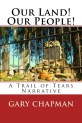
OLOP Cover Photo 3 OOMH TRFBWcover

A Chapman is literally and historically a peddler, often of books as well as other trifles. That is how we began anyway, and I have been continuing the tradition. The first popular books for public consumption were chapbooks. Today we would call them pamphlets or paperbacks. One of my favorite Seventeenth Century chapbooks, held in the Lowenbach Collection in Chicago when I was the curator, was titled “Cures for the Plague,” and of course none of the cures would have worked.

One of the advantages of travelling around the country peddling my books is finding out where I have made mistakes in writing them. This has got to be as true when a person writes historical fiction as when writing legitimate history, if that person is concerned about getting as close to the truth as possible, both in telling a good story and in telling an accurate one.

I have known that the stories I have written in my retirement years have been about histories that will never be totally accurate, but are important nonetheless. I have tried to write my father’s early life stories so that they would be interesting and faithful to his spirit, my son-in-law’s and his brother’s emigration from Vietnam and Cambodia so that the stories would honor the ancestors who made their lives possible, and my wife’s Cherokee ancestry so that more contemporary people would appreciate the real sacrifices that have been made in building our country and the values that we should try to serve, even when they have not been served well in the past.

Talking to other people who know some of these backgrounds can be humbling. The soldier who served in Vietnam told me that he doesn’t want to listen to someone who wasn’t there, and he doesn’t want to hear the stories of his enemies, and I can understand his reasons. The family member doesn’t want to have the privacy of her dear deceased grandparents invaded, and I sympathize with that motivation as well, although our grandparents had nothing to be ashamed of and  much to make them proud. The active member of the Cherokee Nation doesn’t need another white man making money off of his people. I can only reassure him that I am not making any money.

I am learning and correcting as I go. I am finding out much that I could not have if I had not published. I am discovering that it is good to write on matters in which you have little prior knowledge or experience, because you begin to fill the holes in your own ignorance.


Moving On from ‘A Fail’

28 Wednesday Sep 2016

Posted by chaplines2014 in Disabilities, Faith, Gullibility, Learning from mistakes, Words

≈ Leave a comment

Tags

life experiences, Out of My Hands

3 Owls

Yesterday I got the news. I had failed. There was good news with the bad. I had averaged six and a half hours a night during the past six months with the blessed Bi-PAP machine. My number of apnea incidents per hour had reduced by… three. Whoopee! The resulting total made it three times the acceptable goal. My fifth mask had done pretty well. It usually let me sleep an hour before waking me. Unfortunately my face is evidently misshapen from what any of the existing masks fit. The neurologist’s verdict—a fail.

It is not easy to accept failure. I never failed a course. That ‘B’ in English the freshman year in high school, and in Biology in my sophomore year in college, were had to take, but in my defense I suffered with a kidney stone and infection during that college semester. I was never fired from a job, and when one job ended I always had another one to go to. I married one of the most helpful, loving, and gracious persons in the world, and we had two wonderful children who found terrific spouses, and we have three fantastic grandchildren who amaze us with their accomplishments, and they all still love me. At least they do everything to make me think they do. Somehow I have survived illnesses and close calls and the deaths of people close to me, and to faith goes the credit, but I made it through. I have made many mistakes and people have for the most part forgiven me and let me know that. I have enjoyed a long career that was, if not successful, at least fulfilling and rewarding in every way that I could expect. I consider myself to be one of the richest, most fortunate people who have ever lived, even without winning a lottery. Why buy a ticket? I can donate directly to the schools.

The money that my insurance companies have spent could have helped someone who really needed it. It could have bought a new car. (Not for me. I didn’t really need a new car.)

I am pretty tired of the Bi-Pap machine, but I will continue to use it until something else replaces it. I cannot remember sleeping so badly for months at a time, and feeling so exhausted because of it. I am cured of the sin of looking forward to bedtime. The initial hopes of reduced angina and arrhythmia have given way to just being glad I do not bother my wife with snoring as much as I did. That is probably enough, come to think of it.

One is supposed to learn from failure; it is respected as a great teacher. Next on the agenda is an “oral appliance.” I will make a call to the installer now. I have been delaying long enough.

Becoming a Draft Counselor

18 Monday Jan 2016

Posted by chaplines2014 in Citizenship, Events, Faith, Growing up, Learning from mistakes

≈ Leave a comment

Tags

Books by Gary Chapman, Memories, Out of My Hands, The River Flows Both Ways, Vietnam and Cambodia

Chicago skyline 1970

I was almost finished with applications for conscientious objector status when a physician informed me that the question had no personal significance since I would not pass the physical examination anyway, even if I wanted to serve in a non-combatant role. Since I was opposed to the U.S. involvement in the war in Vietnam, I looked for other constructive ways to be involved. In the fall of 1968, as we took up residence in Chicago and I continued graduate studies for ministry, I entered the American Friends Service Committee training for draft counselors.

Having training in law would have been an advantage in dealing with the selective service system and legal precedents in the cases that we studied, in order to give helpful information to people who came with concerns, both draft-eligible men and their families. Having more experience in counseling also would have been useful, but some of that came with the counselees as they presented their questions. Motivations and concerns varied greatly, and responding equitably and sympathetically to people who held different beliefs and values was challenging. Enough trained people participated as counselors that it was not overly demanding for each of us who entered the volunteer AFSC network, and that was important as I tried to balance all of the requirements of study, work, service to others, and being a new husband. It could have been much harder, and I still would not have faced a fraction of the hardships that several of my friends and family, and especially my family-members-to-be, were facing in Vietnam.

Those who came with questions included people who were conscientious objectors, people who were simply draft avoiders, people who wanted to help others in their family or friendship circles who were having trouble dealing with the variety in draft boards and their practices, people who were in the military service but unwilling to fight in Indochina, people who were already in trouble one way or another, and those who were interested in all the options that were available before they committed themselves. We all had a lot at stake, and, although I was glad that an all-volunteer force replaced the selective service system, finding ways to serve our country as good citizens was in front of all of us in ways that have not been matched afterward.

Serving our country as citizens remains a universal duty, but being willing to kill people who differ with us in perspective, who are not threatening us, as persons or as a nation, in any direct or meaningful way, is not justifiable. Often personal judgment must be set aside, but too often conscience has been set aside as well, in responding to the orders that come from a chain of command.

We are now in the gap between the Vietnam War’s foggy beginnings and ignominious ending fifty years ago. I still puzzle about how to honor those who served their country as soldiers and those who served their country as resistors, then and now. The phrases “serving our country” and “defending our freedoms” pass easily off the lips of many people. The reality is much more complicated and difficult.

Jan identifies with her mother so much that…

01 Thursday Oct 2015

Posted by chaplines2014 in Caring, Learning from mistakes, People, Travel

≈ 1 Comment

Tags

events, Out of My Hands

dock at sunset

Three and a half weeks after her mother fell and broke her neck, nose, and three other compression fractures in her back, as well as badly bruised her face, her mother continues in therapy and in the care of staff in a nursing home. Jan spent twelve nights in all with her mother, attempting to work out the challenges of pain-relief and sleeping medications, staff responses, and keeping her neck brace in position without her mother removing it. Finally, a tentative stability achieved, Jan returned to her own life and got some rest.

One night her mother had spent several hours preparing for her first grade class of school children, identifying their individual needs, and strategizing how to meet those needs. Of course she retired nearly twenty-five years ago, but she had taught for more years than that, and it is easy for her mind to return to those years, even as she also slips back into the early years of motherhood, or childhood with her own mother. Jan could easily identify with each stage of her mother’s concerns.

Jan was nearly caught up with her rest, as we travelled to Lincoln, Nebraska, for an enjoyable day with Granddaughter Willow, a trip that we had postponed because of Mother’s needs. On the way back, we stopped at one of Missouri’s remaining rest areas. Gary took the Nguy family beagle, Odette, into the pet walking area. Odette had stayed with Willow for six weeks but worn out her welcome with her persistent demand to be outside when Willow needed to study. We volunteered to take Odette back to O’Fallon. Jan sat in the car, finishing a phone conversation.

When Jan got out to walk to the rest station, her toe caught on a parking barrier, and she fell face-first onto a concrete curb. Her face was bloodied, scraped, and bruised, but her glasses somehow escaped with just a bend in an earpiece. Gary came running when he saw Jan lying flat, put Odette in the car, and checked Jan out. She was bleeding profusely, but the two small facial cuts were closing quickly with pressure. Her nose was pouring, so we used Jan’s tried and true method of a small compress under her upper lip, and it began to slow, and finally stopped after five minutes.

A rest area worker came quickly when she saw us on the ground. She was so focused on Jan’s visible injuries that she stepped on the glasses, but she was so eager to be helpful that we could not fault her. A pediatrician and his wife were next to help. The doctor admitted that Jan was older than his usual patients, but the injuries looked familiar. He checked her over, said that one stitch or a butterfly bandage might be useful, made sure that she was not feeling pain anywhere else that might indicate a break, and discussed what to watch for in concussion symptoms, which were not appearing—no headache, vision or dilation effects, or confusion. The rest area worker helped Jan into the restroom to get cleaned up.

We made stops at Walgreens and CVS forty minutes later to get bandages, antibiotic cream, and antiseptics. We passed four hospital signs during the rest of the trip, checking with each other about the advisability of stopping, but we arrived at O’Fallon six hours later.

Jan had copied her mother’s accident, in facial injuries, but not in broken bones, fortunately. She had two seriously black eyes and a nasty abrasion on her forehead to alarm and impress Alicia, Au, and Symphony. Alicia had fallen down her stairway a few years ago and seriously damaged her knee. Jan could easily identify with her mother and her daughter in an even more intimate respect.

Labor Saving Devices (Chapter 28, Out of My Hands)

25 Monday May 2015

Posted by chaplines2014 in Books by Gary Chapman, Farm

≈ Leave a comment

Tags

Books by Gary Chapman, Out of My Hands

OOMH

Riding the sulky plow and the disk and the harrow behind the horses, I was relieved to be preparing the soil for planting. Earl helped a lot with the disking and harrowing. We used both spring tooth and spike tooth harrows to break up the soil into a fine mix, and we usually had two or even three teams of horses working in the field. Grandpa had bought a “Combined Check Row Corn Planter” made by the Chambers, Bering, Quinlan Company at Decatur, and we had to learn how to use it. The planter used wire-tripped check plates and a wheel driven chain to create a planting pattern that made cultivation in more than one direction possible. If it worked the way it was supposed to, we would not have to follow the cultivator with hoes and clear the weeds by hand in the row near the new stalks. We finally figured out how to use it. When we cultivated we still had to do some hand-hoeing and weed-pulling, but the cultivator did more of the weeding than it could do before.

When time came to cut the winter wheat Grandpa brought home a new McCormick Deering mechanical binder.

“What’s going on, Grandpa? You never bought so much new equipment at one time,” I said.

“I’m looking ahead. If these machines can save half as much labor as they say they can, I’ll be able to keep farming and supporting myself after you boys have gone out on your own. You won’t have to worry about your Grandpa when the machinery does the farming. The farm will take care of me, instead of vice versa.”

“That will be the day, won’t it?” I replied. I didn’t know whether there was such a thing as a labor-saving device. Most of the machines that I had seen working soon broke down and took even more work to fix. Yet machines fascinated me, and I enjoyed seeing new inventions operate.

The mechanical binder looked like a platform on wheels, with a windmill apparatus at the front and on top. In front of the platform, a mowing sickle slid back and forth, as the horse pulled the machine. A chain drive from the wheel-shaft powered several pulleys and steel belts that moved the sickle and cut the wheat stalks. The drive also powered the mill as it laid the wheat neatly onto the platform that moved the wheat back into a collector that rolled and tied each bundle of wheat sideways. The bundle either fell to the ground or a man could pick up a completed wheat bundle at the side of the platform and place it on a rack. The machine, if it worked properly, would eliminate the separate mowing with a scythe or cradle, the raking of the cut stalks, the hand tying of bundles, the forking of the bundles onto a hayrack, and the losing of a lot of wheat grain on the ground.   Three workers could still help—one to drive the team that pulled the machine, one to pick up the bundles and toss them onto the rack with the seed heads pointed toward the center of the rack, and one to drive the team that pulled the rack and stack the seed as high as it could go. In a pinch, one person could operate the machine by himself, and come back later to pick up the bundles, but that was a lot to try to do by oneself.

The machine operated beautifully through nineteen acres of wheat, while Grandpa, Earl, and I worked. Then the tying apparatus began to malfunction, and the twine got fouled and knotted into such a mess that I had to use my pocket knife to cut the knots apart. We finished the last acre with me hand-tying the bundles that rolled up to me on the conveyor, and tossing the bundles onto the rack. That was still easier than the old method.

Two full racks of wheat, with bundles stacked to three times my height, waited in the shed until the threshing machine was available.

Bootlegging…the Family Business

23 Saturday May 2015

Posted by chaplines2014 in Books by Gary Chapman, Events, Growing up, Gullibility, Learning from mistakes

≈ Leave a comment

Tags

Books by Gary Chapman, Out of My Hands

OOMH

My Uncle Albert Hunsaker had sold his share in the railroad as it was going bankrupt, and I didn’t know how he was making a living. He and Mary had gotten a divorce. She and the four children still at home continued to live where they had at Yale, but Albert rented a room in an old boarding house nearby with three other guys. Grandpa had suspected that he was making his living by bootlegging, and mentioned it to me, but we did not really know what he was doing. He had lost his car, so he approached me for a ride. He said he had a job over in Indiana. “Could you take me in your Model A?”

I wondered what kind of job he was talking about, but he had helped me get to my jobs years ago, and he was my uncle, so I decided I could drive him where he needed to go. He loaded my car with his “gear and tools,” he called them, and we took off on Route 40 headed east. Meanwhile the Cumberland County sheriff had caught on to his bootlegging operation and came after him. He kept looking back at the road behind us, so I suspected something was wrong. Suddenly he ordered me to turn off the highway onto a dirt road, and he told me to look for a hiding place for the car and ourselves in a gravel pit that was at the end of that road.

“What’s going on?” I yelled at him. “I’m not going to break any laws,” I insisted, but he informed me that I already had. His “gear” included bootlegged liquor and, whether I liked it or not, I was an accessory, and the law would treat me as guilty as he was. We hid ourselves overnight. During the night, while we hid in the dark and didn’t dare even to light a fire, he told me about various trips he had made in recent years. He had carried liquor and made enough to support himself. Sometimes it was over the Canadian border between Detroit and Windsor. More often he carried between Illinois and a club in Indiana. He worked with people connected to the Chicago crime syndicates and Al Capone. He would be in worse trouble if he did not complete this delivery, so I continued the trip with him, and made it back without any further incident. I informed him that I was never going to do that again. “Don’t even think about asking!” I told him.

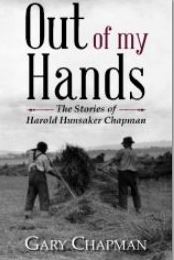
Out of My Hands: The Stories of Harold Hunsaker Chapman

05 Tuesday May 2015

Posted by chaplines2014 in Books by Gary Chapman

≈ Leave a comment

Tags

Books by Gary Chapman, Out of My Hands

OOMHA poignant personal memoir, Out of My Hands presents the story of Harold Chapman, a Jasper County boy, born at Yale, Illinois, in 1911, whose difficulties begin in the grip of one of the worst influenza outbreaks in history.

With his mother dead, seven-year-old Harold must take on the care of his siblings—who soon increase in number when his father and the nanny he hired to help them produce a seventh, then an eighth, child. But tuberculosis and a disastrous move to eastern Colorado weaken Harold’s father, leaving Harold responsible for getting the farming and ranching work done.

Extended family, friends, and community always come to the aid of Harold’s struggling family, and Harold’s maternal grandparents play a significant role in their lives, instilling values and imparting the skills the children will need to survive before and during the Great Depression.

Harold becomes a breadwinner early in life and as a teenager works at a gas station, a repair shop, and a dairy farm as well as in the cornfields and hayfields of Illinois doing menial labor.

An often-humorous tale of hope and perseverance, Out of My Hands was written by Harold’s son, Gary Chapman, based on Harold’s first-person stories about growing up, helping his family, and overcoming life’s inevitable obstacles.

Available from Create Space Publishers, http://www.createspace.com/4876050 , http://www.Amazon.com, and your local bookseller.

Back Cover Summary: Based on his stories about growing up before and during the Great Depression, Out of My Hands begins with Harold Chapman as a young boy whose life is turned upside down when his mother falls victim to the influenza epidemic sweeping the nation.

Charged with helping raise his brothers and sisters, Harold finds himself and his family shuffled from one home to another, from the rich fields of Jasper County, Illinois, to the dusty ranches of eastern Colorado and back.

After branching out on his own at the age of fourteen, Harold scrapes by for years working hard at various jobs…especially after he meets Vena, the girl of his dreams.

Years of waiting, working to secure enough income to provide for her, and respectfully courting her finally draw near to the time of their marriage, when Harold discovers that, no matter how prepared you think you are, there are always more obstacles to overcome in life.

Lessons on how to keep a skunk from spraying you

27 Monday Apr 2015

Posted by chaplines2014 in Books by Gary Chapman, Growing up, Gullibility, Learning from mistakes

≈ Leave a comment

Tags

Books by Gary Chapman, Out of My Hands

OOMH

Walter Wehmeyer and Gerald Golden sat behind me at school, which meant they were a grade or two ahead of me. They were always bragging about something they did or knew how to do.  One day they were talking on the playground about how they were able to disarm skunks.  There was one sure way to keep a skunk from spraying you, they said.  You have to approach very slowly and carefully, not doing anything to scare it, talking softly and all friendly-like. Then you could use a pole to lift the skunk’s back legs off the ground, so the skunk couldn’t use its scent sack to spray you. Then you could do anything you wanted with it.

Later I took the bait and tried out their advice. There was an old broomstick in the shed. Skunks often nosed through the garbage pile in the corner of our yard. We dumped peelings and bones and other garbage there. I snuck up while a skunk was poking through the garbage and eating.  I got that stick under its back legs and lifted it up quickly. For the split second that the skunk’s feet were still in the air, the air filled with the most horrid stench you can imagine. I could stand the strong scent of a skunk from a distance, but up close it took my breath away. I thought I’d die, and mostly I wanted to.

Bonnie (my stepmother) set up a galvanized tub in the yard. My sister and brother took turns hauling buckets of hot water from the stove reservoir, and Bonnie poured on the strong lye laundry soap, but it didn’t help much. The Jenkins gave Bonnie some tomato juice they had canned, and made me wash with it, but I couldn’t tell that it made any difference. We burned my clothes, so I only had one outfit left to wear.  Several days passed before I was allowed to return to school, only to face smirks from Walt and Jerry.

The Long Walk Home… April 1, 1925

02 Thursday Apr 2015

Posted by chaplines2014 in Events, People, Seasons

≈ Leave a comment

Tags

Out of My Hands

purple butterfly

Spring was on the way again, and we were busy with the preparations. Grandma supervised the planting of the seed trays again, but she did not come out to watch the garden being plowed.

Our neighbor Elza Warfel lived a mile north of us. He came to the house on Thursday, March 19, saying he had been hearing some news and wanted to make sure we knew about it. A horrible tornado had ripped through southern Illinois just sixty miles south of us. The tornado had been worse than any storm on record.

“Even worse than the tornado that hit Mattoon and Charleston in 1917?” Grandma asked. She marveled that any storm could be worse. Nearly a hundred people had died and hundreds of homes and businesses had been lost back then. Grandma had known some of the people affected. It had been so close to home, and familiar places had disappeared.

“This is so much worse than that, people are wondering if it is a sign of the end,” Mr. Warfel said. The tornado had traveled nearly three hundred miles from Missouri through Illinois into Indiana. It hit Murphysboro, West Frankfort, and dozens of smaller towns, farms, and schools. It traveled fast, during the afternoon when everyone was busy and going about their regular jobs. A thousand people may have died, more thousands injured. Thousands of homes were gone. No one had ever seen such a storm.

“It strikes the just and the unjust,” Grandma said quietly. “In an hour when no one expects it.” And she closed her eyes and I think she may have been praying.

Why wasn’t there any warning?” Grandpa wanted to know. “They have telegraphs, and telephones along the railroad tracks, and people can see what’s happening. Why don’t they tell the people ahead that something’s coming, so they can find shelter?”

“I don’t know,” Elza said. “The government says they don’t want to alarm and frighten people, but people do need a warning. It seems that times are getting worse and worse. Things are changing.”

Grandma shed tears for the suffering she continued to hear about. The death toll reached seven hundred people, with fifteen thousand homes destroyed. We were only a few miles away, but we did not know what to do to help. She was small enough to start with. She seemed to shrink before our eyes, except for the enlargement of her legs and feet. Grandpa and Chlora wrapped her legs and feet with white gauze as the doctor had told them to do, but it didn’t seem to help much.

A week and a half later, in the evening, Grandma announced softly that it was time for her long walk. We looked at each other, puzzled, but no one asked her what she meant. She asked Mary to read to her from her old bible, the Twenty-third Psalm, which Mary did, stumbling over some of the words and needing Pearl’s help. Grandpa needed to help her move from her easy chair in the parlor into the downstairs bedroom. She didn’t wake up the next morning. Grandma died on April 1, 1925. We thought it odd that she died on the day everybody called “April Fools Day.” She could never tolerate fools.

“Grandma enjoyed these last few months, didn’t she?” Mary said.

I pictured her at the Christmas tree. “I guess she did,” I said to Mary.

The undertaker came from Hidalgo, bringing a casket, and set up the casket on a stand in the parlor. Family and neighbors came from all over the neighborhood , bringing food, and visiting through the evening, and some stayed up through the night, as we prepared for the funeral the next day.

Brother Hutson and Brother Ward and other elders of the church came and prayed with us during the evening, and they returned in the morning when we closed the casket. They walked with us as my two uncles, three cousins and I carried Grandma’s  casket to the black funeral carriage pulled by two black Belgian horses. We followed the carriage in Grandpa’s Model T. Other cars and horse-drawn buggies followed us as we drove the three and a half miles toward Aten Cemetery It was a slow ride through Hidalgo, and then we turned right on the dirt road that led to the woods northwest of Hidalgo. Her father, Solomon Cooper, had been buried back in 1899– after the service we found his old  tombstone. Grandpa Lon said he would be buried there, too, right next to Grandma. Aunt Allie and Uncle Bill said they had a plot right next to Grandma’s and Grandpa’s. It seemed strange that my Mom and Dad, and Grandma and Grandpa Hunsaker, would be in different places, but I guess it didn’t matter.

← Older posts

Subscribe

  • Entries (RSS)
  • Comments (RSS)

Archives

  • February 2022
  • May 2020
  • October 2018
  • December 2017
  • November 2017
  • October 2017
  • June 2017
  • April 2017
  • March 2017
  • February 2017
  • January 2017
  • November 2016
  • October 2016
  • September 2016
  • August 2016
  • July 2016
  • June 2016
  • May 2016
  • April 2016
  • March 2016
  • February 2016
  • January 2016
  • December 2015
  • November 2015
  • October 2015
  • September 2015
  • August 2015
  • July 2015
  • June 2015
  • May 2015
  • April 2015
  • March 2015
  • February 2015
  • January 2015
  • December 2014
  • November 2014
  • October 2014

Categories

  • beach
  • Books by Gary Chapman
  • canoeing
  • Caring
  • Cherokee history
  • Church
  • Citizenship
  • Death
  • Disabilities
  • Events
  • Faith
  • Farm
  • fighting fires
  • Forest
  • Garden
  • Growing up
  • Gullibility
  • guns
  • Health
  • Hiking
  • House
  • Innocence
  • Learning from mistakes
  • Life along the River
  • Miracles
  • Nature
  • Patience
  • People
  • Prayer
  • Racial Prejudice
  • rafting
  • Running
  • Seasons
  • Small town life
  • Suffering
  • Travel
  • Uncategorized
  • Vehicles
  • Volunteering
  • Words
  • Yard

Meta

  • Create account
  • Log in

Create a free website or blog at WordPress.com.

Privacy & Cookies: This site uses cookies. By continuing to use this website, you agree to their use.
To find out more, including how to control cookies, see here: Cookie Policy
  • Subscribe Subscribed
    • chaplinesblog
    • Join 71 other subscribers
    • Already have a WordPress.com account? Log in now.
    • chaplinesblog
    • Subscribe Subscribed
    • Sign up
    • Log in
    • Report this content
    • View site in Reader
    • Manage subscriptions
    • Collapse this bar
 

Loading Comments...