The End to the War on Christmas

Tags

A long time ago there was a “War on Christmas.”  I am thankful that the war ended and people arrived at a compromise. People used to complain about how the Christmas season began in the stores in September, and everyone had capitulated to the commercialization of Christmas and lost the spirit of Christmas.  Then the Great Compromise was reached and the last five weeks of the year were devoted entirely to Thanksgiving. People agreed that, whether one celebrated Christmas, Winter Solstice, Hanukkah,  Kwanzaa, The Holiday Season, New Year’s, or Epiphany, whether one gave gifts or enjoyed special food or fasted from both, we all had reasons to be thankful, and that one day a year for Thanksgiving was much too little. So the Season of Thanksgiving was born. What better way to end one year and begin another than to give thanks?

To whom? Most people give thanks to God, but the spill-over into giving thanks to one another and the ability to be gracious even to those we disagree with, when we are truly grateful, are reasons enough to be tolerant of those who can’t agree about how to give thanks to God.

Some people continued to give thanks for the birth of Jesus as part of the general thanksgiving, and sang carols in the same ways and words they always had sung. A minority moved Christmas into springtime, and connected it with Easter, since the story of Jesus’ birth belonged in the springtime, when the shepherds were actually in the fields taking care of their sheep, and Easter and Christmas did logically belong together, they said, with “new birth” and incarnation themes. That meant a lot of familiar carols were sung to new words. “In the Bleak Midwinter” became “In the Blessed Springtime” and  “Greensleeves” came to be called “Greengrasses,” which made more sense anyway, since no one knew what green sleeves was about. Other people gave thanks with the Santa Claus custom and continued the gift-giving traditions that came with it. Lots of things gradually changed.

“Seasons Greetings” was always too generic, while “Merry Christmas” was too specific, so “Be Grateful” came to dominate. Partly a happy wish and partly a serious recommendation, there was no room for a Grinch to be a grouch anymore. People agreed that everyone surely had something to be grateful for, and, if they didn’t, there was even more reason to spread good cheer by sharing in the spirit of Thanksgiving by giving to those who had little.

“The Twelve Days of Christmas” became the “The Six weeks of Thanksgiving,” and lots more verse were added to the song, since there were now forty-two days for “my true love’s” gifts. The single day of feasting that recalled the Pilgrims at Plymouth gave way for some folks to continuous feasting during the six weeks so that all of those end-of-the-year family eating traditions could take their rightful place as part of Thanksgiving. Of course that didn’t really change from the way the end of the year had been observed for those folks anyway.

Wars need to come to an end, and the spirit of Christmas predominated finally over those who were resentful and jealous of the many customs that encroached upon Christmas. They understood that resentment and jealousy had no part in Christmas, and so they led the way toward a truce that captured the best of all the competing factions. And nowadays when we sing “Silent night, holy night,” it really is calm and peaceful. Thank God! Be Grateful!
oodles of noodles

Tags

Oodles of noodles covered the beds, the tables, and every available flat space in the house. This is how our house looked as my mother prepared for the annual church holiday bazaar. After a few days and the noodles were dry she would package them in appropriate quantities, dozens of large bags for the chicken and noodle supper at the bazaar, and scores of small packages for direct sale at the bazaar tables. Hundreds of thousands of noodles prepared my mind to receive “string theory” as the ultimate building block in the construction of the universe; only to me it will always be “noodle theory.”

Those noodles were delicious, and the bazaar always was an outrageous success, leaving the women’s organizations that sponsored it with the problem of what to do with all their money. During the noodle days in later years I had to be careful about inviting ourselves, with our children, to come home for a visit, if it was noodle time. All of those beds, that she made sure were available the rest of the year for our visits, would be full in those days.

A house filled with noodles is one of my images of abundance. I lived with them when I was growing up. I saw them in return visits. I still have pictures of them. The world is chock full of noodles.

Thanksgiving and Christmas together illuminate the exceptional abundance available to us in this world. The tables overflow with enough for everyone, including those who are poor, if we make some effort to allow access to the tables for them and to them.

In all the world there is excess—in its immensity and in the extraordinary patterns in even the smallest things we find. When we make the effort to duplicate them, we see that inherent intricacies far outstrip our creative abilities. Instead we must simplify and summarize, missing most of what exists. There is an elegance in things that speaks to us of profound generosity and attention to details. There is excess that allows us second chances, and third and fourth, and ninth if we are cats, and more if we are people. Whether we examine the microcosm or the macrocosm the universe is excessively generous.

So our making of noodles can go on and on, without approximating the slightest part of divine benevolence. In God’s magnanimity our little repetitions and duplications are honored, even when God makes everything new and unique. We will gladly taste them again, and fill ourselves up with the same thing, even though there is something slightly different every time, as the excellent cook tries to improve upon the best recipe, and as the tiny noodles in all creation align themselves in new and not exactly predictable patterns.

Christmas at the Warfels, 1930 (from Out of My Hands…Stories of Harold Chapman)

Tags

Carl’s family didn’t have any extra money to celebrate Christmas
in their usual way that year. There was no money to buy a tree, and
cedar trees did not grow freely around Tolono as they did on the hills
and scrub areas of Jasper County. Everything in Champaign County
is as flat as flat can be, and the prairies are treeless as far as the eye
can see, except where people plant trees around their houses, and
the rows of osage orange trees planted as fence rows and windbreaks.
Vena decided they were going to decorate a tree anyway. She went
searching and cut the largest dried weed she could find, six feet tall,
and brought it home. She and her little brothers and sisters turned it
into the Christmas tree for their house in 1930. The little ones were
delighted.

the color of Christmas

What color is Christmas? Silly question. It is many colors. But the memory of a child’s question came to mind when Crayola announced the cancellation of its “flesh” and “Indian red” crayon names. Flesh too is many colors, and Indian red got confused with Native American colors instead of the East Indian color it was supposed to resemble. So those colors had to go. 

When I was a child I most certainly would have said “red and green.” All the construction paper projects we made in school for Christmas were red and green. But that has changed, too, just as surely as the season is now known as the “Holiday season,” including not only the Advent and Hanukkah traditions I grew up with, but  Kwanza and many others. Many colored lights compete and confuse the selection. 

Violet and blue appear on the church color calendar. For relatively obscure reasons they show up for Advent just as they do for Lent, combining hints of royalty with the theme of penitence. Why purple? Who knows? It is more apt to signify unleashed passion today, than self-denial and solemn preparation. 

So I am going to suggest that brown is the real color of Christmas. Just try to find a brown bulb. Try to light it! 

Brown is the color of a donkey, the wood of a stable, unbleached cloth, straw– in many shades of brown of course. And brown is the color of flesh, in just as many shades, the flesh that Jesus came to deliver, not necessarily the flesh of a newborn delivery, which almost always shows up pink and red at first, then gradually moves into its various shades of brown, pale light to rich dark. 

Brown contrasts with the colors usually chosen for Christmas, which tend to be bright and garish. Silver and gold decorate a lot of things, but that we should save for Epiphany, long after Christmas, when the magi brought their unusual gifts. According to Matthew that may have been up to two years after Jesus’ birth. In the stable silver and gold are out of place. Life shows up as it is, humble and needy, connected directly to God’s love poured into human flesh.  

If it is to be red, it must be the red of birthing blood. If it is to be green it must be the green of grass where sheep safely graze in the fields around Bethlehem. 

Some suggest Christmases must be white. Not me. Too much trouble surrounds that color. I leave white well enough alone. Plain old brown it is. No fancy names to obscure the reality. I will decorate with brown. No one dares to cancel that color.

Swedish Christmas with the Johnsons…1925 (Out of My Hands: Harold Chapman)

Tags

,

IMG_1568

I didn’t go to church until Christmas, when it was obvious that Mr.  and Mrs. Johnson were eager to have us go. Back home sometimes I  had not attended for several weeks in a row, so I had not given much  thought to going to church here, where I was a stranger to everyone.

The prospect of Christmas services interested me. I had enjoyed hear- ing Christmas hymns and stories at home. Mrs. Johnson hung some suits and dress shirts on the coat pegs in the pantry where we ate. We  took them back to the bunkhouse to try on, and we each found a suit  and shirt that fit well enough. Herman decided he would go with the  Johnsons and me to the Lutheran Church. John and Ira had family in  Rock Island that they would join for Christmas.
The church was a large brick building with a central bell tower in  front with the main entrance below the tower. Inside the church the  abundant boughs of evergreen, silver and gold ribbons, and candles  dazzled me and perfumed the air. The pews rapidly filled from back  to front, and a choir of singers filled the loft that rose behind the high
central pulpit. A spruce tree stood from the floor to the high ceiling on  one side of the loft, filled with candles and ribbons, and a huge organ  covered the front wall with pipes and a carved case. The organ began  to play, filling the large room with wondrous sounds that vibrated the  furniture and the many-colored glass panes in the windows. I sat in awe.

This was so much different from my little frame church in which the  people refused to use instruments. People sang out in both churches  though. Here they sang about Christmas with songs I had never heard,  but they were beautiful.  Toward the end of the service, ushers lighted  candles and passed them from person to person, and the people joined  in singing some songs in Swedish, which must have been about Jesus’
birth, though I didn’t understand a word. I was glad I went. It was really  something!

Mrs. Johnson served Christmas dinner to all of us in the dining  room—honey glazed ham, mashed potatoes and sweet potatoes, a sweet- bread dressing, corn, green beans, a variety of pickled vegetables and  little fish, and many cakes, candies, and puddings. They were all laid  out on a buffet and she called it a smorgasbord. We could keep going  back for more of anything we wanted. Their sons were home, and all of
us made pigs of ourselves. They asked us to say whatever prayers we were  used to saying, and I said Grandpa’s prayer—“Lord, bless this food for  its intended use and us to thy service, and, God, save us. Amen.” The  Johnsons all said a prayer in unison in Swedish, but they had taught us  the English words, too. They were—“Come, Lord, Jesus, be our guest,  and let this food to us be blessed. Amen.”

Glory in the lowest!

Tags

Here in the last days of calendar autumn I look out at the oak trees and still wonder at the remaining colors.  Hidden all season by vibrant greens were these yellows, oranges and reds, as well as the base of rich and varied browns. (You remember my claim that these are the true colors of Christmas, made holy in manger and straw and animal skin.)

But this is a bright sunny day of redheads. First arrived the little Downy woodpecker and its mate, with their black and white barred coats, then the large outrageous Pileated woodpecker came, looking like the remnant of an ancient race. Then came the regulation “Northern” woodpecker, its mate wearing a rather plain tan coat except for that fierce black triangular breastplate. They all work with amazing determination and skill, flying straight down, straight up, perching upside down, beating their heads against the grain, finding all those tiny moving morsels, ugly to me but appetizing to them. The redheads of course include the cardinals and the tanager, whose mate still wears a luminous green coat, which I would have thought she would have shed for a less noticeable one in these woods.

I wonder what the redheads would do with that red and yellow centipede I found yesterday. A mean looking creature, four inches long, scurrying with uncountable legs, with biting pinchers and stingers that intimidated me. A too close encounter would send any sensible person to the Emergency Room. Would they have digested it, enough for several meals, or would they have left it well enough alone? More friendly encounters occur with the humble walking sticks, affixed to anything stable, enjoying the last warm autumn hours.  At six to nine inches long, some of them look like walking branches, large enough for the birds to perch on.

With all these decorated creatures hanging around, I am transported to the scene last night, when the curtains of clouds suddenly revealed themselves as no clouds at all in the northern night sky. They were lights, Northern Lights, shimmering in that rare dance of sunspot rays that fills the northern sky, first with white light, that I mistook for clouds, then gradually revealing all the colors of the rainbow. They shimmered and danced in splendor.

And we think that we will decorate for Christmas? Who can match the extraordinary display that is already in place for us to see?  Glory to the Son! Glory in the Highest! And the lowest.

December 25, 1838 (from Our Land! Our People! a Trail of Tears Narrative )

Tags

, ,

snow geese migration near St Elmo IL, Dave Moody 2

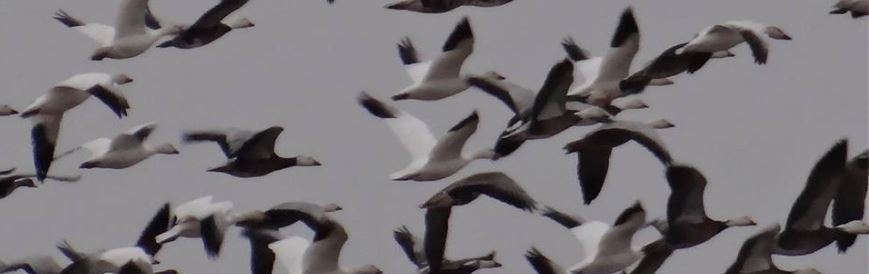
Flocks of Canada geese made lots of noise this morning to wake us up. We followed the Post Road today into a pine forest along the Illinois Bayou. Tomorrow we will follow the river upstream until we find an easier place to cross. We are not near a town now, just out in the middle of the woods.

Sarah remembers decorating for Christmas at the Moravian missions at Springplace and New Echota. The missionaries cut evergreen bows and brought them inside. They filled their chapels and houses with candlelight on this evening and the coming day to celebrate the birth of Jesus. We are outside among the pine trees and under the stars tonight, with a blazing fire to keep us warm. She says the story of Jesus began with Joseph and Mary taking a long trip to Bethlehem, ordered to do so by a distant government, and giving birth to Jesus in a stable. We are doing something like they did. I would enjoy the warmth of a stable tonight. Otherwise our night is much like theirs. It is a good starry night to remember that the Great Spirit is with us too.

…excerpts from Red Wolf’s (John Francis Bell’s) Day Log

The light shines in the darkness

Tags

The farm where I grew up was 320 acres, a half-section. That meant that the “back sixty” field lay a mile south of the farmhouse and buildings. My jobs as a youth included the best jobs in driving the tractor—disking, harrowing, windrowing hay and straw, pulling the wagons back and forth. Those jobs didn’t involve a lot of skill, but there was pleasure in getting them done. Then I was often by myself, when Dad had other work to do, and now I find myself in memory, in the back sixty as the darkness of night approaches.

In those years “pole lights,” as we called them, were turned on by hand. Ours was a large incandescent bulb, maybe 250 watts, hanging about thirty feet up one leg of a tall windmill. Large sodium vapor lamps, and other automatic all-night lamps, had not yet brought to the countryside a crowd of bright lights to overwhelm the exquisite starscape of night.

Looking over the fields, no other pole lights would usually appear. The lights of distant neighbors would be blocked by the woods that grew along the river that wound through the area. When the time came for me to quit, when I had not finished before dark, the pole light would provide my cue. The planets and stars would begin to show up in the sky, and that one pole light would shine from my home. It would signal the end of work, the supper table nearly ready, and the time to turn toward home.

In the darkness, from a mile away one small light served as a beacon. For the next twenty minutes, riding the Farmall H or the John Deere A, following the farm lane north across the prairie, crossing the river bridge, opening and closing the gates that enclosed the cattle, the light beckoned—warm, inviting, reassuring, promising comfort, hunger satisfied, thirst quenched, and rest.

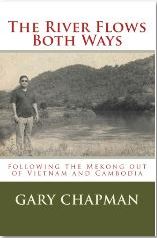
Christmas in Camp NW9 (from Ch. 14 “The River Flows Both Ways: Following the Mekong Out….”)

Tags

, ,

TRFBWcover

After the night passed, and nearly a full day in all, a truck arrived with Thai soldiers who identified themselves as Camp NW9 personnel. They climbed aboard and traveled another hour until they stopped toward evening outside a line of berms and trenches that surrounded several mat-sided, tin-roofed huts. People were milling around, feeding several evening fires and lighting torches. Single palm trees, saved from the clearing operation, gave the scene the look of an out-of-place beach. The residents seemed to be celebrating, talking loudly, sometimes singing. Stacks of rice bags and other boxes of food supplies sat under an open-sided roofed shelter.

Phuong and Long at first believed that this must be a wonderful place where people celebrated late into the evening instead of facing the sunset curfew which they had come to expect. The camp appeared to be a paradise compared to where they had been. When they began to wonder whether anyone knew they were there, the coordinator arrived. He welcomed them to Camp NW9, that had just opened last May, and he explained that this was Christmas Eve, 1980. They were celebrating Christmas, and singing Christmas carols, since several of the refugees and some of the staff were Roman Catholic.

The residents welcomed Phuong and Long to their Christmas celebration. They learned that Camp NW9 sat about six kilometers from Nong Chan. Just about all of the refugees there were from Vietnam. Most had walked across Cambodia.

Sure enough, after Christmas the curfew returned regularly as the sun went down, so residents had to stay near their huts, walk away only to visit the latrine, and stay off of the main paths. Everyone returned to the routine that included an early morning awakening to the distant sound of artillery shells. Every refugee took the metal cooking oil container that had been assigned to them to get the four liters of water that was their allotment. They had that much and no more for any purpose for which they needed water. Everyone had a paper pass with their hut number on it, and a record was made each time a person received a water ration. Volunteers among the refugees prepared the rice and canned sardine allotments into the meals served each day at noon and early evening. Sometimes the workers served soup, made of a few bean sprouts, lettuce of some kind, and water. There was no variety in the food available unless someone managed to trap a jungle rat or trade for a chicken. Long helped to clean the rats or other animals that men trapped, and he developed some skill in doing it, but while he was there, other volunteers did the cooking.

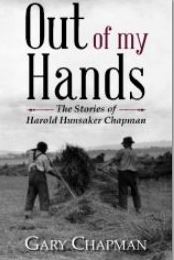
The Return of Christmas (Ch 22, Out of My Hands: the Stories of Harold Hunsaker Chapman)

Tags

,

OOMHWe hadn’t celebrated Christmas for several years. We were all sick with  the flu in 1918, and Mom died just after Christmas. Great-grandpa Ben  Hunsaker had died at Christmas in 1919. In 1920 and 1921 we were just
scraping by in Colorado, and we didn’t think we had anything to celebrate.  Dad died just before Christmas in 1922. The year 1924 was different.  Grandma started it just a few days before Christmas by saying,  “I’m tired of being sad at this time of year. It’s time for us to celebrate
Christmas again.”
Grandpa said simply, “All right.” He immediately sent Earl and me  out into the woods nearby to find a red cedar tree, “about as tall as you  are.” So we took a two-person saw, and we looked for a tree that had a  good shape and that was about my height. We found one, and sawed it  off, and brought it home. I found two two-by-fours, and Grandpa’s brace  and bit, and drilled a hole through the center of the boards. We cut a
couple of blocks the same width as the boards to nail to the bottom of  the ends of one board. With Earl holding the tree sideways and still, I  drilled a hole into the trunk of the tree. We found a seven inch spike in  a bucket of old nails, and we had a tree stand to keep the tree upright.  We proudly took it inside.

Grandma had popped corn and put Pearl, Mary, and little Lon in  charge of stringing the popcorn. Not much of Lon’s portion made it  past his mouth onto the string. They were plainly enjoying the tree-decorating. Grandma supervised the making of popcorn balls in exchange for a promise from little Lon that he would finish the strings.  Then they switched to strings of dried crabapples, so the tree was finally  crisscrossed with red and white garlands.

When the garlands were all on the tree, Grandma disappeared into  her bedroom for a while. She returned carrying a shiny metal star with  a candle holder attached to the front, and a partially burned candle in  it. She gave it to Chlora to crown the treetop.
Christmas morning we got up to a big breakfast. A bowl of oranges  was under the tree, and we each had one of them. There was also a bowl  of hard candy, a handful apiece, Grandma said, and six small boxes. We  children opened the boxes at the same time, and we each had a new pair  of brown cotton gloves. It seemed quite an extravagant occasion.

Grandma asked us what we wanted to eat for Christmas dinner.  What would be special? I had shot two wild rabbits a week before. Earl and Pearl suggested that we hadn’t had rabbit stew for quite a while, and  it would seem special, since we had eaten that stew so many times with Dad and Bonnie. So their suggestion won against the ham or chicken  or goose that the rest of us suggested. With Grandma’s supervision, the rabbit stew was filled with vegetables and potatoes and noodles, and
even small chunks of ham, and it tasted a lot better than any rabbit stew we had eaten before. We also enjoyed apple pie and pumpkin pie.  “Now I can pack my bags,” Grandma said. We looked at each other and wondered what in the world she was talking about.