• About
  • Celebrating our decades…
  • Welcoming all and inclusiveness

chaplinesblog

~ everyday and commonplace parables

chaplinesblog

Monthly Archives: January 2015

December 1, 1838, on Crowley’s Ridge, in John Bell’s Day Log

29 Thursday Jan 2015

Posted by chaplines2014 in Books by Gary Chapman, Cherokee history, Events

≈ Leave a comment

Tags

Books by Gary Chapman, Our Land! Our People!, The Trail of Tears

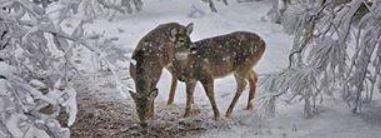
pair of deer in snowWhen we left Strong’s Inn this morning we followed the Military Road up a gradual incline to Crowley’s Ridge, which is the top of the bluffs along the river valley. We followed the ridge through wooded and hilly areas for several miles. The road stayed level, turning a little left and right, but not going up and down the steep ravines.

Not long after we reached the top of the bluff a doe and her fawn walked through the woods alongside the wagon train, about ten paces from the road. She kept walking alongside for at least two hands of time. Some wanted to shoot her, but my Udoda told them we had enough meat, and her feeling of safety with us was a good sign. Many of our people are Deer Clan. We can take their presence as a sign that helping spirits are with us on our journey. That reminded me of seeing the red wolf on the way to Ududu’s place, when I was feeling lost and weak. We feel blessed to have spirit helpers with us. It seems to be a rare and special event.

When the road turned west away from the bluff, the land became flat again. The trees changed from bare-of-leaf maples and brown-leafed oaks to pine woods bordering grass and marsh lands. In this flat area the road goes straight as an arrow. We can see all of the wagons stretched ahead of us for more than a mile. We didn’t go far today, before we set up camp. Those who stayed in the inn a second night will be able to catch up with us tomorrow.

On Crowley Ridge…the Trail of Tears

28 Wednesday Jan 2015

Posted by chaplines2014 in Books by Gary Chapman, Cherokee history, Events, Travel

≈ Leave a comment

Tags

Books by Gary Chapman, Our Land! Our People!, The Trail of Tears

Red Wolf2Snow and ice covered the roads on January 9, 2010, in Northeast Arkansas, so, true to southern pattern, few people ventured out, and the ranger at Village Creek State Park spent a lonely day in the visitor center. When I relied on my four-wheel-drive Jeep to navigate the hills and curves of the park, I was the only one to do so. The ranger doubted that I really wanted to drive two miles farther into the park, and walk the mile across the dam and into the woods, until I reached the last remnant of the original military road on Crowley Ridge. There the ancestors were among the 670 Cherokee travelers who followed the road west for 790 miles until they reached the Indian Territory that would “forever” be theirs for another forty years anyway.  But I was willing, and she gave me directions. There would be just enough time before sunset to make the journey.

Crossing the ice-covered dam tested my resolve,  as did the sound of dogs howling deep in the woods ahead, but I grabbed a straight branch for a walking stick, and walked on, following a marked trail, up and down the hills until I reached the ridge, and the simple historical marker. Only  a few miles remain of the original road, but I had time before sunset only to hike a mile of it before turning around to start back. The silence and the snow were sufficient to let me hear the distant echoes of  one hundred twenty wagons and carriages, pulled by teams of horses and oxen, accompanied by many walkers through the winter of 1838 and 1839. One hundred seventy years later, it was very quiet, but telling its story loudly.

I had turned around and started back when she joined me—a doe walking through the woods parallel to the road and about thirty feet away. She seemed curious about me, and as I did not threaten her, she walked along at that distance for about half a mile until she decided to amble down into the deep ravine.  I was glad for her company, and I could not help but think that all of the Bell ancestors of the Deer Clan would be pleased.

The question of burrowing muskrats

25 Sunday Jan 2015

Posted by chaplines2014 in Farm, Growing up, Nature

≈ Leave a comment

What makes muskrats build domed lodges in the middle of ponds instead of burrowing in the banks at the edge? A friend told me of the problems they were having with muskrats that erode the banks of their pond with their constant burrowing. “Just train them to build lodges instead of burrows,” I answered. The solution is simple enough.

I think about the muskrats of my childhood. We trapped the gentle rodents and sold their pelts for fur. Unlike raccoons, opossums and badgers, no one suggested eating muskrats, and their pelts were a poor value compared to mink and fox. Eventually we just left them alone. One year they decided to reward us by building the most amazing group of townhouses in the middle of our farm pond. Before that they, like my friend’s muskrats, had lived in burrows along the river.

Maybe someone knows how to train muskrats. I don’t. They gave their lodges to us freely, not knowing the gift they were giving. If we had tried to make them build lodges they would undoubtedly have returned to burrows. If we had made an issue out of it, they would have done whatever they wanted to do anyway. Muskrats are like that.

The issue is not what is easiest. Lodges appear to be harder to build than burrows. At least muskrats have a choice. Badgers burrow, and beavers build lodges, but muskrats can do either, depending on the circumstances. A naturalist might explain why they decide to do one or the other. When “our” muskrats chose to build lodges, the riverbanks were still there, still accessible, and the circumstances did not appear any different from usual, yet they worked twice as hard gathering the materials for lodges and constructing them. Was it the “Spirit” that moved them?

If you are having trouble with burrowing muskrats, you must get some of that Spirit. Shooting them is not the solution. Some of that Great Muskrat Spirit is.

The Joy of the arrival of seed catalogues

25 Sunday Jan 2015

Posted by chaplines2014 in Nature, Seasons, Yard

≈ Leave a comment

Tags

Serendipity

It’s January, and the plant and seed catalogues have begun to arrive. Their pages are filled with spectacular specimens that provide a winter diversion until signs of spring actually arrive. I am tempted to order everything so that my yard will be as full of color as the pages of the catalogues. I imagine a large windbreak of Messer Forest spruce and pine on the north side of the house alongside the shade garden, an orchard of Stark Brothers dwarf apple, pear and peach trees on the east side, every kind of Wayside Gardens viburnum, agapanthus, aconitum, heuchera, aquilegia, campanula, coreopsis, echinacea… in the south and east yards, except for the space reserved for the Gurney’s vegetable garden and the strawberry patch and the Perkins rose garden. Our yard isn’t big enough, of course, for any of that. But this late winter break is for dreaming, not working.

Not that there isn’t work to do. The dried stalks of last year’s garden have served their purpose and need to be cut before the first buds of the new season poke their heads through the soil. The stalks have allowed the roots to breathe through the winter’s frozen crust, and they have formed the “architecture” of the winter garden, according to the sages of Victory Garden and HGTV. In reality I just never get around to cutting them until late winter, so I use any excuse for delay.

All it takes is a few warm days in February to encourage the tulips, daffodils and lilies to show up. Their first appearances always get frost bite, but they spur our hopes for an early spring. The winter accumulation of leaves from the oak trees across the street and any other vagabond neighborhood trees must be cleared, along with the candy wrappers and overflow waste from the neighboring yards that get caught in the existing landscape plants. There is plenty to do before the first crocus blooms, but it will surprise us before it all gets done.

Then we will begin again with the trips to the greenhouses and the selection of a few annuals to fill the empty spaces and provide the splashes of color that the perennials don’t provide in the season’s gaps.  We will take a census of the survivors of the wintry tests, and discover what new arrivals the birds have brought and deposited in the soft earth and mulch. Sometimes they have brought visitors that we have not imagined would take up residence here. Then we will resume the weekly hour of prayer and meditation in the yard following the lawn mower in its noisy labyrinth.

I rarely order anything from the catalogues, but that does not make me appreciate them any less. They provide a welcome tour of anticipation through the seasons ahead and relief from the heaviness of winter’s last effects. In similar ways the combination of secular and religious events on the calendar provide a way of marking time until better days arrive. Between Valentines and St. Patrick’s Day, M L King’s and President’s Day, Lent and Easter and Pentecost, there is a mixture of nature and history to keep us moving along in our hopes and imaginations. We count the days with an expectation that something new will break through the old patterns and refresh our spirits and make it possible for us to see with new eyes and hear with new ears and feel with new hearts that God is indeed good…all the time.

The farm in winter

24 Saturday Jan 2015

Posted by chaplines2014 in Farm, Growing up, Seasons

≈ Leave a comment

In the coldest and hardest days of winter the tasks of the farm family took a different shape. The stores of hay, feed grain, and silage were parceled out with eyes fixed in principal directions– feeding for market, maintaining body heat and weight, and making the stores last until spring. Heat was critical, to keep liquid water available for all the animals, and, to  provide extra heat for the small and the weak, we had to place heat lamps and electric water heaters and regular supplies of fresh water in accessible places. We had to make sure adequate shelter was available, and for access to shelter we had to cut pathways through ice and snow for ourselves and sometimes for the animals themselves. Often births came on the worst days, and special care had to be given. It usually fell to the youngest child to care for the weakest of the litter, the runts, by bottle and bucket feedings.

We had to bundle up warmly and wear heavy boots and gloves and hats that made anything that we did harder to manage, but the task of protecting ourselves was at least as important and difficult as protecting the animals, as we went from barn to barn and shed to shed.

Although there was no work in the fields beyond spreading manure, there was plenty of paper work to do, placing orders, updating records, filing taxes. This was the time to sort what we had set aside for planting, so that only the strongest plants would provide seeds and bulbs for the spring planting. We would make sure they were protected in their clean and dry containers.

In the barns and the sheds the work took on an urgency that was about survival in the cold and ice, for the newborn and the growing and the breeding stock. To keep the chickens laying their eggs, we had the usual daily rounds of feeding, watering and collecting, within a henhouse that seemed dustier and more confining than ever, while the brooder house would be newly filled with two hundred baby chicks clustered under a heat lamp, to provide the next crop of laying hens and a supply of chicken for the freezer and the table.

The milk cows needed milking twice a day, but the herd of milk cows had long since dwindled to one or two by the time I was old enough to help with that. Usually it was done before I got around to doing it. Fresh milk, cream, and butter were luxuries that I have long missed. Churning the butter on Saturday morning was an activity I looked forward to doing.

Many of my farm dreams surround the least critical of the chores– caring for the rabbits. Rabbits were not critical to the success of the farm but they were my job alone for several years. Their hutches stood in the open, and they needed tending at least twice a day for food and water and providing care for the new litters.  Pieces of sheet metal and bales of hay provided the makeshift wind breaks that protected the hutches. Once in a while I still dream about forgetting to tend them, returning to the hutches and finding their carcasses starved and frozen. To my knowledge I never forgot, but I certainly wanted to on particularly miserable days, and I always lost some to the cold anyway.

While winter tended to isolate people, there were times when the neighborhood came together. Card parties gathered neighbors. So did the shelling of corn from the crib when farmers tired of waiting for the price to go up, and decided to empty the crib in readiness for the next season’s crop. Extra hands were needed when we loaded the truck with steers for a trip to the Chicago stockyards, and the trip itself was an adventure into alien territory. Any combined effort became the occasion for a meal shared with neighbors.

These days when only the birds call for my tending, and only the sidewalks require my efforts to clear them, the tasks are greatly reduced, but the needs of many people around us in the world still require our willingness and readiness to do the chores that mean survival and prosperity for the seasons to come.

Cooper’s Hawk and the snake

23 Friday Jan 2015

Posted by chaplines2014 in Forest

≈ Leave a comment

Tags

Serendipity

The large Cooper’s Hawk glided to a tree branch at the edge of the little clearing in front of our Ozark home. His red eyes searched, his gold chest puffed out, his navy blue banded tail feathers twitched. He looked at the long white snake that stretched across our driveway, ready to pounce and carry it away. For half an hour he studied quietly, then out of exasperation he started to cry out, trying anything to get that snake to move.

We had been taking note of cardinals, tanagers, chickadees and other unidentified birds. They of course disappeared when the hawk arrived, leaving him to consider the snake as easier prey. But he looked like he wanted some help; maybe a flock of Cooper Hawks might be needed for that intractable white snake.

We had some problems getting telephone service into the new little house. The contractor dutifully followed the wiring plan and installed several telephone jacks and bundled them into one line at the Northeast corner of the house. The phone company, as promised, provided telephone service down the 400 foot lane and installed the service box… at the Southwest corner of the house. We suppose they thought that the intervening link might be provided by satellite or something. Tiring quickly of going outside to plug a phone directly into the service box, I stretched a hundred foot line between the box and the bundle… a long white telephone line, across our front drive.

The hawk finally gave up and flew away, but a few hours later he was back for a while, and next day, too. Wondering what’s up here? Concluding that some things are not meant to be. Like a lot of things in life that may work out in accord with our plans, or not, we just have to wait, and see.

barred owl and I

20 Tuesday Jan 2015

Posted by chaplines2014 in Forest

≈ Leave a comment

The large barred owl perched asleep in the broken core of an old oak tree, twenty feet up, and forty feet out from my study window. Occasionally opening his eyes and peeking at me, he was there for a long time before I recognized him as something more than an odd colored hunk of wood. Surrounded by the open hollow log of the tree, with a clear V-notch for entry and exit, he sat on a high secure throne for hours, almost motionless. Imperturbable. Wise. Patient. Serene. Watching the owl, one can see why people have assigned these attributes to him.

How can a person reach such a position of self-possession and peace? One must carefully choose the surroundings. I will surround myself with spiritual walls as strong and sturdy as oak, yet where I can see a great distance, where no one can threaten and yet all can reach with perseverance and trust, where the sun can shine on my face and bathe my body in warmth even in the wintertime, where I can look steadily into the eyes of any intruder yet feel unafraid. From there I survey the whole forest and know my little place in it and be content.

I hear the words of conviction matching my admiration for the owl in these moments of observation. So quiet and still in the midst of the place where everything moves and changes. So open and yet so secure. God provides. From such a place we will finally spread our wings and soar.

Mirror pandiculation

14 Wednesday Jan 2015

Posted by chaplines2014 in Words

≈ Leave a comment

Tags

A License to Preach

Some experts were talking on the radio about “mirror pandiculation.” I see a lot of that. In fact most public speakers in warm spaces in the middle of winter do, and at other times of year also. I had a lot of questions to ask, but the experts agreed that not much is known about why people do it, just that they do. Other creatures also pandiculate, but mirror pandiculation seems to be limited to higher primates, and is often observed in people, while other primates may just do it coincidentally. Could this be the meaning of the “image of God,” that theological trait that no one seems to be able to define, except that human beings have it, and other animals don’t?

Mirror pandiculation occurs when you yawn, and then I feel the need to yawn also, although I had not felt that need until your yawn triggered mine. It’s hard to stifle a yawn, so usually we just go ahead and do it. Even in church. When it comes to spontaneity in church, apart from occasional applause and even rarer “Amens,” yawns are the single most frequent spontaneous behavior.

Does God yawn? If our sympathetic yawning reaction to one another is in the image of God, then we must believe that God does yawn, at least in some figurative, transcendent way. When human beings could not care less about some turn of events, and we practice apathy, then perhaps it is a signal to God that patience is in order and this particular matter must wait, at least until someone else is willing to pay attention. On the other hand, when we take up some matter with urgency and intensity, we draw from God’s power and surely do try God’s patience and “wear God out” in another way. Either way, a divine yawn might be in order, and if we are sensitive to fluctuations in God’s power, our yawns may again be triggered in response, leading to the usual chain reaction.

I wish that there were other behaviors that called for such a ready mirrored response. Sympathy and empathy remain in short enough supply that we need to call attention to the need for them to extend farther than they do.  They occur naturally in people but not in sufficient quantities. We never seem to run out of yawns, and as noted before, they are hard to stifle, unlike human caring for people who are outside a defined realm of family or group. But let anyone yawn, anyone from any group, and you feel the need to respond.

So I appreciate the need for mirror pandiculation, and I want to encourage it (as if I didn’t do that enough already). Let it be a symbol, when it occurs, of all the other things that could lead to improvements if we just did them with the same responsiveness to one another.

People on a journey…again.

13 Tuesday Jan 2015

Posted by chaplines2014 in People, Travel

≈ Leave a comment

Tags

A License to Preach

We are away from one home and at another. We have family members and friends far away from us, some in places of danger, and it makes us anxious. What’s all this traveling about?  

What happens when we travel? We spend a lot of time on the road. We get tired. We feel miserable in unfamiliar beds and locations. We can’t wait to get where we’re going. We meet new people or get reacquainted with old friends. We learn how to manage with less than we usually have. We eat too well and too poorly. We try to get some unusual things accomplished and often feel the frustration of too little time and too many expectations. We experience and understand things up close that we see only from a distance at home. We see ourselves differently, feeling strange feelings of discomfort and exhilaration. Why would anyone do such things to themselves when they could be relaxing at home? 

We say “life is a journey” so often it becomes trite. Sometimes our lives are stuck, and getting away becomes a way to obtain that perspective that will move us beyond the sticking points. Sometimes we return with a fresh outlook. Sometimes we never quite go back to where we were. Sometimes we move in an illusion of leaving that brings us right back to where we started because we carry so much baggage with us, although I suspect that getting back to a starting point is harder to do than it appears. Travelers can try to give the impression that nothing has changed and then report years later how much did. 

Of all the trips the one with the most potential for transformation is the inner journey. How can any of our trips reflect so much change in belief and equipment for service to others as the stories of our spiritual forebears?  

Family travels and travails have brought us here, and the mappings of our heritage show that our trips are often short and easy compared to those earlier ones. They remind us that we are not rooted to one place and we must keep moving and growing or we will shrivel and die. Our sojourn may be short or long but we remain sojourners wherever we are. 

When we sing, “We are people on a journey,” it is not just words. Gathering around a praying table we find a resting place along the way and a joyful foretaste of homecoming.


He left his mark….

12 Monday Jan 2015

Posted by chaplines2014 in People

≈ Leave a comment

Tags

Carl and Bessie- True Friends, Our Land! Our People!, Serendipity

People used to “sign” their important documents with a mark, sometimes a simple “X,” sometimes some other personal symbol, or even a ring impression in wax. My grandfather sent love letters to his wife-to-be on a nearly daily basis for four years, and signed them RCW, not because he couldn’t spell his own name, though he invented the spelling of a lot of the words he used. Grandpa did not really write anything. He printed, and he did not print well.  As he reminisced about his elementary school education, he acknowledged that he preferred to hunt and farm when he was a youngster. He did not spend many days in school. He wanted his children to do better, and they did.

One afternoon in the 1950’s we went to visit Grandma and Grandpa, who lived an hour away from us. We did not find them at home, so we went on to visit someone else in the vicinity, but when we returned to our home, we found notes all around the outside of our house and yard with the sentence, “Kilroy was here.” That was as close to Grandpa’s signing his name “Roy” as I ever saw, but most people knew him as “Carl” anyway.

When I was in school the Palmer Method cursive letters surrounded the classroom. We expended much effort practicing those flowing shapes, holding the pen correctly, not flexing the wrist, but using the whole arm in writing cursive. Even our signatures followed the method. Later my banker brother said that I must individualize my signature, or anyone would be able to copy it who knew how to write.  His was truly unique.

Times have changed. Signatures mostly look like people have been coached in signing by their physicians. Illegible marks. Keyboarding has replaced anachronistic cursive in many schools. We return to the mark as sign. When many of our documents require a virtual signature over the Internet, and we never see one another in the process of signing, the X may be more than what is really necessary.

I think about this in connection with my wife’s great-great grandfather whose life I have been researching and trying to reconstruct over several years. He bought and sold many properties during the last half (twenty years) of his life, and the deeds were recorded in the county record book with the notation of “his mark.” Did he know how to read or write or print? We won’t find an answer in those records in which many people “made their mark” who knew how to read. Many knew languages that are no longer spoken or written there, including him, so it may not have been a matter of education that marks were made, but merely a matter of trust. He was there. He made his mark.

Some of the most revered people in history left no inscribed marks of any kind. Perhaps the one most dear to many of us is known still most completely by his cross-shaped X. He left his mark.

← Older posts

Subscribe

  • Entries (RSS)
  • Comments (RSS)

Archives

  • February 2022
  • May 2020
  • October 2018
  • December 2017
  • November 2017
  • October 2017
  • June 2017
  • April 2017
  • March 2017
  • February 2017
  • January 2017
  • November 2016
  • October 2016
  • September 2016
  • August 2016
  • July 2016
  • June 2016
  • May 2016
  • April 2016
  • March 2016
  • February 2016
  • January 2016
  • December 2015
  • November 2015
  • October 2015
  • September 2015
  • August 2015
  • July 2015
  • June 2015
  • May 2015
  • April 2015
  • March 2015
  • February 2015
  • January 2015
  • December 2014
  • November 2014
  • October 2014

Categories

  • beach
  • Books by Gary Chapman
  • canoeing
  • Caring
  • Cherokee history
  • Church
  • Citizenship
  • Death
  • Disabilities
  • Events
  • Faith
  • Farm
  • fighting fires
  • Forest
  • Garden
  • Growing up
  • Gullibility
  • guns
  • Health
  • Hiking
  • House
  • Innocence
  • Learning from mistakes
  • Life along the River
  • Miracles
  • Nature
  • Patience
  • People
  • Prayer
  • Racial Prejudice
  • rafting
  • Running
  • Seasons
  • Small town life
  • Suffering
  • Travel
  • Uncategorized
  • Vehicles
  • Volunteering
  • Words
  • Yard

Meta

  • Create account
  • Log in

Create a free website or blog at WordPress.com.

Privacy & Cookies: This site uses cookies. By continuing to use this website, you agree to their use.
To find out more, including how to control cookies, see here: Cookie Policy
  • Subscribe Subscribed
    • chaplinesblog
    • Join 71 other subscribers
    • Already have a WordPress.com account? Log in now.
    • chaplinesblog
    • Subscribe Subscribed
    • Sign up
    • Log in
    • Report this content
    • View site in Reader
    • Manage subscriptions
    • Collapse this bar
 

Loading Comments...